The Effects of a Preventive Program on the Intention Behaviors to Prevent Preterm Labor and Rate of Preterm Birth
Keywords:
Preterm Labor, Prevention Behavior, Rate of Preterm LaborAbstract
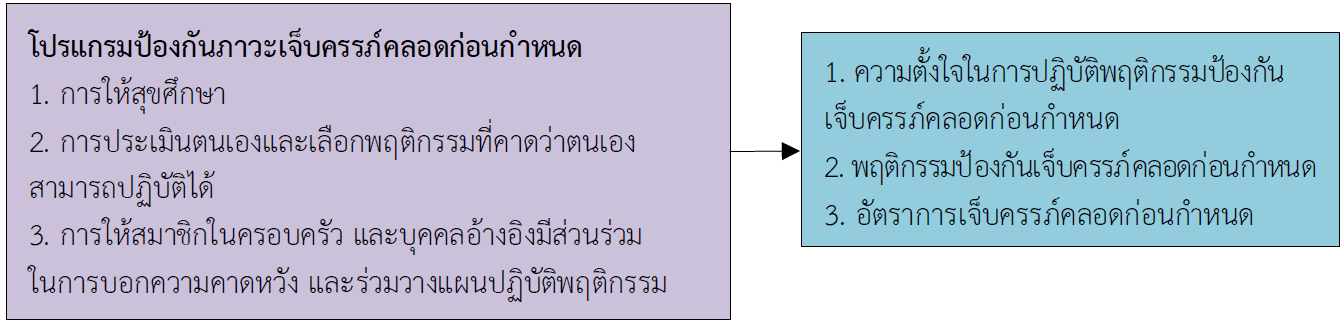
Preterm labor is a significant public health issue in Thailand. It is a cause of preterm birth, which results in health problems for both mothers and infants. This pretest-posttest quasi-experimental research, based on Ajzen's theory of planned behavior , aimed to evaluate the effects of a new preventive program on the intention behaviors to prevent preterm labor, as well as the rate of preterm birth. The sample consisted of 60 pregnant women receiving antenatal care at the Narendra General Hospital of Chainat Province, from March to July 2024. Participants were selected using the inclusion criteria, then randomly divided into experimental or control group (30 participants in each group). Data were collected using a questionnaire on intention to prevent preterm labor, as well as an assessment form on behaviors to prevent preterm labor, both yielding content validity indice of 1.00, and Cronbach's alpha coefficients of .86 and .89, respectively. Data were analyzed using descriptive statistics, chi-Square test, Fisher’s exact test, and t-test. The results were as follow.
1. After receiving the program, the experimental group had a significantly higher mean score for the intention to prevent preterm labor than before receiving the program (t = 25.73, p-value < .001 and t = 58, p-value < .001, respectively).
2. After receiving the program, the experimental group had a significantly higher mean score than the control group for preterm labor prevention behavior (t = 14.88, p-value < .001 and t = 15.29, p-value < .001, respectively).
3. The experimental group also had a significantly higher rate of full-term deliveries than the control group (p < .001).
Therefore, this program can be used to promote appropriate preventive behaviors against preterm labor among pregnant women, enabling them to carry their pregnancies to full term.
References
Ajzen, I. (1991). Theory of planed behavior. Organizational Behavior and Human Decision Process, 50(2), 179-211.
Antenatal Care Unit Jainad Narendra Hospital. (2023). Antenatal Registration. Chainat: Jainad Narendra Hospital. (in Thai)
Chairat, N. & Kala, S. (2021). Intention of breastfeeding among mothers with cesarean section: The effects of a nursing program based on the planned behavior theory. The Southern College Network Journal of Nursing and Public Health, 9(1), 121-134. (in Thai)
Chawanpaiboon, S., Vogel, J.P., Moller, A.B., Lumbiganon, P., Petzold, M., Hogan, D., et al. (2019). Global, regional, and national estimates of levels of preterm birth in 2014: a systematic review and modelling analysis. Lancet Global Health, 7(1), e37-e46. doi.org/10.1016/S2214-109X(18)30451-0.
Dahlin, S., Gunnerbech, A., Wikstrom, A.K., Cnattingius, S., & Edstedt Bonamy, A.K. (2016). Maternal tobacco use and extremely premature birth – a population-based cohort study. British Journal of Obstetrics and Gynaecology, 123(12), 1938-1946.
Department of Medical Services. (2023). Guidelines for the Prevention of Preterm Labor for Thailand, 2023 edition. Retrieved February 10, 2024 from https://www.dms.moph.go.th/. (in Thai)
Faul, F., Erdfelder, E., Buchner, A., & Lang, A. G. (2009). Statistical power analyses using G*Power 3.1: Tests for correlation and regression analyses. Behavior Research Methods, 41(4), 1149-1160. doi.org/10.3758/BRM.41.4.1149
Health Data Center. (2022). Percentage of Thai Women Giving Birth Prematurely in Fiscal Year 2022. Maternal and child health standards reporting group. Retrieved March 13, 2024, from https://hdcservice.moph.go.th/hdc/reports/. (in Thai)
Karabutr, T., Klomyong, S., Sripum, J., & Keawtuptim, A. (2023). Gestational diabetes among overweight pregnant women: The effects of a new program on preventive intention and behaviors. The Southern College Network Journal of Nursing and Public Health, 10(2), 1-14. e258494. (in Thai)
Khianman, B., Kanmali, Y., & Tumme, W. (2022). Development of care model for pregnant
women with preterm labor. Research and Development Health System Journal, 15(3), 286-300. (in Thai)
Kongroad, S. & Chirit, C. (2020). Effectiveness of an education program on knowledge, attitude, and practice of pregnant women with premature labour. Journal of Health Science, 29(6), 1055-1061. (in Thai)
Malek, L., Umberger, W.J., Makrides, M., & ShaoJia, Z. (2017). Predicting healthy eating intention and adherence to dietary recommendations during pregnancy in Australia using the theory of planned behavior. Science Direct, 16(1), 431-441.
Morgan, A.S., Mendonça, M., Thiele, N., & David, A.L. (2022). Management and outcomes of extreme preterm birth. British Medical Journal, 376:e055924. doi.org/10.1136/bmj-2021-055924
Pinkaew, S., Ratinthorn, A., Serisathien, Y., & Rueangchainikhom, W. (2014). The effect of program of care for pregnant women at risk for preterm labor on the rates of preterm labor and preterm birth. The Journal of Faculty of Nursing Burapha University, 22(1), 58-71. (in Thai)
Sotatawi, W. & Chunuan, S. (2023). Effects of family meeting on stress and gestational age at birth of pregnant women with preterm labor. Thai Journal of Nursing and Midwifery Practice, 10(2), 123-139. (in Thai)
Sreepetch, S. & Kala, S. (2021). The effects of a nursing program applying the theory of planned behavior on the intention of breastfeeding among postpartum teenage mothers. The Southern College Network Journal of Nursing and Public Health, 9(1), 26-39. (in Thai)
Tavakol, M. & Dennick, R. (2011). Making sense of Cronbach’s alpha. International Journal of Medical Education, 2, 53-55. doi.org/10.5116/ijme.4dfb.8dfd
The Royal Thai College of Obstetricians and Gynaecologists. (2018). RTCOG Clinical Practice Guideline Management of Preterm Labor and Preterm Prelabor Rupture of Membranes. Clinical Practice Guidelines Issue Vol. 4. Retrieved January 1, 2024, from https://www.rtcog.or.th/content/viewid/276. (in Thai)
Downloads
Published
Issue
Section
License
Copyright (c) 2024 The Southern College Network Journal of Nursing and Public Health

This work is licensed under a Creative Commons Attribution-NonCommercial-NoDerivatives 4.0 International License.
1. บทความหรือข้อคิดเห็นใด ๆ ที่ปรากฏในวารสารเครือข่าย วิทยาลัยพยาบาลและการสาธารณสุขภาคใต้ ที่เป็นวรรณกรรมของผู้เขียน บรรณาธิการหรือเครือข่ายวิทยาลัยพยาบาลและวิทยาลัยการสาธารณสุขภาคใต้ ไม่จำเป็นต้องเห็นด้วย
2. บทความที่ได้รับการตีพิมพ์ถือเป็นลิขสิทธิ์ของ วารสารเครือข่ายวิทยาลัยพยาบาลและการสาธารณสุขภาคใต้