Process of Recovery from Depression in Older Adults with Chronic Diseases
Keywords:
Recovery Process, Depression, Older Adults with Chronic DiseaseAbstract
This grounded theory study aimed to explore the depression’s recovery process in older adults with chronic diseases. Theoretical sampling procedures were employed to recruit a total of 10 chronically ill older adults who had been diagnosed and treated with depression, and their 21 significant persons. Participants were selected by a purposive sampling method based on the inclusion criteria and guided by the discovered clues. Data were collect by in-depth interview by semi-structured in-depth interviews as well as audio records. Constant comparative analysis was conducted through open, axial, and selective coding procedures.
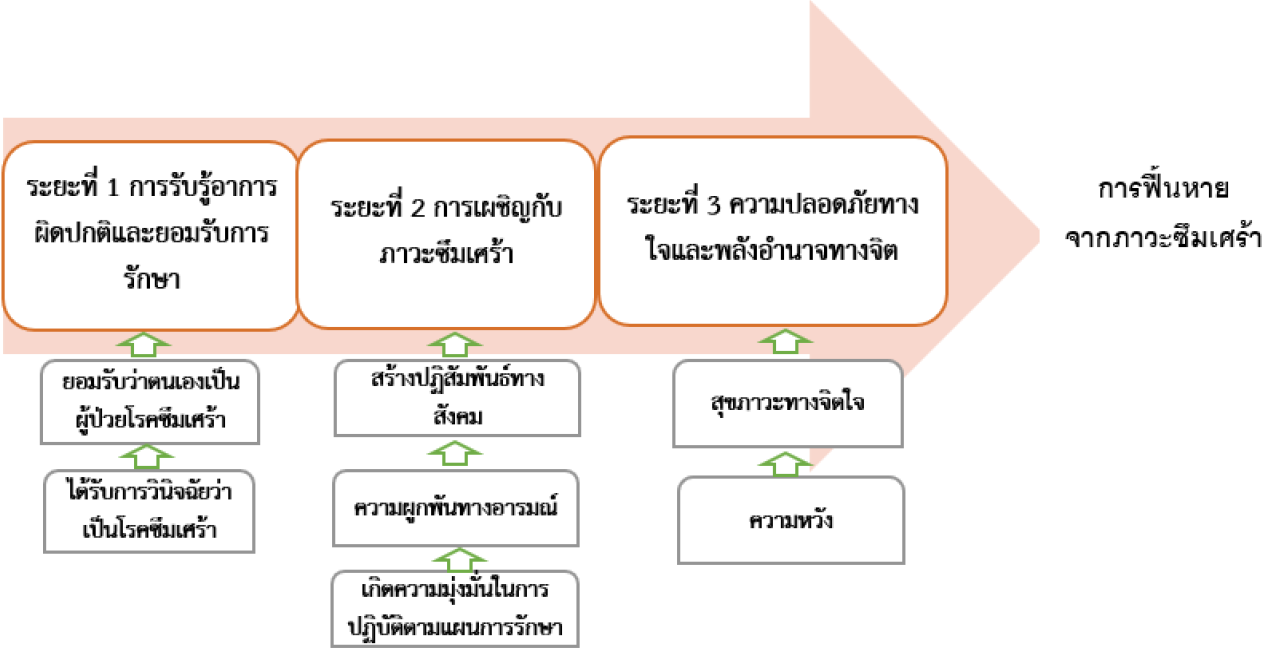
The results of the study found that depression’s recovery process in older adults with chronic disease involved 3 stages. The first stage consisted in recognizing abnormal symptoms and accepting treatment for diagnosed depression as factors that helped the older adults with chronic diseases. The second stage was coping with depression, characterized by a commitment to treatment regimens, emotional attachment, and creating social interactions. The final stage was a quest for psychological safety and empowerment, which was the phase that older adults with chronic disease in this study felt more pleasure and happiness into. Two factors that helped older adults with NCDs facing with depression at this stage of psychological resilience were having hope and being able to feel psychological well-being.
Therefore, the awareness and understanding of the recovery process from depression in elderly patients with chronic diseases can serve as a guideline for healthcare professionals to provide proactive treatment to patients. It is likely to encourage elderly individuals with chronic illnesses to seek mental health care at an early stage, helping to reduce the risk of severe mental health problems and chronic diseases.
References
Anthony, W. A. (1993). Recovery from mental illness: the guiding vision of the mental health service system in the 1990s. Psychosocial Rehabilitation Journal, 16(4), 11-23.
Corbin, J. M., & Strauss, A. (1990). Grounded theory research: Procedures, canons, and evaluative criteria. Qualitative Sociology, 13(1), 3-21.
Craighead, W. E., & Dunlop, B. W. (2014). Combination psychotherapy and antidepressant medication treatment for depression: for whom, when, and how. Annual Review of Psychology, 65, 267-300.
Department of Older Persons. (2023). Elderly Statistics. https://www.dop.go.th/th/know/1 (in Thai)
Eliopoulos, C. (2014). Gerontological Nursing. (8th ed). Philadelphi: Wolters Kluwer/Lippincott Williams & Wilkins.
Goo, S. K. L., Wang, J. B., Yeo, J. M. L., Ong, S. H., & Marimuttu, V. J. (2019). Patient and family perspective on factors that promote recovery in adolescent depression in Singapore: A qualitative study. Asian Journal of Psychiatry, 46, 21–23. doi.org/10.1016/j.ajp.2019.09.020
Hendriks, T., Schotanus-Dijkstra, M., Hassankhan, A., Graafsma, T. G. T., Bohlmeijer, E., & de Jong, J.
(2018). The efficacy of positive psychological interventions from non-western countries:
A systematic review and meta-analysis. International Journal of Wellbeing, 8(1), 71-98. doi.org/10.5502/ijw.v8i1.711
Jitsangob, P. (2017). Recovery experiences of patients with depression diagnosed for the first time. Journal of Mental Health, 23(2), 123-145. (in Thai)
Jorm, A. F. (2012). Mental health literacy: Empowering the community to take action for better mental health. American Psychologist, 67(3), 231-243. doi:10.1037/a0025957
King, R. B., & Caleon, I. S. (2021). School psychological capital: Instrument development, validation, and prediction. Child Indicators Research, 14(1), 341-367.
Krause, M., & Behn, A. (2021). Depression and Personality Dysfunction: Towards the Understanding of Complex Depression. In Depression and personality dysfunction (pp. 1-13). Springer, Cham.
Mandolikar, R. Y., Naik, P., Akram, M. S., & Nirgude, A. S. (2017). Depression among the elderly:
A cross-sectional study in an urban community. International Journal of Medical Science and Public Health, 6(2), 318-323.
Phormpayak, D., Saenyos, J., Makorn, H., & Chansong, Y. (2024). The Development of a Health Literacy Enhancement Programfor Newly Diagnosed Patients with Type 2 Diabetes. The Southern College Network Journal of Nursing and Public Health, 11(3), e271083. (in Thai)
Phothisita, C. (2007). The Science and Art of Qualitative Research (3rd ed.). Bangkok: Amarin Printing and Publishing. (in Thai)
Polit, D. F., & Beck, C. T. (2006). The content validity index: are you sure you know what's being reported? Critique and recommendations. Research In Nursing & Health, 29(5), 489-497.
Richardson, K., & Barkham, M. (2020). Recovery from depression: A systematic review of perceptions and associated factors. Journal of Mental Health, 29(1), 103-115.
Seeherunwong, A. Boontong, T. Sindhu, S. & Nilchaikovit, T. (2002). Self-regaining from loss of self: A substantive theory of recovering from depression of middle-aged Thai women. Thai Journal Nursing Research, 6, 186-99
Singer, M. Bulled, N. Ostrach, B. & Mendenhall, E. (2017). Syndemics and the biosocial conception of health. Lancet, 389(10072), 941–950. doi.org/10.1016/S01406736(17)30003-X
Van Dooren, F. E., Nefs, G., Schram, M. T., Verhey, F. R., Denollet, J., & Pouwer, F. (2013). Depression and risk of mortality in people with diabetes mellitus: A systematic review and meta-analysis. PloS One, 8(3), e57058.
World Health Organization. (2016). Mental Health and Older Adults [Internet]. Geneva: World
Health Organization. Retrieved May 20, 2024 from http://www.who.int/mediacentre/ factsheets/fs381/enl
Zenebe, Y., Akele, B., W/Selassie, M., & Necho, M. (2021). Prevalence and determinants of depression among old age: A systematic review and meta-analysis. Annals of General Psychiatry, 20(1), 55.
Downloads
Published
Issue
Section
License
Copyright (c) 2024 The Southern College Network Journal of Nursing and Public Health

This work is licensed under a Creative Commons Attribution-NonCommercial-NoDerivatives 4.0 International License.
1. บทความหรือข้อคิดเห็นใด ๆ ที่ปรากฏในวารสารเครือข่าย วิทยาลัยพยาบาลและการสาธารณสุขภาคใต้ ที่เป็นวรรณกรรมของผู้เขียน บรรณาธิการหรือเครือข่ายวิทยาลัยพยาบาลและวิทยาลัยการสาธารณสุขภาคใต้ ไม่จำเป็นต้องเห็นด้วย
2. บทความที่ได้รับการตีพิมพ์ถือเป็นลิขสิทธิ์ของ วารสารเครือข่ายวิทยาลัยพยาบาลและการสาธารณสุขภาคใต้