Strategies for Developing Future Skills of Nursing Students in Faculty of Nursing Praboromarajchanok Institute
Keywords:
Strategies, Future Skills, Nursing StudentAbstract
This qualitative research aimed to synthesize the future skills of nursing students, develop strategies, and evaluate the draft strategies for the development of future skills for nursing students at the Faculty of Nursing, Praboromarajchanok Institute. Future skills refer to the set of competencies, abilities, and knowledge that are predicted to be in high demand in the future job market. The research was conducted in four steps: 1) synthesize the future skills of nursing students through a literature review and interviews with 8 nursing college administrators, 2) synthesize the internal and external organizational environments through the analysis of strategic planning documents and interviews with 40 nursing college administrators, 3) develop strategies based on the environmental analysis using the TOWS Matrix method, and 4) ten experts evaluated the strategies through focus group discussions. The data was analyzed using content analysis. The research results showed as follows.
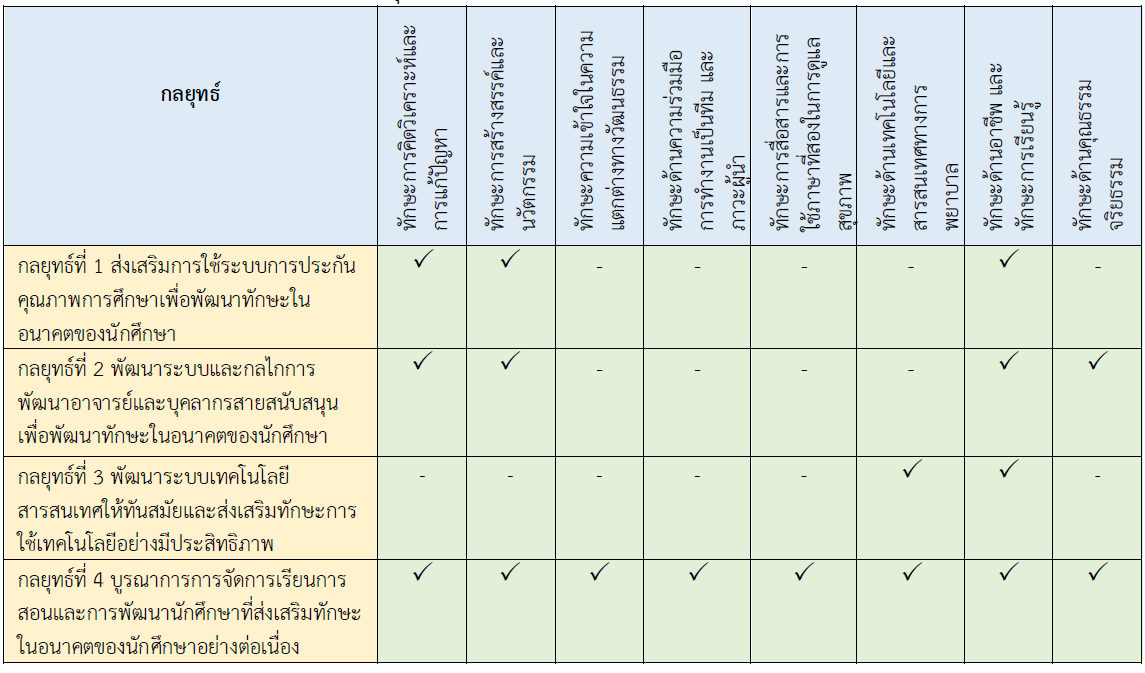
1. The future skills of nursing students include 8 key skills: a) analytical thinking and problem-solving skills, b) creativity and innovation skills, c) cultural diversity understanding, d) collaboration, teamwork, and leadership skills, e)communication skills and the use of a second language in healthcare, f) technology skills, g) career and lifelong learning skills, and h) moral and ethical skills.
2. There were 4 strategies for developing the future skills of nursing students: a) to promote the use of an educational quality assurance system, b) to develop systems and mechanisms for faculty and staff development to support students' future skills, c) to modernize the information technology system and promote the effective use of technology, and d) to integrate teaching and learning management with student development, so to continuously enhance future skills.
3. The four strategies for developing the future skills of nursing students at the Praboromarajchanok Institute Faculty of Nursing were found to be consistent, appropriate, feasible, and beneficial for the future skill development among nursing students.
Based on this research results, the Praboromarajchanok Institute Faculty of Nursing can utilize these strategies to design programs, projects, or activities to more effectively develop the future skills among nursing students.
References
ASEAN University Network. (2020). Guide to AUN-QA Assessment at Programme Level Version 4.0. Bangkok: Chulalongkorn University.
Chaikongkiat, P., Niha, S. & Chantarasiripoot, B. (2019). 21st Century learning skills of nursing students: A survey research in Yala. The Southern College Network Journal of Nursing and Public Health, 6(1), 112-120. (in Thai)
Chaisooksung, S., Sumettikoon, P., & Siribanpitak, P. (2015). Academic administration strategies to promote 21st century skills of students in alternative private schools. Sripatum Chonburi Academic Journal, 12(1), 99-108. (in Thai)
Chaiyes, C., Preeyanont, P., Phonoi, N., & Thongkanya, P. (2023). Factors affecting to the learning skills in the 21st century among Mahidol university’s undergraduates. Journal of Humanities and Social Sciences Mahasarakham University, 42(3), 340-353. (in Thai)
Chantra, R. & Sarakshetrin, A. (2017). Learning skills in 21st century of nursing students at Boromarajonani college of nursing, Suratthani. The Southern College Network Journal of Nursing and Public Health, 4(1), 180-190. (in Thai)
Choojai, R., Patcheep, K., & Kitnopkiat, K. (2001). Quality of nursing graduates of Boromarajonani college of nursing, Ratchaburi perceived by the superiors, academic year 2018. Journal of Research for Health Improvement and Quality of Life, 1(1), 58-67. (in Thai)
Giles, S. (2018). How VUCA is Reshaping the Business Environment, and What It Means for Innovation. Retrieved April 16, 2021 from https://www. researchgate.net/publication/333907737_How_VUCA_ Is_Reshaping_The_Business_ Environment_and_What_It_Means_for_Innovation.
Junwin, B., Ratchathawan, R., Witwattananggoon, A., & Kanchanaaree, S. (2022). Factors influencing the development of 21st century skills among nursing students: A study from Praboromarajchanok institute, Ministry of public health. The Southern College Network Journal of Nursing and Public Health, 9(3), 1-14. (in Thai)
Khomtanet, S., Saedkong, P., Prombooth, R., Tupsai, T., Thitiyanviroj, B., Butudom, A., et al. (2020). A quality evaluation of the graduates, Boromarajonani college of nursing, Khon Kaen. Journal of Curriculum and Instruction Sakon Nakhon Rajabhat University, 12(34), 133-144. (in Thai)
Khosuk, C. (2017). A qualitative research approach to nursing education in the 21st century. Journal of Ratchathani Innovative Health Sciences, 1(2), 1-13. (in Thai)
Korsakul, V. (2018). Lecture Documents for Strategic Management Courses. Bangkok: Ramkhamhaeng University.
Kwamkhunkoei, J. (2019). Strategic Planning Process. Retrieved December 25, 2021 from https://plan.vru.ac.th/?p=3596
Meekhamthong, P., & Saenpong, K.(2019).Techniques for analyzing development conditions for strategic planning of school. New Academic and Research Journal.9(3), 111–120. (in Thai)
Meenakorn, C. (2019). Strategy Development. Retrieved August 18, 2021 from https://slideplayer.in.th/slide/16002563/ (in Thai)
Namprom, T. (2019). VUCA World. Retrieved April 15, 2021 from https://reder.red/vuga-world-18-12-2019/
Njnpeng, N., Katonyoo, C., Wongla, R., & Chawapeng W. (2004). Development Strategies to be a Leader of Educational Institute of Nursing Colleges, Praboromarajchanok Institute. Retrieved August 18, 2021 from http://cmruir.cmru.ac.th/handle/123456789/1668 (in Thai)
Nursing Council. (2022). The 7th National Nursing Research Conference on Trends and Challenge and Nursing Research Network in the Era of World-Changing Technology on January 27,2022. Retrieved February 5, 2022 from https://www.tnmc.or.th/news/430 (in Thai)
Office of the Education Council. (2021). Future Skill. Bangkok: Office of the Education Council.
Rangabtook, W. (2020). Thai learners’ key competencies in a VUCA world. Journal of Teacher Professional Development, 1(1), 8–18. (in Thai)
Saokhumkate, M. & Mangkhang, C. (2021). Development of Co-Curricular Activities in Social Studies to Promote Futuristic Think Skill for Secondary School Students. Journal of Social Science and Buddhistic Anthropology, 6(6), 373-386. (in Thai)
Saraketrin, A., Rongmuang, D., & Chantra, R. (2019). Nursing education in the 21st century:
competencies and roles of nursing instructors. Journal of The Royal Thai Army Nurses. 20(1), 12 – 20. (in Thai)
Sitvoranonand, N., & Ladavalya Na Ayuthya, S. (2023). Factors, affecting the use of digital technology of staffs in the attorney general’s office, Lampang province. Journal of Modern Learning Development, 8(9), 217-234.
Stephanie L. (2021). Future Skills You’ll Need in Your Career by 2030. Retrieved August 14, 2021, https://www.topuniversities.com/student-info/careers- advice/future-skills-youll- need-your-career-2030.
Wattanakul, P., & Mungsing, S. (2015). Knowledge and skills necessary for learning in the 21st century. APHEIT, 4(1), 84-92. (in Thai)
World Economic Forum. (2020). School of the Future Defining New Models of Education for the Fourth Industrail Revolution. Retrieved December 25, 2021, from https://www.weforum.org/press/2020/01/from-wall-less-design-to-robotics-training-meet-the-16-schools-defining-the-future-of-education/
Youngtrong, P., Siridhrungsri P., & Khamdit, S. (2017). The strategies for the desirable characteristic development of Learners in basic education institutions the 21st century. Suthiparithat, 31(100), 1-12. (in Thai)
Downloads
Published
Issue
Section
License
Copyright (c) 2024 The Southern College Network Journal of Nursing and Public Health

This work is licensed under a Creative Commons Attribution-NonCommercial-NoDerivatives 4.0 International License.
1. บทความหรือข้อคิดเห็นใด ๆ ที่ปรากฏในวารสารเครือข่าย วิทยาลัยพยาบาลและการสาธารณสุขภาคใต้ ที่เป็นวรรณกรรมของผู้เขียน บรรณาธิการหรือเครือข่ายวิทยาลัยพยาบาลและวิทยาลัยการสาธารณสุขภาคใต้ ไม่จำเป็นต้องเห็นด้วย
2. บทความที่ได้รับการตีพิมพ์ถือเป็นลิขสิทธิ์ของ วารสารเครือข่ายวิทยาลัยพยาบาลและการสาธารณสุขภาคใต้