The Effect of a Self-Efficacy Promoting Program on the Intention to Drug Abstinence among Persons with Amphetamine Induced Psychosis
Keywords:
Amphetamine Induced Psychosis, Self-efficacy Promoting Program, Intention to Drug AbstinenceAbstract
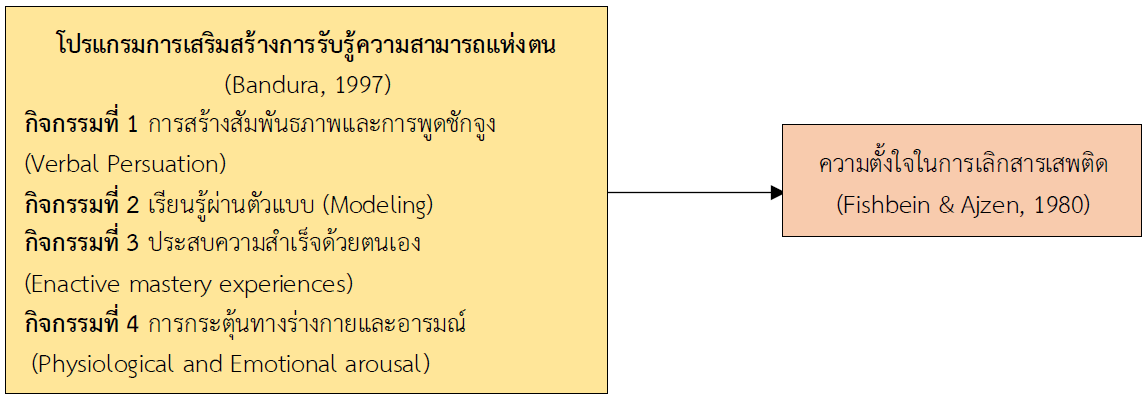
This quasi-experimental multiple time-series design research aimed to compare: 1) the intention to drug abstinence of persons with amphetamine induced psychosis, before and after the experiment, among the experimental group, and 2) the intention to drug abstinence of persons with amphetamine induced psychosis between the experimental group who received the intervention program and the control group who received regular nursing care. The sample consisted of 60 persons with amphetamine induced psychosis, who received services at the inpatient of Songkhla Rajanagarindra Psychiatric Hospital. All participants met the inclusion criteria. They were matched and paired with gender and age and then randomly assigned either to the experimental or control group, 30 subjects in each group. The experimental group received the self-efficacy promoting program while the control group received regular nursing care. Research instruments comprised the self-efficacy promoting program and the intention to drug abstinence test. All instruments were verified for content validity by 3 professional experts. The intention to drug abstinence test yielded a Cronbach’s alpha coefficient reliability of .82. Data were analyzed by descriptive statistics, chi-square, Fishers exact test, independent t-test, repeated measures ANOVA, Greenhouse-Geisser statistics and Huynh-Feldt statistics. The main results were as follows.
1. Intention to drug abstinence of persons with amphetamine-induced psychosis in the experimental group, who received the self-efficacy promoting program, was significantly higher than before, at the .001 level.
2. Intention to drug abstinence of persons with amphetamine-induced psychosis in the experimental group, who received the self-efficacy program, was significantly higher than in the control group, at the .05 level.
Per findings, the program should be implemented as a treatment approach for patients with methamphetamine-induced psychosis. Policies should be clearly established for practical application. Furthermore, systematic monitoring and evaluation should be conducted to ensure that patients receive effective care.
References
Alexander, P. D., Gicas, K. M., Willi, T. S., Kim, C. N., Boyeva, V., Procyshyn, R. M., et. al. (2017). A comparison of psychotic symptoms in subjects with methamphetamine versus cocaine dependence. Psychopharmacology, 234, 1535-1547.
Bandura, A. (1977). Social Learning. New Jersey: Prentice-Hall.
Bandura, A. (1997). The anatomy of stages of change. American Journal of Health Promotion: AJHP, 12(1), 8-10.
Chokrung, P., Hengudomsub, P., Vatanasin, D., & Pratoomsri, W. (2016). The effect of program to enhance perceived drug abstinence self-efficacy on intention to drug abstinence among persons with amphetamine dependence. Journal of Boromarajonani College of Nursing, Bangkok, 32(3), 37-50. (in Thai)
Ezzatpanah, Z., Shariat, S. V., & Tehrani-Doost, M. (2014). Cognitive functions in methamphetamine induced psychosis compared to schizophrenia and normal subjects. Iranian Journal of Psychiatry, 9(3), 152.
Fishbein, M., & Ajzen, I. (1980). Understanding Attitudes and Predicting Social Behavior. New Jersey: Prentice Hall.
Gray, J. R., Grove, S. K., & Sutherland, S. (2017). The Practice of Nursing Research. St Louis, Missouri: Elsevier.
Hayaki, J., Conti, M. T., Bailey, G. L., Herman, D. S., Anderson, B. J., & Stein, M. D. (2021). Negative affect-associated drug refusal self-efficacy, illicit opioid use, and medication use following short-term inpatient opioid withdrawal management. Journal of substance abuse treatment, 126, 108309.
Hendianti, G. N., & Uthis, P. (2018). Factors related to methamphetamine relapse risk among clients in the substance rehabilitation center of national narcotics board in west Java, Indonesia. Journal of Health Research, 32(4), 279-287.
Hongtiyanon, T., Tipawong, A., Yodkolkij, L., & Chaleoykitti, S. (2019). The effectiveness of perceived self-efficacy program for assisting adolescences towards behavioral of avoiding narcotics. Royal Thai Army Medical Journal, 72(1), 33-40. (in Thai)
Hussain, M. A., Iudicello, J. E., Morgan, E. E., Kamat, R., Heaton, R. K., Grant, I., et. al. (2021). Apathy is associated with poorer abstinence self-efficacy in individuals with methamphetamine dependence. Addictive Behaviors Reports, 13, 100331.
Kelly, J. F., & Greene, M. C. (2014). Where there’sa will there’sa way: a longitudinal investigation of the interplay between recovery motivation and self-efficacy in predicting treatment outcome. Psychology of Addictive Behaviors, 28(3), 928.
Kenney, S. R., Bailey, G. L., Anderson, B. J., & Stein, M. D. (2017). Heroin refusal self-efficacy and preference for medication-assisted treatment after inpatient detoxification. Addictive Behaviors, 73, 124-128.
Lotrakul, M., & Sukanich, P. (2015). Ramathibody Psychiatry. Bangkok: Department of Psychiatry, Faculty of Medicine, Mahidol University. (in Thai)
Maisto, S. A., Roos, C. R., O'Sickey, A. J., Kirouac, M., Connors, G. J., Tonigan, J. S., et. al. (2015). The indirect effect of the therapeutic alliance and alcohol abstinence self-efficacy on alcohol use and alcohol-related problems in Project MATCH. Alcoholism: Clinical and Experimental Research, 39(3), 504-513.
Majer, J. M., Olson, B. D., Komer, A. C., & Jason, L. A. (2015). Motivation among exoffenders exiting treatment: The role of abstinence self-efficacy. Journal of Offender Rehabilitation, 54(3), 161-174.
Ministry of Public Health. (2020). Health Data Center (HDC). Retrieved November 11, 2020 from https://www.dmh.go.th/report/datacenter/hdc/reds.asp. (in Thai)
Napattaradechanon, K., Phattharasirisomboon, P., & Laokompruittajarn, J. (2023). Effects of a perceived self-efficacy-based smoking reduction program on participatory smoking reduction behaviors among university students addicted to cigarettes. Journal of Health and Nursing Education, 29(2), 1-15. (in Thai)
Sakunpong, N., Choochom, O., & Taephant, N. (2015). Development of abstinent intention scale among substance dependence women. Journal of Nursing and Health Care, 33(3), 144-151. (in Thai)
Sara, G. E., Burgess, P. M., Malhi, G. S., Whiteford, H. A., & Hall, W. C. (2014). Cannabis and stimulant disorders and readmission 2 years after first-episode psychosis. The British Journal of Psychiatry, 204(6), 448-453.
Songkhla Rajanagarindra Psychiatric Hospital. (2023). Medical Record of Persons with Amphetamine Induced Psychosis. Songkhla. (in Thai)
Stevens, A. K., Littlefield, A. K., Blanchard, B. E., Talley, A. E., & Brown, J. L. (2016). Does drinking refusal self-efficacy mediate the impulsivity–problematic alcohol use relation?. Addictive Behaviors, 53, 181-186.
Toeam, A., Lapvongwatana, P., Chansatitporn, N, & Chamroonsawasdi, K. (2016). Predictive factors of amphetamine use among youths in a congested community. Thai Red Cross Nursing Journal, 9(2), 88-103. (in Thai)
United Nations Office on Drugs and Crime. (2019). World Drug Report 2017. New York: United Nations Office on Drugs and Crime.
Downloads
Published
Issue
Section
License
Copyright (c) 2024 The Southern College Network Journal of Nursing and Public Health

This work is licensed under a Creative Commons Attribution-NonCommercial-NoDerivatives 4.0 International License.
1. บทความหรือข้อคิดเห็นใด ๆ ที่ปรากฏในวารสารเครือข่าย วิทยาลัยพยาบาลและการสาธารณสุขภาคใต้ ที่เป็นวรรณกรรมของผู้เขียน บรรณาธิการหรือเครือข่ายวิทยาลัยพยาบาลและวิทยาลัยการสาธารณสุขภาคใต้ ไม่จำเป็นต้องเห็นด้วย
2. บทความที่ได้รับการตีพิมพ์ถือเป็นลิขสิทธิ์ของ วารสารเครือข่ายวิทยาลัยพยาบาลและการสาธารณสุขภาคใต้