Effects of the Addiction Preventive Program on Behavioral Intention to Non-Drug and Substance Used among Early Adolescents
Keywords:
โปรแกรมป้องกันการเสพติด , เจตนาเชิงพฤติกรรมที่จะไม่เสพยาและสารเสพติด , วัยรุ่นตอนต้นAbstract
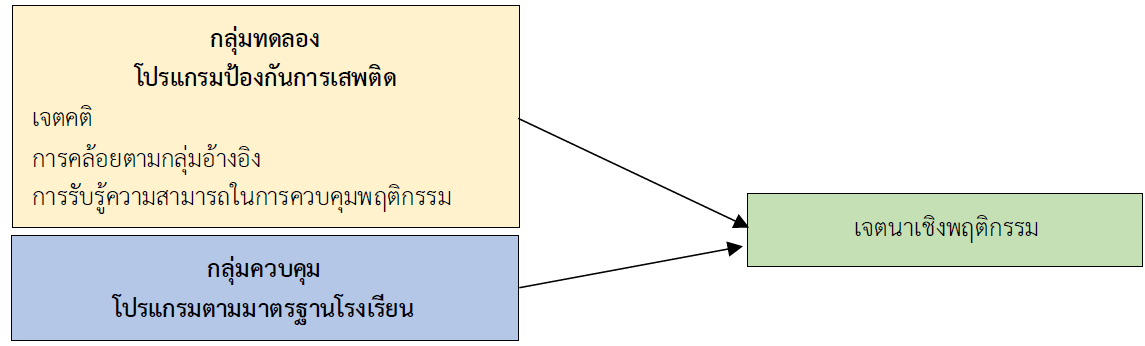
This quasi-experimental research aimed to study the effects of an addiction prevention program on behavioral intentions not to use drugs or addictive substances among early adolescents. The sample group consisted of 25 early male and female adolescents, aged 10-13 years, attending school in the Primary Educational Service Area number 2 of Northern Region. There was also 25 adolescents in control group (total = 50). The research tools consisted of a personal information questionnaire, as well as an assessment on a scale for the behavioral intention of adolescents not to take any drugs or addictive substances. The accuracy of the CVI content were .91 and .97, respectively. The confidence on the measurement of behavioral intention not to take drugs or substances was at the .80 level. The data were analyzed using paired t-test and independent t-test statistics. The results revealed as follows.
1. The average behavioral intention score to abstain from drug and substance abuse among the experimental group one month after receiving the program (M = 96.56, SD = 2.95) was significantly higher than before receiving the program (M = 38.88, SD = 7.94) with a statistical significance at the p-value < .01 level.
2. The average behavioral intention score to abstain from drug and substance abuse among the experimental group one month after receiving the program (M = 96.56, SD = 2.95) was significantly higher than the control group (M = 38.88, SD = 7.94) with a statistical significance at the p-value < .01 level.
The results of this study indicate that the prevention program effectively increases the behavioral intention to abstain from drug and substance abuse among early adolescents.Therefore, this study shows that this addiction prevention program positively affects early adolescents’ behavioral intentions not to take drugs and substances.
References
Ajzen, I. (1991). The theory of planned behavior. Organizational Behavior and Human Decision Processes, 50(2), 179-211.
Alfonso, M. L., & Kaur, R. (2012). Self‐injury among early adolescents: Identifying segments protected and at risk. Journal of School Health, 82(12), 537-547.
Beyth-Marom, R., & Fischhoff, B. (1997). Adolescents’ decisions about risks: A cognitive perspective. Health Risks And Developmental Transitions during Adolescence, 110-135.
Burns, N. & Grove, S.K. (2005). The Practice of Nursing Research: Conduct, Critique, and Utilization
(5th ed.). The United States of America: Elsevier Saunders
Department of Mental Health. TO BE NUMBER ONE Project in honor of Her Royal Highness Princess Ubolratana Rajakanya Siriwatthana Phannawadi. (2021). Stress, relieve stress. Retrieved March 11, 2023, from the database (Chiang Mai University Digital Collections). (in Thai)
Giedd, J. N. (2004). Structural magnetic resonance imaging of the adolescent brain. Annals of the Newyork Academy of Sciences, 1021(1), 77-85.
Kantarit, C. (2021). Method reduction of offending behavior. Journal of Suvarnabhumi Institute of Technology (Humanities and Social Sciences), 7(1), 1-12. (in Thai)
Khani Jeihooni, A., Sorbi, A., Afzali Harsini, P., Taghinezhad, A., & Yari, A. (2021). The application of theory of planned behavior in improving substance abuse prevention behaviors in male high school students. Current Psychology, 1-9.
Liamdee, P., Sarakarn, P., & Sirichuanjun, K. (2019). Examination for goodness of fit between theory of planned behavior and preventive alcohol consumption behavior of secondary students in Sangkha district, Surin province. Journal of Health Science of Thailand, 28(1), S88-S96. (in Thai)
Mohammadi Zeydi, I., & Pakpour-Hagiagha, A. (2016). Application of the theory of planned behavior for the prevention of substance abuse among male adolescents. Iranian Journal Health Education and Health Promotion, 3(4), 298-310.
Office of the Narcotics Control Board. (2019). Action Plan for Prevention and Suppression and Drug Treatment, Year 2019. Bangkok: Narcotics Control Board.
Polit, D. F., & Beck, C. T. (2012). Is there still gender bias in nursing research? An update. Research in Nursing & Health, 36(1), 75-83.
Sangarun, W., Jinngee, P., & Kasamnet, L. (2018). Structure of causal relationships affecting behavior to prevent alcohol drinking among early adolescents in Rayong Province. Journal of Behavioral Science, 24(2), 119-134. (in Thai)
Sarilae N. (2018). Factors affecting the intention to quit using drugs among drug addicts who enter treatment. Treatment at Thanyarak Udon Thani Hospital. Journal of Nursing, Health and Education, 1(3), 35-42. (in Thai)
Steinberg, L., & Cauffman, E. (1996). Maturity of judgment in adolescence: Psychosocial factors in adolescent decision making. Law and Human Behavior, 20(3), 249-272.
Thumthong, B., Vannit, P., & Kitiyanon, H. (2021). Results of self-awareness assessment to prevent sadness and Facebook addiction of Rajabhat University students in the new normal era. Journal of Humanities and Social Sciences for Sustainable Development, 4(2), 49-63. (in Thai)
Wattananonsakul, S. (2014). Research Report on the Effects of Preventive Program Use on Tobacco Behavioral Intent in Middle School Students. Bangkok: Srinakharinwirot University. (in Thai)
Ubonsai, K. (2018). Psycho-social factors correlating with drugs abuse preventive behaviors among thai adolescence: Application of meta-analysis. Journal of Behavioral Science for Development, 10(2), 21-40. (in Thai)
Downloads
Published
Issue
Section
License
Copyright (c) 2024 The Southern College Network Journal of Nursing and Public Health

This work is licensed under a Creative Commons Attribution-NonCommercial-NoDerivatives 4.0 International License.
1. บทความหรือข้อคิดเห็นใด ๆ ที่ปรากฏในวารสารเครือข่าย วิทยาลัยพยาบาลและการสาธารณสุขภาคใต้ ที่เป็นวรรณกรรมของผู้เขียน บรรณาธิการหรือเครือข่ายวิทยาลัยพยาบาลและวิทยาลัยการสาธารณสุขภาคใต้ ไม่จำเป็นต้องเห็นด้วย
2. บทความที่ได้รับการตีพิมพ์ถือเป็นลิขสิทธิ์ของ วารสารเครือข่ายวิทยาลัยพยาบาลและการสาธารณสุขภาคใต้