ผลของการใช้สถานการณ์จำลองเสมือนจริงต่อความรู้และทักษะ ในการดูแลผู้ป่วยที่ใช้เครื่องช่วยหายใจของนักศึกษาพยาบาล
คำสำคัญ:
สถานการณ์จำลองเสมือนจริง, การดูแลผู้ป่วยที่ใช้เครื่องช่วยหายใจ, นักศึกษาพยาบาลบทคัดย่อ
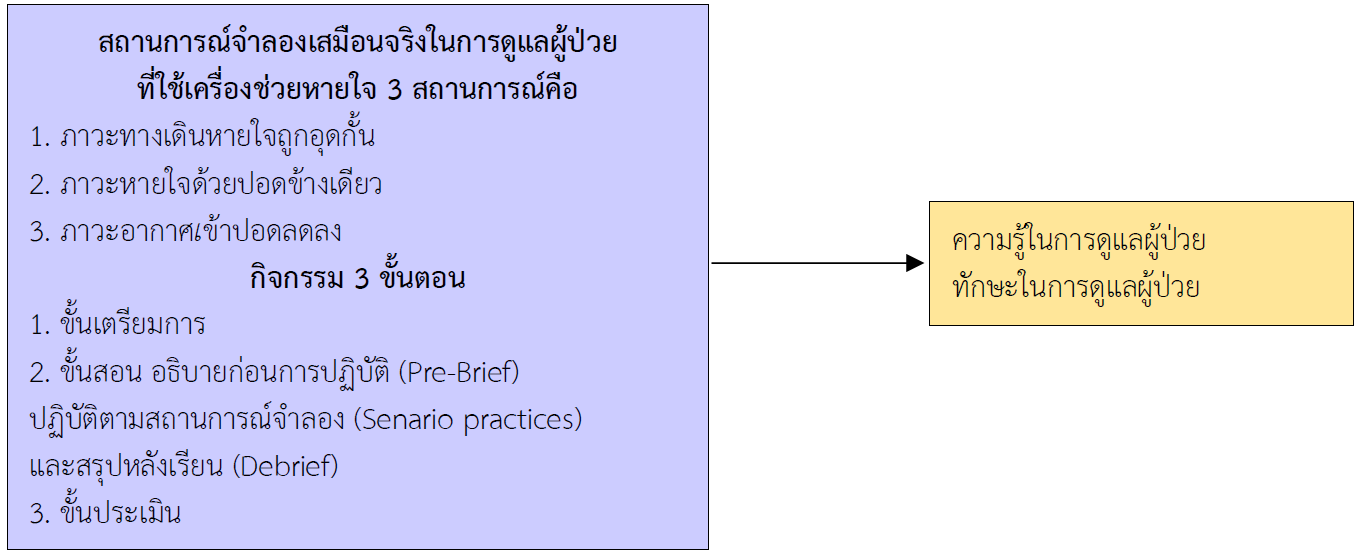
การวิจัยกึ่งทดลองแบบ 2 กลุ่ม วัดผลก่อนและหลังการทดลองนี้ มีวัตถุประสงค์เพื่อศึกษาผลการสอนด้วยสถานการณ์จำลองเสมือนจริงต่อความรู้และทักษะในการดูแลผู้ป่วยที่ใช้เครื่องช่วยหายใจ กลุ่มตัวอย่างคือนักศึกษาพยาบาลศาสตรบัณฑิตชั้นปีที่ 3 รุ่น 33 วิทยาลัยพยาบาลบรมราชชนนี นครศรีธรรมราช ในรายวิชาการพยาบาลผู้ใหญ่ 2 จำนวน 62 คน แบ่งเป็น 2 กลุ่ม คือกลุ่มที่ได้รับการสอนด้วยสถานการณ์จำลองเสมือนจริงและแบบบรรยาย กลุ่มๆ ละ 31 คน ใช้การสุ่มอย่างง่ายแบบไม่แทนที่ เครื่องมือประกอบด้วย เครื่องมือใช้ในการทดลอง คือสถานการณ์จำลองเสมือนจริงในการดูแลผู้ป่วยที่ใช้เครื่องช่วยหายใจ และเครื่องมือใช้ในการเก็บรวบรวมข้อมูล ได้แก่ แบบบันทึกข้อมูลทั่วไป แบบทดสอบความรู้ วิเคราะห์ค่าความเชื่อมั่นของแบบทดสอบผลสัมฤทธิ์ทางการเรียน KR-20 เท่ากับ .66 และแบบประเมินทักษะในการดูแลผู้ป่วยที่ใช้เครื่องช่วยหายใจ ค่าดัชนีความเที่ยงตรงเชิงเนื้อหา เท่ากับ .84 และค่าความเชื่อมั่นสัมประสิทธิ์แอลฟาครอนบาค เท่ากับ .87 วิเคราะห์ข้อมูลด้วยสถิติเชิงพรรณนา สถิติ Chi–square test, Independent t-test, Paired t-test ผลการวิจัยพบว่า
1. ความรู้ในการดูแลผู้ป่วยที่ใช้เครื่องช่วยหายใจของนักศึกษาพยาบาลที่ได้รับการสอนด้วยสถานการณ์จำลองเสมือนจริงมีคะแนนเฉลี่ยหลังเรียนสูงกว่าการสอนแบบบรรยายอย่างมีนัยสำคัญทางสถิติที่ระดับ 0.01 (t=3.51)
2. ทักษะในการดูแลผู้ป่วยที่ใช้เครื่องช่วยหายใจของนักศึกษาพยาบาลที่ได้รับการสอนด้วยสถานการณ์จำลองเสมือนจริงมีคะแนนเฉลี่ยหลังเรียนสูงกว่าการสอนแบบบรรยายอย่างมีนัยสำคัญทางสถิติที่ระดับ 0.01 (t=13.06)
ข้อเสนอแนะ ควรพัฒนาการจัดการเรียนการสอนในการดูแลผู้ป่วยวิกฤตทั้งภาคทฤษฎีและภาคปฏิบัติโดยการใช้สถานการณ์จำลองเสมือนจริงร่วมกับการจัดการเรียนการสอนตามปกติ
เอกสารอ้างอิง
Boonmee, P., Mahamit, S.W, & Kawila, T. (2018). Knowledge, perception, and awareness of risk management and patient safety towards nursing students at Boromarajonani College of Nursing, Phayao. Journal of Nursing and Education, 11(3), 112-124. (in Thai)
Boromarajonani College of Nursing, Nakhon Si Thammarat. (2022). Meeting Report Curriculum Management Committee. Nakhon Si Thammarat: Boromarajonani College of Nursing. (in Thai)
Boromarajonani College of Nursing Nakhon Si Thammarat. (2023). Course Syllabus: Adult 2. Nakhon Si Thammarat: Boromarajonani College of Nursing. (in Thai)
Bunma, W. (2018). Effect of program for promoting emergency patient care skill toward perceived self- efficacy in emergency care among nursing students at Boromarajonani College of Nursing, Chiang Mai. Journal of Nursing and Education, 11(2), 74-86. (in Thai)
Chubkhuntod, P., Thasanoh Elter, P., Gaewgoontol, N., Rutchanee Potchana, R. (2020). Effects of simulation based learning model on knowledge, self-efficacy and abilities of applying nursing process skills during intrapartum care of nursing students. Journal of Health Science. 29(6), 1062-1072. (in Thai)
Cowperthwait, A. (2020). NLN Jeffries simulation framework for simulated participant methodology. Clinical Simulation in Nursing, 42, 12-21. doi.org/10.1016/j.ecns.2019.12.009
Ebrahimi, H. K., Sohrabi, S., Ashtiyani, F. Z., Hafize, F., Esmaeilian, S., & Jafarnejad, S. (2020). Effect of simalation-based CPR education on knowledge and performance of neonatal intensive care unit nurses. Journal of Critical Reviews, 7(7), 1135-1140.
Jamjang. S., Atthamatakul, W., Nilliaum. R., & Wongyara. N. (2021). The effects of simulation-based learning on problem solving ability, and self-confidence in nursing care on the patient with health problem of nursing students. Journal of Prachomklao College of Nursing, Phetchaburi Province, 4(3), 178-192. (in Thai)
Jamjang, S., Yomdit, V., Pongphetdit, B., Pitaksin, D., Changsieng, P., & Montong, A. (2018). Effects of using simulation-based learning for preparation of nursing practicum on perceptions of self efficacy in performing nursing care in a hospital. Nursing Journal of the Ministry of Public Health, 27(Special Issure), 46-58. (in Thai)
Jeffries, P. R. (2005). A framework for designingimplementing and evaluating simulations used as teaching strategies in nursing. Nursing Education Perspectives, 26(2), 96-103.
Kaenbubpha, N., Chomngam, P., Nuangchalerm, N. (2018). The effects of simulation-based teaching on perceived self-efficacy in cardio pulmonary resuscitation of students in Sirindhorn College of Public Health, Ubon Ratchathani Province. Journal of Health Science Boromarajonani College of Nursing Sunpasithiprasong, 2(3), 63-78. (in Thai)
Khemmani, T. (2014). Teaching knowledge to the Learning Process Effective 10th ed. Bangkok: Chulalongkorn University Press. (in Thai).
Kim, J. Y., & Kim, E. J. (2015). Effects of simulation on nursing students’ knowledge, clinical reasoning, and self-confidence: A quasi-experimental study. Korean Journal of Adult Nursing, 27(5), 604-611. doi.org/10.7475/kjan.2015.27.5.604
Kolb, D. A. (1984). Experiential Learning: Experience as the Source of Learning and Development (Vol. 1). Englewood Cliffs, NJ: Prentice-Hall. Retrieved January 21, 2024 from https://www.learningfromexperience.com/images/uploads/process-of-experiential-learning.pdf.
Krongthaeo, S., Partiprajak, S., & Udomkasemsab, A. (2022). Effectiveness of the airway management and ventilation training program in undergraduate nursing students. Rama Nurse Journal, 22(1), 93-110. (in Thai)
Kuder, G. F., & Richardson, M. W. (1937). The theory of estimation of test reliability. Psychometrika. 2, 151-160.
Lertlum, L., Tanasansutee, C., Panawatthanapisuit, S., & Bumrungsri, C. (2019). Development of a simulation-based learning model. The Southern College Network Journal of Nursing and Public Health, 6(Special Issue), 43-58. (in Thai)
Meeboon, S., Tummee, S., & Charoenpon, S. (2022). Development of nursing students preparation model for principles and techniques in nursing practicum through simulation-based learning ward, Phetchaburi Province. Journal of Prachomklao College of Nursing, 5(1), 147-161. (in Thai)
Norkaeo, D., Treenon, P., Chabuakam, N., Kanbupar, N, Teanthong, S., & Kaewmanee, C. (2018). Nursing students knowledge and skills about basic life support (bls): The effects of simulation-based learning. The Southern College Network Journal of Nursing and Public Health, 5(3), 84-95. (in Thai)
Pangsuk, P., Kingmala, C. (2021). The effect of simulation-based learning on knowledge and self-efficacy of the third year nursing students in caring for emergency patients. Songklanagarind Journal of Nursing, 41(2), 89-100. (in Thai)
Seesanea, P., Kunoy, C., Karunchareonphanit, S., Rupngam, S. (2022). Effects of simulation-based learning on knowledge, clinical judgment, and nursing skills in caring for critical patients with acute myocardial infarction: a case study. Journal of Nursing and Health Research (JNHR), 23(1), 123-133. (in Thai)
Sinthuchai, S., Ubolwan, K., & Boonsin, S. (2017). Effects of high-fidelity simulation based learning on knowledge, satisfaction, and self-confidence among the fourth year nursing students in comprehensive nursing care practicum. Rama Nurse Journal, 41(2), 113-127. (in Thai)
Srijanpal, W., Thatan, S., & Fukfon, K. (2021). Effects of simulation-based learning on perceived self-efficacy of nursing students in caring for patients with septic shock. Journal of The Royal Thai Army Nurses, 22(1), 283-293. (in Thai)
Somsiri, V., Thasaneesuwan, S., & Damkliang, J., (2023). Effects of a simulation-based learning on knowledge and self-confidence in nursing practice for patients with acute coronary syndrome at emergency department among nursing students. Journal of Research in Nursing-Midwifery and Health Sciences, 43(3), 24-38. (in Thai)
Tantalanukul, S., Khiaolueang, D., Srijaiwong, S., Fongkerd, S., & Nawsuwan, K., (2020). Effect of simulation-based learning toward drug used in primary medical care of nursing students Boromarajonani College of Nursing Uttaradit. Udon Thani Rajabhat University Journal of Humanities and Social Sciene, 9(1), 57-72. (in Thai)
Tantalanukul, S. (2021). Development of instructional model with simulated situations to enhance performance in primary medical care of nursing students. Boromarajonani College of Nursing, Uttaradit Journal, 22(1), 124-136. (in Thai)
Tawalbeh, L. I. (2020). Effect of simulation modules on jordanian nursing student knowledge and confidence in performing critical care skills: A randomized controlled trial. International Journal of Africa Nursing Sciences, 13(10024), 1-6. doi.org/10.1016/j.ijans.2020.100242
World Health Organization. (2011). WHO Patient Safety Curriculum Guide: Multi-professional Edition. Geneva: World Health Organization. Retrieved September 13, 2021, from http://apps.who.int/iris/bitstream/handle/10665/44641/9789241501958_eng.pdf.
ดาวน์โหลด
เผยแพร่แล้ว
ฉบับ
ประเภทบทความ
สัญญาอนุญาต
ลิขสิทธิ์ (c) 2024 วารสารเครือข่ายวิทยาลัยพยาบาลและการสาธารณสุขภาคใต้

อนุญาตภายใต้เงื่อนไข Creative Commons Attribution-NonCommercial-NoDerivatives 4.0 International License.
1. บทความหรือข้อคิดเห็นใด ๆ ที่ปรากฏในวารสารเครือข่าย วิทยาลัยพยาบาลและการสาธารณสุขภาคใต้ ที่เป็นวรรณกรรมของผู้เขียน บรรณาธิการหรือเครือข่ายวิทยาลัยพยาบาลและวิทยาลัยการสาธารณสุขภาคใต้ ไม่จำเป็นต้องเห็นด้วย
2. บทความที่ได้รับการตีพิมพ์ถือเป็นลิขสิทธิ์ของ วารสารเครือข่ายวิทยาลัยพยาบาลและการสาธารณสุขภาคใต้