The Development and Effects of an Enhancing Empowerment Program on Self-regulation for Quitting Illegal Drugs among Patients with Amphetamine Addiction during Rehabilitation Phase
Keywords:
Empowerment Program, Self-regulation, Patients with Amphetamine Addiction, Quitting Use of Illegal DrugsAbstract
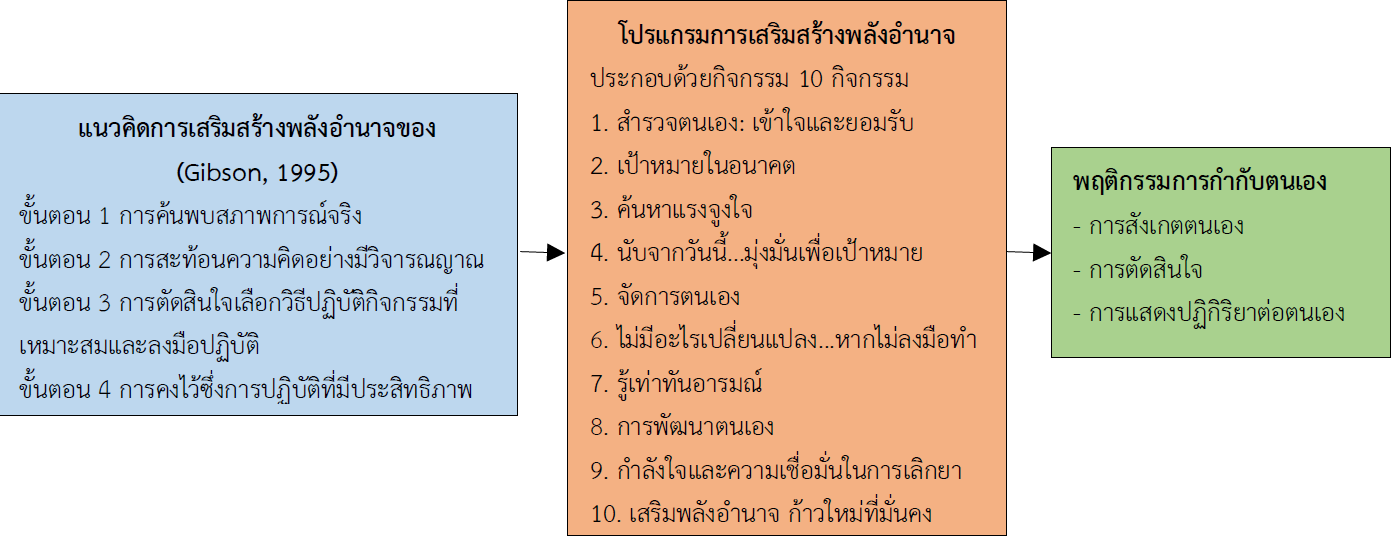
The present research and development aimed to develop and test the effects of an empowerment program on self-regulatory behavior for quitting drugs among patients with amphetamine during their rehabilitation period. The research process consisted of three phases: 1) the development of such program included to perform a situation analysis by reviewing medical records, but also focus groups and in-depth interviews, accordingly with the framework of Gibson and some literature review, 2) to try out and to revise the program with 10 participants, by using content validity, 3) to test the effect of program at after finish program, one month, three months, participants comprised 60 persons which divided into control group (29 participants) and experimental group (30 participants). Research instruments consisted of: 1) an enhancing empowerment program, and 2) a self-regulatory behavior assessment for quitting drugs. Content validity of 2 parts was verified by 5 experts. Reliability of the self-regulation behavior for quitting illegal drugs was analyzed using Cronbach’s Alpha coefficient, yielding a value of .96. The quantitative data were analyzed using descriptive statistics and Repeated measure ANOVA, while the qualitative data was an analysis using content analysis. The results showed:
1. The enhancing empowerment program on self-regulation for quitting illegal drugs consisted of group activities, each activity for 60 - 90 minute, 3 times per week, and consecutively 4 weeks, using a patient empowerment guideline.
2. Overall, the difference mean score of self-regulation for quitting illegal drugs in patients with amphetamine between experimental and control group, before and after finishing the program, following 1 and 3 months, was a statistically significant different mean score of self-regulation (F = 761.640, p < .001).
This enhancing empowerment program among patients with amphetamine addiction could increase self-regulation behaviors for quitting illegal drugs in rehabilitation phase. Therefore, nurses could apply the program to the patients in rehabilitation phase.
References
Bandura, A. (1977). Social Learning Theory. Retrieved August, 27, 2022, from http://www.rpi.edu/~ verwyc/bandura.html
Burns, N., & Grove, S. K. (2009). The Practice of Nursing Research: Appraisal, Synthesis, and Generation of Evidence (6th). Missouri: Saunders Elsevier.
Detdee, S. & Nukaew, O. (2021). The development and effects of empowerment program on self-care behavuors among patients with substance-induced psychotic disorder. The Journal of Psychiatric Nursing and Mental Health, 35(1), 91-111. (in Thai)
Gibson, C.H. (1995). The process of empowerment in mothers of chronically ill children. Journal of Advance Nursing. 21, 1201-1210.
Gibson, C. H. (1993). A Study of Empowerment in Mother of Chronically Ill Children. Unpublished
Doctoral Dissertation, Boston college, Boston.
Joanna Briggs Institute for Evidence Based Nursing & Midwifery. (2008). Reviewers’ s Manual. Retrieved January 25, 2022 from http://www.joannabriggs.edu.au
Kongsut, P., Chaisri, S., & Teangtum, S. (2013). The development empowerment program on management with drinking behavior of alcohol dependence patients. The Journal of Psychiatric Nursing and Mental Health, 27(1), 45-61. (in Thai)
Nilaban, S., Sriherun, B., & Kongthong, U. (2016). Causal relationship of factors affect relapsing behavior of methamphetamine. Journal of Graduate Studies Valaya Alongkron Rajabhat University, 10(1), 82-84. (in Thai)
Office of the Narcotics Control Board. (2021). Report Performance Prevent and Suppress Drugs Annual Budget 2021. Bangkok: Office of the Narcotics Control Board. Retrieved January 30, 2022, from https://www.oncb.go.th/EBookLibrary/annual%20report%202564.pdf
Polit, D.F., & Beck, C.T. (2012). Essentials of Nursing Research: Appraising Evidence for Nursing Practice. 8th Ed, Wolters Kluwer Health/Lippincott Williams & Wilkins, Philadelphia.
Phuakpong, K., Bunthumporn, N., & Somprasert, C. (2018). The effects of an empowerment program on the self-control of amphetamine use disorder patients. Journal of The Royal Thai Army Nurses, 19, 118-128. (in Thai)
Phurungruangphon, S. (2019). Narcotics Act, B.E. 2522. Retrieved on January 28, 2021 from https://www. chiangmaihealth.go.th/cmpho web/document/ 190816156591830384.pdf.
Pochnagone, S. (2020). The empowerment model for addicted patients and family to prevent relapse. Journal of Social Science and Buddhistic Anthropology, 5(12), 305-232. (in Thai)
Puntong, B., & Kimsungnoen, N. (2014). Effectiveness of self-efficacy and family support program on addiction behaviors in patients with amphetamine dependence in the National Institute of drug Abuse Treatment. Journal of Health Science, 23(1), 62-68. (in Thai)
Ratthaman, N., & Dangdomyout, P. (2017). The effect of empowerment with family participation
program on alcohol drinking behavior of schizophrenic patient with alcohol use. The Journal of Psychiatric Nursing and Mental Health, 31(3), 99-112. (in Thai)
Sangsa-nguan, K., Nukeaw, O., Chatarat, P., & Khanhansuk, P. (2023). The development of the empowerment program on caring behaviors among caregivers of children with Learning disability. The Southern College Network Journal of Nursing and Public Health, 10(2), 1-13. (in Thai)
Thanyarak Songkhla. (2022). Medical Record Audit Annual Statistic Report Songkhla. Songkhla: Thanyarak Songkhla. (in Thai)
United Nations Office on Drugs and Crime. (2021). Drug Market Trends: Cocaine Amphetamine Type Stimulants. United Nations Publication, Sales No. E.21.XI.8. New York: United Nations; 2021 Retrieved January 25, 2022 from https://www.unodc.org/res/wdr2021/ field/WDR21_ Booklet_4.pdf
Uten, K., Ratsamesuwiwat, J., & Yasin, W. (2022). The development of integrative program on release prevention among persons with amphetamine induce psychotic disorder. The Journal of Psychiatric Nursing and Mental Health, 36(3), 46-70. (in Thai)
Downloads
Published
Issue
Section
License
Copyright (c) 2024 The Southern College Network Journal of Nursing and Public Health

This work is licensed under a Creative Commons Attribution-NonCommercial-NoDerivatives 4.0 International License.
1. บทความหรือข้อคิดเห็นใด ๆ ที่ปรากฏในวารสารเครือข่าย วิทยาลัยพยาบาลและการสาธารณสุขภาคใต้ ที่เป็นวรรณกรรมของผู้เขียน บรรณาธิการหรือเครือข่ายวิทยาลัยพยาบาลและวิทยาลัยการสาธารณสุขภาคใต้ ไม่จำเป็นต้องเห็นด้วย
2. บทความที่ได้รับการตีพิมพ์ถือเป็นลิขสิทธิ์ของ วารสารเครือข่ายวิทยาลัยพยาบาลและการสาธารณสุขภาคใต้