First-Level Nurse Executives Competencies in the New Normal at a Tertiary Hospital, Chiang Rai Province
Keywords:
Competency, First-level Nurse Executives, New NormalAbstract
The objectives of this descriptive research were to: 1) study the competencies of first-level nurse executives in the new normal, and 2) assess the level of development of "new normal" competencies among first-level nurse managers at a tertiary hospital in Chiang Rai Province. The sample group consisted of 103 first-level nurse executives. The research instrument consisted of a personal information form and a competencies assessment form for first-level nurse executives. The content validity ranged from .67 to 1.00 and the reliability value was at the 0.844 level. Data were analyzed by descriptive statistics and first-order confirmatory factor analysis, using the KMO (Kaiser-Meyer-Olkin) statistical index and Bartlett's test of sphericity. The results were as follows.
1. Overall, the "new normal" competencies of the first-level nurse executives were at the highest level.
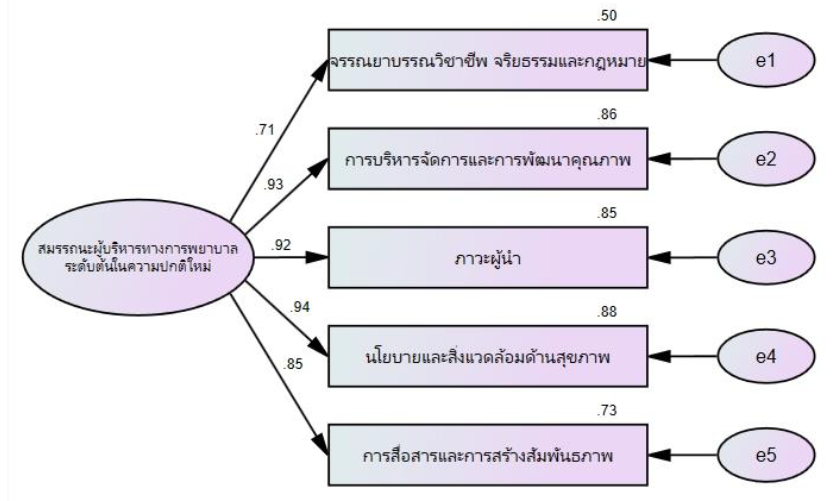
2. The first-order confirmatory factor analysis of the first-level nurse executives in the new normal consisted in 5 components: 1) professional, ethics, and law, 2) quality management and development, 3) leadership, 4) health policy and environment, and 5) communication and relationship building. The first-order confirmatory was consistent with empirical data. The statistical values met the criteria for the test of harmony (x21st order = 1.448, df = 2, p-value = 0.485 และ RMSEA = 0.958).
In conclusion, those five components for the nurses competencies under "new normal" scheme should be developed among first-level nurse executives.
References
American Organization for Nursing Leadership (AONL). (2021). AONL covid-19 Longitudinal Study August 2021 report: Nurse Leaders’ Top Challenges, Emotional Health, and Areas of Needed Support, July 2020 to August 2021. Retrieved April 16, 2022 from https://www.aonl.org/system/files/media/file/2021/09/AONL%20COVID19%20Longitudinal%203%20Written%20Report.pdf
American Organization for Nursing Leadership (AONL). (2021). AONL COVID-19 Longitudinal Study Finds Top Challenges for Nurse Leaders. Retrieved April 16, 2022 from https://www.aonl.org/news/voice/may-2021/COVID19-Longitudinal-Study
American Organization for Nursing Leadership (AONL). (2015). AONL Nurse Manager Competencies. Chicago: American Organization for Nursing Leadership.
Bender, M., L'Ecuyer, K., & Williams, M. (2019). A clinical nurse leader competency framework: concept mapping competencies across policy documents. Journal of Professional Nursing 35(6), 431-439. doi.10.1016/j.profnurs.2019.05.002.
Chaichanaviroj, U. & Wanthum, C. (2017). Evaluation of content validity for research instrument. Journal of Nursing and Health Sciences, 11(2), 105-111. (in Thai)
Crawford, C. L., Omery, A., & Spicer, J. (2017). An Integrative review of 21st-century roles, responsibilities, characteristics, and competencies of chief nurse executives: A blueprint for the next generation. Nursing Administration Quarterly, 41(4), 297–309. doi.10.1097/NAQ.0000000000000245.
Darach, N. & Prajusil, K. (2018). Competency of junior nurse administrators Bangkok Hospital Medical Center. Journal of the Police Nurses, 10(2), 244–252. (in Thai)
Department of disease control, Ministry of Public Health. (2022). Plan and Strategy in COVID – 19 Administrations (Endemic Approach to COVID-19). Letter news about Epidemic act B.E. 2558. (in Thai)
Department of Inspection, Ministry of Public Health. (2021). Strategic indicators in Service Excellence No. 28 in Advanced and Standard hospital: Key Step Assessment. Nonthaburi: Ministry of Public Health. (in Thai)
González García, A., Pinto-Carral, A., Sanz Villorejo, J., & Marqués-Sánchez, P. (2020). Nurse manager core competencies: A proposal in the Spanish Health System. International Journal of Environmental Research and Public Health, 17(9), 3173. doi.10.3390/ijerph17093173.
Hair, J. F., Black, W. C., Babin, B. J., & Anderson, R. E. (2010). Multivariate Data Analysis: A Global Perspective. New Jersey: Pearson Prentice Hall.
Hoffmann, R. L., Battaglia, A., Perpetua, Z., Wojtaszek, K., & Campbell, G. (2020). The clinical nurse leader and covid-19: Leadership and quality at the point of care. Journal of Professional Nursing, 36(4), 178-180. doi.org/10.1016/j.profnurs.2020.06.008
Massachusetts Department of Higher Education Nursing Initiative. (2016). Massachusetts Nurse of the Future Nursing Core Competencies (3rd ed.). Massachusetts, United State of America: McGraw Hill.
Nursing Council. (2018). Announcement of the Nursing and Midwifery Council on Nursing Council Policy Regarding Manpower in the Nursing Team. Nontaburi: Nursing Council. (in Thai)
Prachachit, J. (2015). Head nurse competency in IPD of Sakolnakorn hospital. Retrieved April 16, 2022 from https://digital_collect.lib.buu.ac.th/dcms/files/53921087.pdf. (in Thai)
Rattanasan, S. & Wisetrit, W. (2008). The development of a competency assessment scale for head nurses. Thai Red Cross Nursing Journal, 1, 38–54. (in Thai)
Rewthong, R. (2014). The Competencies of Head Nurses at a Hospital under the Bangkok Metropolitan Administration. Master Thesis of Nursing Science Program in Nursing Administration, Christian University. (in Thai)
Todd, R. W. (2011). Analyzing and interpreting rating scale data from questionnaires. rEFLections, 14, 69-77. doi.org/10.61508/refl.v14i0.114230
Wanichbuncha, K. (2008). Advanced Statistical Analysis by SPSS for Windows. Bangkok: Chulalongkorn University. (in Thai)
Weber, E., Ward, J., Walsh, T. (2015). Nurse leader competencies. Nursing Management, 46(12), 47-50. doi: 10.1097/01.NUMA.0000473505.23431.85
Williams, M. P., & Li, Y. (2019). North Carolina Nurse Leader Project. JONA: The Journal of Nursing Administration, 49(5), 256–259. doi: 10.1097/NNA.0000000000000747
Downloads
Published
Issue
Section
License
Copyright (c) 2024 The Southern College Network Journal of Nursing and Public Health

This work is licensed under a Creative Commons Attribution-NonCommercial-NoDerivatives 4.0 International License.
1. บทความหรือข้อคิดเห็นใด ๆ ที่ปรากฏในวารสารเครือข่าย วิทยาลัยพยาบาลและการสาธารณสุขภาคใต้ ที่เป็นวรรณกรรมของผู้เขียน บรรณาธิการหรือเครือข่ายวิทยาลัยพยาบาลและวิทยาลัยการสาธารณสุขภาคใต้ ไม่จำเป็นต้องเห็นด้วย
2. บทความที่ได้รับการตีพิมพ์ถือเป็นลิขสิทธิ์ของ วารสารเครือข่ายวิทยาลัยพยาบาลและการสาธารณสุขภาคใต้