The Effects of a Health Behavior Modification Program on Blood Lipid Levels and Body Mass Index among Hypertensive Patients with Overweight in Phonpisai District, Nongkhai Province
Keywords:
Health Behavior Modification Program, Hypertensive Patients with OverweightAbstract
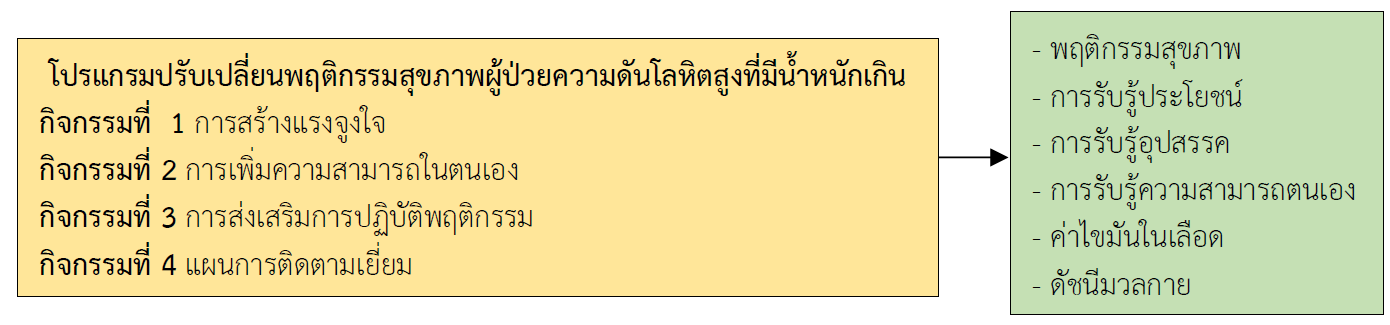
This two groups pretest-posttest design quasi-experimental research aimed to study the effects of a health behavior modification program among hypertensive patients with overweight in Phonpisai District, Nong Khai Province. The 56 participants were assigned to either experimental or control group (28 patients/ group). The research tool were a health behavior modification program, and a questionnaire on health behaviors, perceived benefits, perceived barriers, and perceived self-efficacy. The content validity was validated with a CVI value of .87. The reliability of the different parts of questionnaire (health behavior, perceived benefits, perceived barriers, and perceived self-efficacy) were .82, .72, .77, and .81, respectively. Data were analyzed using descriptive statistics, chi-square, Wilcoxon signed-rank test, Mann-Whitney U test, paired t-test, as well as independent t-test.
1. After receiving the program, the experimental group had significantly higher scores in health behaviors, perceived benefits, perceived barriers, and perceived self-efficacy than before the experiment (p< .05). While the control group had significantly higher scores only in perceived barriers and perceived self-efficacy than before the experiment (p<.05).
2. In the experimental group, the difference before and after the experiment in terms of blood lipid level was significantly lower than in the control group (t = -3.85, p<.05). However, there was no difference in body mass index scores.
The results of this study suggest that public health personnel can implement this program, but should also implement behavior modification programs in other areas of nursing, so to change the behaviors of patients with other chronic diseases.
References
Bawornthip, P. & Chaimai, A. (2019). Modification of the dietary approaches to stop hypertension of people with prehypertension in community. Journal of Nursing Science & Health, 42(4), 132-139. (in Thai)
Chanthima, P. & Sritharathikhun, S. (2021). Application of integrated health behavior change theory in hyperlipidemia reduction in hypertensive patients, Si Mueang Chum Tambon Health Promoting Hospital, Mae Sai District. Chiang Rai Medical Journal, 13(3), 205-219. (in Thai)
Chotikhuntod, S., Thueksungnoen, S. & Koksungnoen, N. (2015). Effects of enhancing self-efficacy for body weight. BMI and waist circumference of the high-risk group to diabetes and high blood pressure, Pong Daeng Subdistrict Kham Thale So District Nakhon Ratchasima Province. Journal of Health Research and Development Provincial Public Health Office, Nakhon Ratchasima, 1(1), 50-57. (in Thai)
Cohen, J. (1988). Statistical Power Analysis for the Behavioral Sciences (2nd ed), Hillsdale, NJ: Lawrence Earlbaum Associates. Retrieved December 1, 2020 from https://www.utstat.toronto.edu/~brunner/oldclass/378f16/readings/CohenPower.pdf.
Division of Health Education, Department of Health Service Support Ministry of Public Health (2022). Guidelines for implementing health behavior surveillance. Retrieved December 1, 2020 from http://www.hed.go.th/linkHed/430.
Ekpalakorn, W. (2019). “Health status.” Survey Report Thai People's Health By Physical Examination, No. 5, 2014. (pp 133-141) Bangkok: Graphic and Design. (in Thai)
Kaewfong, I., Wannapornsiri, C. & Naewboo, S. (2018). Effective of motivational interviewing program on knowledge, attitude, behaviors and lipid levels among hypertensive patients. Boromarajonani College of Nursing, Uttaradit Journal, 10(2), 57-71. (in Thai)
Klongklew, U. (2022). Effects of health behavior modification program for hypertensive patients Bangklur Subdistrict, Bangpakong District, Chachoengsao Province. Interdisciplinary Journal for Health, 4(1), 18-28. (in Thai)
Kummak, S. (2016). Self-Care behaviors among hypertension patients in Tambon Nanglao Health Promoting Hospital, Amphur Satingpha, Songkhla Province. The Southern College Network Journal of Nursing and Public Health, 3(3), 153-169. (in Thai)
Lakkanasirorat, M. & Tirapat, T., (2021). health behavior modification with family participation among overweight psychiatric patients with diabetes mellitus or hypertension. Thai Journal of Public Health and Health Sciences, 4(2), 67-82. (in Thai)
Nasamdaeng, M. (2018). A study on relationship between perceived health threat and obesity among the elderly in Wiang Kao District, Khonkaen Province. A Dissertation Submitted in Partial Fulfillment of the Requirement for the Master of Public Health, Burapha University. (in Thai)
Nong Khai Provincial Public Health Office (2020). Health Data Center (HDC). Retrieved December 5, 2020 from https://nki.hdc.moph.go.th/hdc/main/index.php. (in Thai)
Pender N. J., Murdaugh C. L., Parsons M. A. (2011). Health Promotion in Nursing Practice. 6th ed. Boston: Pearson. Retrieved December 1, 2020 from https://www.goodreads.com/book/show/8627699-health-promotion-in-nursing-practice.
Pradubpoj, K. & Kaenin, S., (2021). Results of the health behavior change program 3 self to changes in blood sugar levels high blood pressure and waist circumference of risk groups Diabetes and high blood pressure Phrom Khiri District Nakhon Si Thammarat Province. Mahachula Nakhondhat Journal, 8(5), 148-161. (in Thai)
Showsungnoen, N., (2016). Health promotion to improve health behavior in people who working age which aim to prevent hypertension. Health Care Division Journal, 12(1), 9-16. (in Thai)
Tupanich, W. & Thongsri, P. (2019). Effects of the modifying health promoting behavior program on self-efficacy, health promoting behavior and health status of hypertensive patients in community. Vajira Medical Journal: Journal of Urban Medicine, 63(supplemental issue), 93-104. (in Thai)
World Health Organization. (2018). How to Fulfil National NCD Commitments in 2015 and 2016. The First WHO Global Meeting of National NCD Programme Directors and Managers.Geneva 2016. Retrieved December 1, 2020 from http://www.who.int/nmh/events/2016/ncd-concept-note-en.pdf.
Worathanarat, T. (2018). Be Aware - adjust Behavior - enhance Health. Prevent non-communicable Diseases NCDs. Retrieved December 5, 2020 from https://www.thairath.co.th/content/1374821. (in Thai)
Downloads
Published
Issue
Section
License
Copyright (c) 2024 The Southern College Network Journal of Nursing and Public Health

This work is licensed under a Creative Commons Attribution-NonCommercial-NoDerivatives 4.0 International License.
1. บทความหรือข้อคิดเห็นใด ๆ ที่ปรากฏในวารสารเครือข่าย วิทยาลัยพยาบาลและการสาธารณสุขภาคใต้ ที่เป็นวรรณกรรมของผู้เขียน บรรณาธิการหรือเครือข่ายวิทยาลัยพยาบาลและวิทยาลัยการสาธารณสุขภาคใต้ ไม่จำเป็นต้องเห็นด้วย
2. บทความที่ได้รับการตีพิมพ์ถือเป็นลิขสิทธิ์ของ วารสารเครือข่ายวิทยาลัยพยาบาลและการสาธารณสุขภาคใต้