Guidelines for Developing the Servant Leadership among Village Health Volunteers in Suphan Buri Province
Keywords:
Servant Leadership, Training Course Development, Village Health VolunteerAbstract
This mixed-methods research aimed to study the guidelines for developing the servant leadership in providing health services among village public health volunteers. The research was divided into two phases:1)situation analysis regarding the servant leadership of Village Health Volunteers (VHVs),and 2)creating guidelines for developing the servant leadership of VHVs. In the first phase, the research focused on the leadership of village health volunteers. The sample group consisted of 291 VHVs. Simple random sampling was applied. In the second phase, the research conducted a focus group with 10 VHV leaders. Data were analyzed using descriptive statistics and content analysis. The results were as follows.
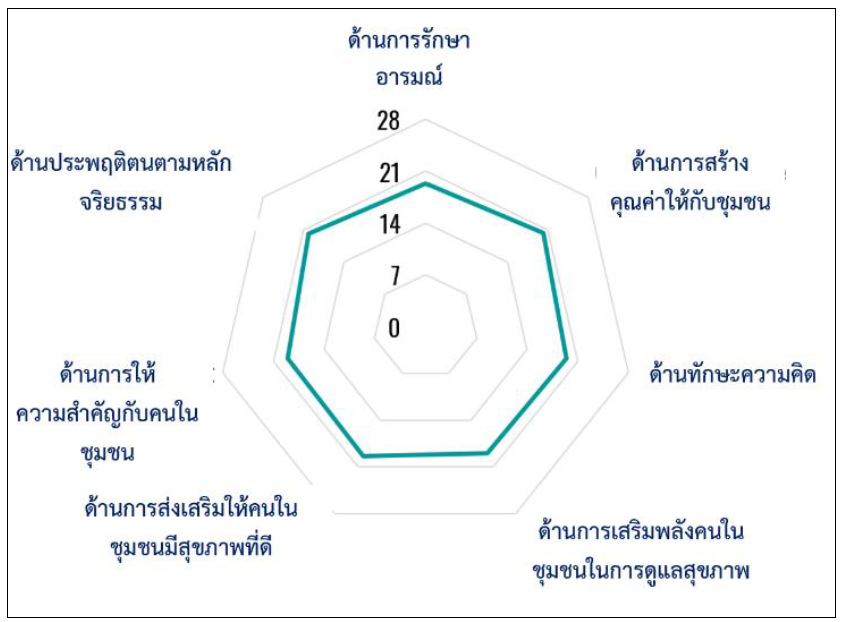
1. The VHVs tend to exhibit the servant leadership behavior in health services at a moderate level across all aspects. The aspect with the highest rating was "creating value for the community" (M = 20.25, SD = 7.11), followed by “behaving ethically" (M = 20.15, SD = 7.25), “conceptual skills" (M = 19.38, SD = 6.46), and "promoting good health in the community" (M = 19.32, SD = 6.66). The aspect with the lowest rating was "empowering community members to take care of their health" (M = 18.94, SD = 6.39).
2. Guidelines for developing the servant leadership in VHVs suggests that a short-term training program of 3-5 days is an effective approach to develop the servant leadership. The training methods should be face-to-face as well as practice in real situations or in community settings. Additionally, evaluation methods should include assessments by the VHVs themselves, community inquiries, and feedback from public health officials. Key skills that should be developed for the servant leadership include communication skills, critical thinking, problem-solving in various situations, relationship management, team building, motivation, ethical behavior, empowering community members to take care of their health, creating value for the community, and emotional control.
Public health personnel and individuals involved in the development of VHVs can apply this model to enhance their servant leadership.
References
Ahmed, S., Akkadechanunt, T. & Chontawan R. (2015). Servant leadership of head nurses and job satisfaction among staff nurses in Medical College Hospitals, Dhaka, The People’s Republic of Bangladesh. Nursing Journal, 42(December), 136-148. (in Thai)
Anansirikasem, & Rungkunakorn. (2019). Village health volunteer’s developmental factors and guideline of leadership in humanized health care service. Silpakorn Educational Research Journal, 11(1), 161-176. (in Thai)
Chimplee, W., Abhicharttibutra, K., & Chitpakdee, B. (2020). Head nurses’ servant leadership and registered nurses’ work engagement, Regional Hospital, Northern Region. Nursing Journal, 47(1), 361-373. (in Thai)
Department of Health service support. (2022). Guidelines for Public Health Operations in Fiscal Year 2021. Retrieved December 2, 2023 from https://hss.moph.go.th/HssDepartment/file_reference/20210506935772122.pdf (in Thai)
Gunnarsdottir, S. (2014). Is servant leadership useful for sustainable nordic health care?. Nordic Journal of Nursing Research, 34(2), 53-55.
Keawsampanjai, P. (2022). Servant leadership: essential skills for student in new normal. Journal of APDEAT, 4(4), 65-76. (in Thai)
Liden, R. C., Wayne, S. J., Zhao, H., & Henderson, D. (2008). Servant leadership: Development of a multidimensional measure and multi-level assessment. The Leadership Quarterly, 19(2), 161–177. doi.org/10.1016/j.leaqua.2008.01.006
Primary Health Care Division. (2023). Public Health Volunteer Report. Retrieved December 10, 2023 from https://www.thaiphc.net/phc/phcadmin/administrator/Report/osm/province.php. (in Thai)
Suphanburi Provincial Health Office. (2018). Suphanburi Provincial Health Strategy, 20-year B.E. 2017-2036. Retrieved December 2, 2022 from https://drive.google.com/file/d/1EBI6dmEUDMywOYdU8iTBfUt6m3ys6vyZ/view. (in Thai)
Schoonenboom, J., & Johnson, R. B. (2017). How to construct a mixed methods research design. Kolner Zeitschrift fur Soziologie und Sozialpsychologie, 69(Suppl 2), 107–131. doi.org/10.1007/s11577-017-0454-1
Trastek, V. F., Hamilton, N. W., & Niles, E. E. (2014). Leadership models in health care - a case for servant leadership. Mayo Clinic proceedings, 89(3), 374–381. doi.org/10.1016/j.mayocp.2013.10.012
Wayne, D. (1995). Biostatistics: A Foundation of Analysis in the Health Sciences (6th ed.). John Wiley & Sons, Inc.
Downloads
Published
Issue
Section
License
Copyright (c) 2023 The Southern College Network Journal of Nursing and Public Health

This work is licensed under a Creative Commons Attribution-NonCommercial-NoDerivatives 4.0 International License.
1. บทความหรือข้อคิดเห็นใด ๆ ที่ปรากฏในวารสารเครือข่าย วิทยาลัยพยาบาลและการสาธารณสุขภาคใต้ ที่เป็นวรรณกรรมของผู้เขียน บรรณาธิการหรือเครือข่ายวิทยาลัยพยาบาลและวิทยาลัยการสาธารณสุขภาคใต้ ไม่จำเป็นต้องเห็นด้วย
2. บทความที่ได้รับการตีพิมพ์ถือเป็นลิขสิทธิ์ของ วารสารเครือข่ายวิทยาลัยพยาบาลและการสาธารณสุขภาคใต้