A Comparison on Budget Allocations from the National Health Security Fund between Contracting Unit for Primary care and Tambon Health Promoting Hospitals with and without Transferred to the Local Administrative Organizations
Keywords:
National Health Security Fund, Budget Allocation, Transfer Missions, Local Administration Organization, Tambon Health Promoting HospitalAbstract
This mixed-methods research aimed to: 1) study the situation of health insurance fund management and expenditure allocation for public health services from the health insurance fund of the contracting unit for primary care (CUP)by conducting in-depth interviews among the 4 contracting parties and 16 directors of tambon health promoting hospitals, and 2) compare the proportion of expenditure allocation using data from contracting unit for primary care (CUP), National Health Security office (NHSO), and Tambon health promoting hospital (THPH), and 3) develop policy recommendations on health insurance fund management and expenditure allocations by analyzing, synthesizing research, concepts, theories and context related to current and future budget management. The results showed as follows.
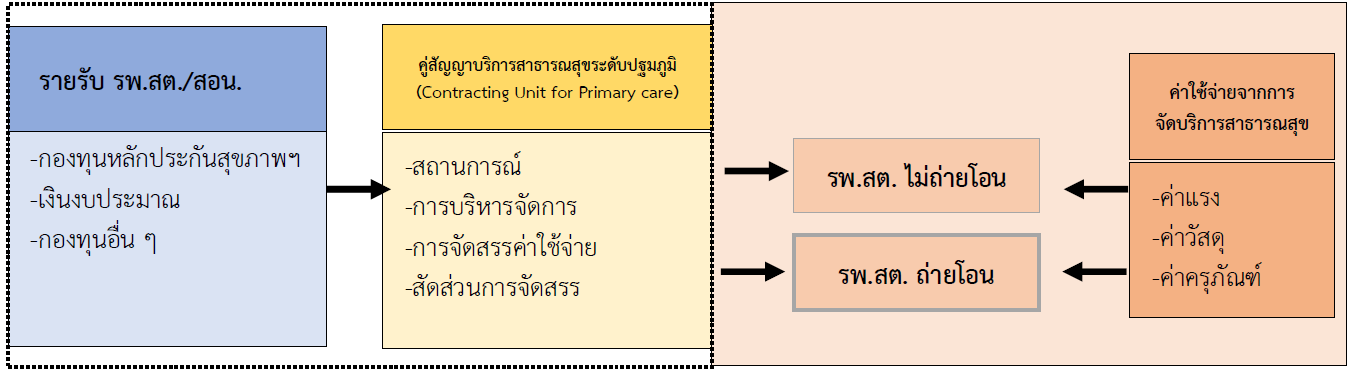
1. The allocation model depends on the agreement with the District Coordinating Committee for the allocation of money, medical supplies, and durable items, and this, at fixed cost.
2. The CUP allocated 73.05 percent of money and 26.95 percent of appliances to non-transferred SHPH. Transferred SHPH is allocated for 54.78% of the money, 45.22% of appliance.
3. To ensure fairness in the provision of services, we proposed three options for different conditions: 1) in the case of the original CUP (the host hospital does not charge service fees) within the context of amending the regulations on the Ministry of Public Health’s maintenance allowance, 2) in the case of the original CUP (the host hospital does not charge service fees), the direct transfers to the SHPH in the context of not amending the maintenance allowance regulations, and 3) in the case of the new CUP (the host hospital does not charge service fees), the direct transfers to the THPH.
4. In terms of policy recommendation, the National Health Security Fund should review and adjust the allocation model to be appropriate, fair, and without inequality in the allocation of medical service costs to THPH, transfers, and non-transfers.
Ministry of Public Health, Department of Local Administration, and the National Health Security Office can use the proposed options to consider the arrangement, mechanism, and proportion of budget allocation for public health services to the transferred THPHs.
References
Barasa, E., Mathauer, I., Kabie, E., Ezumah, N., Mbau, R., Honda, A., et al. (2021). How do healthcare providers respond to multiple funding flows? A conceptual framework and options to align them. Health Policy and Planning, 36(6), 861–868.
Cashin, C., Ankhbayar, B., Phuong, HT., Jamsran, G., Nazad, O., Phuong, NK., et al. (2015). Assessing Health Provider Payment Systems: A Practical Guide for Countries Moving toward UHC. Washington DC: Joint Learning Network for Universal Health Coverage.
Chiangchaisakulthai, K., Wongsin, U., Isayathikom, K., Suppradist, W., Samiphuk, N. (2021). Unit cost of services in primary care cluster. Journal of Health Systems Research, 13(2), 175-187. (in Thai)
Chiangchaisakulthai, K., Wongsin, U. (2018). Cost of primary care service network in health region 8. Journal of Health Systems Research, 12(4), 681-690. (in Thai)
Chu, A., Kwon, S., Cowley, P. (2019). Health financing reforms for moving towards universal health coverage in The Western Pacific Region. Health Systems & Reform, 5(1), 32-47.
Department of Local Administration. (2021). List of Sub-District Health Promoting Hospitals and Health Stations that are Transferred to Local Administrative Organizations. Bangkok: Ministry of Interior. (in Thai)
Faramnuayphol, P. (2008). Money Allocation and Financial Situation of Primary Care Facilities (Health Center) Under the Creation of Universal Health Insurance. Bangkok: Health Information Development Office. (in Thai)
Joint Learning Network. (2016). Financing and Payment models for Primary Health Care Six Lesson from JLN Country Implementation Experience. USA: Joint Learning Network for Universal Healht Coverage.
Kulthanmanusorn, A., Saengruang, N., Wanwong, Y., Kosiyaporn, H., Witthayapipopsakul, W., Srisasalux, J., et al. (2018). Evaluation of the Devolved Health Centers: Synthesis Lesson Learnt from 51 Health Centers and Policy Options. Nonthaburi: Health Systems Research Institute. (in Thai)
Local Government Commission. (2017). Transferring Missions from Tambon Health Promoting Hospital to Local Government. Bangkok: The National Legislative Assembly. (in Thai)
National Health Security Office. (2022). Guidelines for the Practice of Claiming Expenses for Health Services for Fiscal Year 2022. Nonthaburi: Sahamitr Printing & Publishing Company Limited. (in Thai)
Phodha, T., Singweratham, N., Rochanathimoke, O., Techakehakit, W., Bunpean, A.. (2023). A compared cost analysis for health care services in tambon health promotion hospitals before and during the covid-19 pandemic period fiscal year 2019-2021. The Southern College Network Journal of Nursing and Public Health, 10(1), 170-181. (in Thai)
Quality and Standard Service Unit Support office. (2016). Service Unit Registration Audit Guideline for Main Contractor Service Unit, Primary Care Service Unit, Coordinate Service Unit. Bangkok: National Health Security Office. (in Thai)
Rutjamathamrong, P., Singweratham, N., Techakehakij, W., Boontiam, N., Kaewsing, P., Bunpean, A., et al. (2022). Development of Management Guideline for the Health Security Funds to Allocate Budget for The District Health Promoting Hospitals Transferred to the Local Administrative Organizations. Nontaburi: Health Systems Research Institute (HSRI). (in Thai)
Singweratham, N., Khunboonchan, T., Nawsuwan, K., Atitdid, P., Adulyarat, M. (2022). Unit cost of thai traditional medicine service activities for health promotion and disease prevention in health care providers under Ministry of Public Health for the 2018 fiscal year. Princess of Naradhiwas University Journal, 13(3), 89-107. (in Thai)
Sri-ngernyuang, L., Siriwan, P., Vongjinda, S., Chuenchom, S. (2012). Health Center Devolution: Lesson Learned and Policy Implications. Nonthaburi: Health Systems Research Institute. (in Thai)
Srisasalux, J., Vichathai, C., Kaewvichian, R. (2009). Experience with public health decentralization: The health center transfer model. Journal of Health Systems Research, 3(1), 16-34. (in Thai)
Sudhipongpracha, T., Choksettakij, W., Phuripongthanawat, P., Kittayasophon, U., Satthatham, N., Onphothong, Y. (2021). Policy Analysis and Policy Design for the Transfer of Subdistrict Health Promotion Hospitals to Provincial Administrative Organizations (PAOs). Nontaburi: Health Systems Research Institute (HSRI). (in Thai)
Suppatheerathada, J. (2020). Policy Recommendation for Budget Allocation on Subsidy Expenditure Budget for Local Government under Transfer Mission: Case Study in Tumbon Health promoting hospital. Bangkok: The Secretariat of the House of Representatives. (in Thai)
Techaatik, S., Nakham, P. (2009). Studying and Monitoring the Development of the Transfer System of Public Health Centers to Local Government Organizations. Journal of Health Systems Research, 3(1), 113-130. (in Thai)
Techakehakij, W., Singweratham, N., Wongyai, D., Nawsuwan, K. (2020). Unit costs of primary care units: a case study in Kamphaeng Phet, Fiscal Year 2018. Journal of Safety and Health, 13(2), 192-204. (in Thai)
Wongsin, U., Wannasri, A., Thamwanna, P., Pongpattrachai, D., Chiangchaisakulthai, K., Sakunphanit, T. (2017). Estimate Unit Cost per Capita of Services Provided at CUP Network. Journal of Health Systems Research, 10(2), 207-302. (in Thai)
Downloads
Published
Issue
Section
License
Copyright (c) 2023 The Southern College Network Journal of Nursing and Public Health

This work is licensed under a Creative Commons Attribution-NonCommercial-NoDerivatives 4.0 International License.
1. บทความหรือข้อคิดเห็นใด ๆ ที่ปรากฏในวารสารเครือข่าย วิทยาลัยพยาบาลและการสาธารณสุขภาคใต้ ที่เป็นวรรณกรรมของผู้เขียน บรรณาธิการหรือเครือข่ายวิทยาลัยพยาบาลและวิทยาลัยการสาธารณสุขภาคใต้ ไม่จำเป็นต้องเห็นด้วย
2. บทความที่ได้รับการตีพิมพ์ถือเป็นลิขสิทธิ์ของ วารสารเครือข่ายวิทยาลัยพยาบาลและการสาธารณสุขภาคใต้