รูปแบบภาวะผู้นำและคุณภาพการพยาบาลในมิติของพยาบาล: การทบทวนวรรณกรรมอย่างเป็นระบบ
คำสำคัญ:
Leadership and Nursing Quality in Nurse’ Dimension: A systematic Reviewบทคัดย่อ
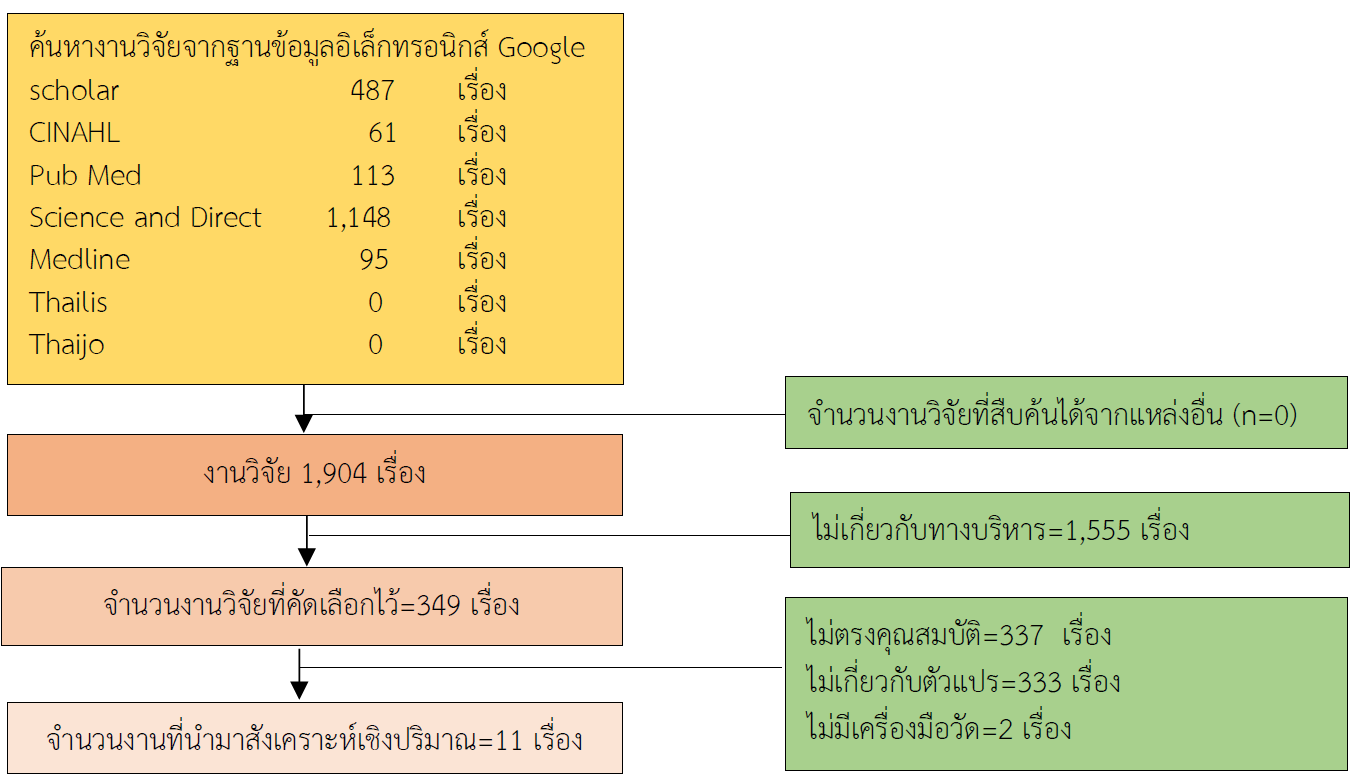
การทบทวนอย่างเป็นระบบนี้มีวัตถุประสงค์เพื่อสังเคราะห์องค์ความรู้ของบทความวิจัยและสังเคราะห์การใช้ทฤษฎีเกี่ยวกับรูปแบบภาวะผู้นำและการวัดคุณภาพการพยาบาลในมิติของพยาบาล โดยสืบค้นจากฐานข้อมูล Science Direct, Emerald Insight, CINAHL, ProQuest, Medline/PubMed, Google Scholar, Thai List, Thaijo และฐานข้อมูลอิเล็กทรอนิกส์ของมหาวิทยาลัย ตัวอย่าง คือ รายงานบทความวิจัยที่เกี่ยวข้อง จำนวน 11 เรื่อง โดยเลือกตัวอย่างแบบเจาะจง ดังนี้ งานวิจัยเชิงปริมาณที่มีการตีพิมพ์เผยแพร่ในช่วงระหว่าง พ.ศ. 2556 - 2566 เครื่องมือที่ใช้ในการวิจัยประกอบด้วย 1) ข้อมูลทั่วไปของรายงานวิจัย และ 2) แบบบันทึกการรายงานกระบวนการคัดเลือกบทความ ตามแนวของ PRISMA 2020 และแบบตรวจสอบคุณภาพรายงานวิจัยของ Kmet, Lee & Cook เพื่อประเมินความสอดคล้องของรายงานโดยใช้ผู้ประเมิน 2 ราย เพื่อประเมินความน่าเชื่อถือของบทความ และใช้สถิติเชิงพรรณนาสถิติแคปปา (Kappa statistics) ผลการวิจัยพบว่า
1. บทความวิจัยส่วนใหญ่ศึกษาในต่างประเทศทั้งหมด และไม่พบว่ามีการศึกษาในประเทศไทย บริบทที่ศึกษาพบในโรงพยาบาลภาครัฐมากที่สุด (n=9) ศึกษากับพยาบาลผู้บริหารระดับต้น (n=6) ใช้ขนาดกลุ่มตัวอย่างมากที่สุดคือ 775 ราย ใช้สถิติเชิงพรรณนามากที่สุด (n=11) มีการทดสอบความตรงเชิงโครงสร้างของบทความวิจัยเพียง 5 เรื่อง
2.บทความวิจัยนิยมใช้ทฤษฎีภาวะผู้นำการเปลี่ยนแปลงของแบส และอโวลิโอ (Bass and Avolio) มากที่สุด ในเรื่องการวัดคุณภาพการพยาบาลในมิติของพยาบาล ปรากฎ 2 มิติ คือ มิติการวัดตามมาตรฐานที่กำหนดขององค์กรมากที่สุด (n=5) ประกอบด้วย 7 องค์ประกอบของมาตรฐานการรับรู้ต่อกิจกรรมการพยาบาลที่ก่อให้เกิดคุณภาพ: EPAECQC) และ 5 องค์ประกอบ ของมาตรฐานคุณภาพการพยาบาล (Quality of Health Service) และมิติการวัดตามผลลัพธ์ของอุบัติการณ์ที่เกิดขึ้นจริงจากการพยาบาลผู้ป่วย (n = 2) เช่น อุบัติการณ์การติดเชื้อ แผลกดทับ
การสังเคราะห์งานวิจัยนี้ชี้ให้เห็นว่า ยังขาดการวิจัยภาวะผู้นำกับคุณภาพการพยาบาล ภาวะผู้นำที่ควรเพิ่มในกลุ่มตัวอย่างเพิ่มในผู้บริหารระดับกลางและระดับสูง และควรมีการขยายการพัฒนาเครื่องมือวัดคุณภาพการพยาบาลในมิติพยาบาลในบริบทองค์กรพยาบาลไทย
เอกสารอ้างอิง
Abdelhafiz, I., Alloubani, A., & Almatari, M. (2016). Impact of leadership styles adopted by head nurses on job satisfaction: A comparative study between governmental and private hospitals in Jordan. Journal of Nursing Management, 24(3), 384-392.
Alloubani, A., Akhu-Zaheya, L., Abdelhafiz, I. M., & Almatari, M. (2019). Leadership styles' influence on the quality of nursing care. International journal of Health Care Quality Assurance, 32(6), 1022–1033. doi.org/10.1108/IJHCQA-06-2018-0138
Alloubani, A. (2016). Leadership Styles and Healthcare Management in Jordan and Worldwide. Saarbrücken: Noor.
Asif, M., Jameel, A., Hussain, A., Hwang, J., & Sahito, N. (2019). Linking transformational leadership with nurse-assessed adverse patient outcomes and the Quality of Care: Assessing the role of job satisfaction and structural empowerment. International Journal of Environmental Research and Public Health, 16(13), 2381.
Avolio, B. J., & Bass, B. M. (2004). Multifactor Leadership Questionnaire. Menlo Park CA: Mind Garden.
Avolio, B. J., Bass, B. M. & Jung, D. I. (1995). MLQ Multifactor Leadership Questionnaire: Technical Report. Palo Alto, CA: Mind Garden.
Bartram, T., Casimir, G., Djurkovic, N., Leggat, S.G. & Stanton, P. (2012). Do perceived high performance work systems influence the relationship between emotional labour, burnout and intention to leave? A study of Australian nurses. Journal of Advanced Nursing, 68(7), 1567-1578.
Bass, B. M. (1985). Leadership and Performance beyond Expectations. UK: Collier Macmillan.
Boamah, S. A., Laschinger, H. K. S., Wong, C., & Clarke, S. (2018). Effect of transformational leadership on job satisfaction and patient safety outcomes. Nursing Outlook, 66(2), 180-189.
Bryman, A. (2013). Leadership and Organizations. (RLE: Organizations). London: Routledge.
Burhans, L. M. & Alligood, M. R. (2010). Quality nursing care in the words of nurses. Journal of Advanced Nursing, 66(8), 1689-1697.
Burke, R. J., Ng, E. S. W. & Fiksenbaum, L. (2009). Virtues, work satisfactions and psychological wellbeing among nurses. International Journal of Workplace Health Management, 2(3), 202-219.
Capuano, T., Bokovoy, J., Hitchings, K., Houser, J. (2005). Use of a validated model to evaluate the impact of the work environment on outcomes at a magnet hospital. Health Care Management Review, 30, 229–236.
Cheng, C., Bartram, T., Karimi, L., & Leggat, S. (2016). Transformational leadership and social identity as predictors of team climate, perceived Quality of Care, burnout and turnover intention among nurses. Personnel Review, 45(6), 1200-1216.
Cummings, G. G., MacGregor, T., Davey, M., Lee, H., Wong, C. A., Lo, E., et al. (2010). Leadership styles and outcome patterns for the nursing workforce and work environment: A systematic review. International Journal of Nursing Studies, 47, 363-385.
den Breejen-de Hooge, L. E., van Os-Medendorp, H., & Hafsteinsdóttir, T. B. (2021). Is leadership of nurses associated with nurse-reported Quality of Care? A cross-sectional survey. Journal of Research in Nursing, 26(1-2), 118-132.
Estabrooks, C., Scott, S., Squires, J., Stevens, B., O’Brien-Pallas, l., Watt-Watson, J., et al. (2008). Patterns of research utilization on patient care units. Implementation Science, 3(31), 1-16.
Frederico, M. & Castilho, A. (2006). Percepc¸~ao de lideranc¸a em enfermagem – validac¸~ao de uma escala. Revista Psycologica, 43, 259-270.
Gunther, M. & Alligood, M. R. (2002). A discipline-specific determination of high-quality nursing care. Journal of Advanced Nursing, 38(4), 353-359.
Huber, D. (2017). Leadership and Nursing Care Management (6thed.). E-Book. Iowa City: Elsevier Health Sciences. Abdelhafiz, I., Alloubani, A., & Almatari, M. (2016). Impact of leadership styles adopted by head nurses on job satisfaction: A comparative study between governmental and private hospitals in Jordan. Journal of Nursing Management, 24(3), 384-392.
Institute of Medicine (IOM). (2011). The Future of Nursing: Leading change, advancing health. Washington, DC: The National Academies.
Khanzada, B., Naeem, S., & Butt, H. (2018). Impact of transformational leadership on job satisfaction and patient safety outcomes in health sector of Pakistan. Journal of Health Education Research and Development, 6(2), 1-10.
Kmet, L. M, Lee, R. C, & Cook, L. S. (2004). Standard Quality Assessment Criteria for Evaluating Primary Research Papers from a Variety of Fields. Canada: Interpret Design.
McLaughlin, C. P., & Kaluzny, A. D. (2004). Defining quality improvement: past, present and future. In McLaughlin C. P., & Kaluzny, A. D. (Eds), Continuous Quality Improvement in Healthcare (2nd). Gaithersburg: Aspen.
Mendes, L., & Fradique, M. deJ. (2014). Influence of leadership on quality nursing care. International Journal of Health Care Quality Assurance, 27(5), 439-450. doi.org/10.1108/IJHCQA-06-2013-0069
Ordem dos Enfermeiros. Conselho de Enfermagem. (2012). Padrões de qualidade dos cuidados de enfermagem: enquadramento conceptual e enunciados descritivos (2nd). Portugal: Lisboa.
Sfantou, D. F, Laliotis, A., Patelarou, A. E., Sifaki-Pistolla, D., Matalliotakis, M. & Patelarou, E. (2017). Importance of leadership style towards Quality of Care measures in healthcare settings: A systematic review. Healthcare, 5(4), 73.
Sochalski, J. (2001). Quality of care, nurse staffing, and patient outcomes. Policy, Politics, & Nursing Practice, 2(1), 9-18.
Tate, K., Penconek, T., Dias, B. M., Cummings, G. G., & Bernardes, A. (2023). Authentic leadership, organizational culture and the effects of hospital quality management practices on Quality of Care and patient satisfaction. Journal of Advanced Nursing, 79(8), 3102–3114. doi.org/10.1111/jan.15663
Tsuno, K., & Kawakami, N. (2015). Multifactor leadership styles and new exposure to workplace bullying: a six-month prospective study. Industrial Health, 53(2), 139-151.
Vinkenburg, C. J., van Engen, M. L., Eagly, A. H. & Johannesen-Schmidt, M. C. (2011). An exploration of stereotypical beliefs about leadership styles: is transformational leadership a route to women’s promotion?. The Leadership Quarterly, 22(1), 10-21.
Warri, D. (2021). Effects of Leadership Styles on Quality of Health Services. Research Square, 1-19. doi.org/10.21203/rs.3.rs-389590/v1 (in press)
Zaghini, F., Fiorini, J., Piredda, M., Fida, R., & Sili, A. (2020). The relationship between nurse managers' leadership style and patients' perception of the quality of the care provided by nurses: Cross sectional survey. International Journal of Nursing Studies, 101, 103446. doi.org/10.1016/j.ijnurstu.2019.103446
ดาวน์โหลด
เผยแพร่แล้ว
ฉบับ
ประเภทบทความ
สัญญาอนุญาต
ลิขสิทธิ์ (c) 2023 วารสารเครือข่ายวิทยาลัยพยาบาลและการสาธารณสุขภาคใต้

อนุญาตภายใต้เงื่อนไข Creative Commons Attribution-NonCommercial-NoDerivatives 4.0 International License.
1. บทความหรือข้อคิดเห็นใด ๆ ที่ปรากฏในวารสารเครือข่าย วิทยาลัยพยาบาลและการสาธารณสุขภาคใต้ ที่เป็นวรรณกรรมของผู้เขียน บรรณาธิการหรือเครือข่ายวิทยาลัยพยาบาลและวิทยาลัยการสาธารณสุขภาคใต้ ไม่จำเป็นต้องเห็นด้วย
2. บทความที่ได้รับการตีพิมพ์ถือเป็นลิขสิทธิ์ของ วารสารเครือข่ายวิทยาลัยพยาบาลและการสาธารณสุขภาคใต้