ข้อเสนอแนะต่อนโยบายการเสริมสร้างศักยภาพญาติผู้ดูแลผู้สูงอายุ ที่มีภาวะพึ่งพิงในชุมชน
คำสำคัญ:
ผู้สูงอายุที่มีภาวะพึ่งพิง , ข้อเสนอแนะต่อนโยบาย, ญาติผู้ดูแลบทคัดย่อ
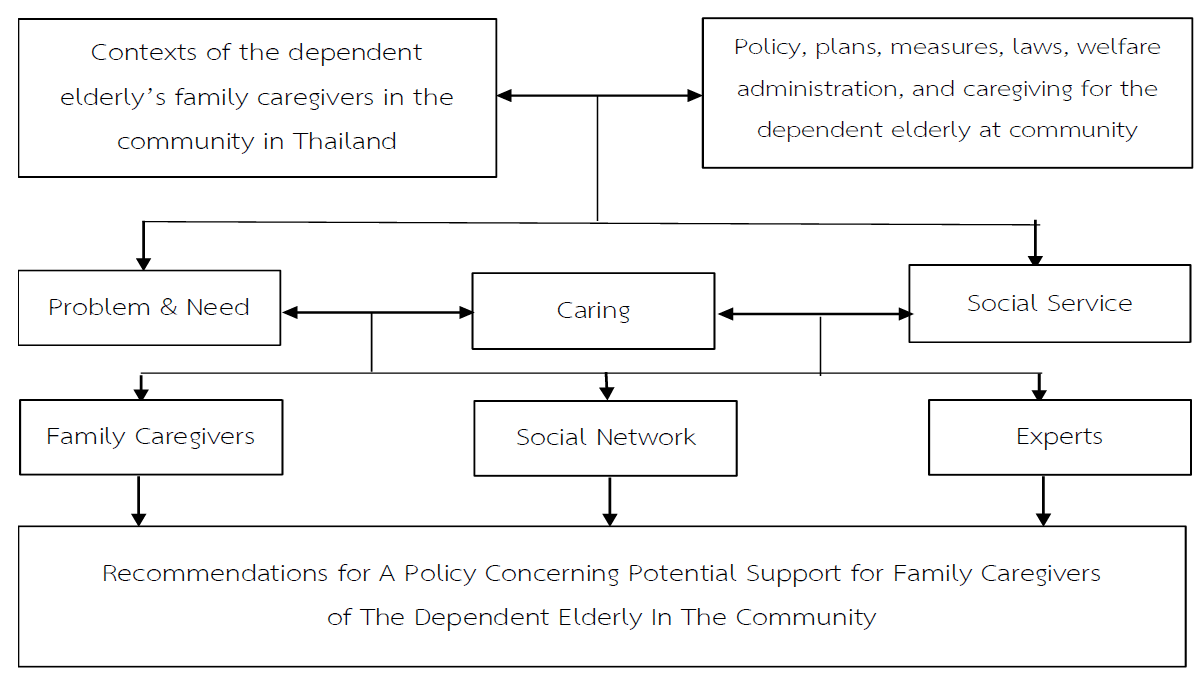
การวิจัยนี้มีวัตถุประสงค์เพื่อศึกษาข้อเสนอแนะต่อนโยบายการเสริมสร้างศักยภาพญาติผู้ดูแลผู้สูงอายุที่มีภาวะพึ่งพิงในชุมชน ใช้วิธีการวิจัยแบบผสานวิธี ดำเนินการ 3 ขั้นตอนคือ ขั้นตอนที่ 1 กำหนดประเด็นปัญหาข้อเสนอแนะเชิงนโยบายเพื่อเสริมสร้างศักยภาพญาติผู้ดูแลผู้สูงอายุที่มีภาวะพึ่งพิงในชุมชน โดยศึกษาจากเอกสารและงานวิจัยที่เกี่ยวข้องรวมทั้งศึกษาจากกลุ่มบุคคลผู้ให้ข้อมูลเชิงปริมาณจำนวน 277 คน และผู้ให้ข้อมูลเชิงคุณภาพจำนวน 109 คน รวมทั้งสิ้น 386 คน แล้วสังเคราะห์เป็นประเด็นปัญหาการพัฒนา ขั้นตอนที่ 2 การสังเคราะห์ทางเลือกข้อเสนอแนะต่อนโยบายการเสริมสร้างศักยภาพญาติผู้ดูแลผู้สูงอายุที่มีภาวะพึ่งพิงในชุมชน โดยนำผลการศึกษาจากขั้นตอนที่ 1 มาสร้างแนวคำถามนำและสัมภาษณ์ผู้ทรงคุณวุฒิ จำนวน 9 ท่าน ทำการวิเคราะห์ข้อมูลเชิงเนื้อหา ขั้นตอนที่ 3 สังเคราะห์ข้อเสนอแนะต่อนโยบายการเสริมสร้างศักยภาพญาติผู้ดูแลผู้สูงอายุที่มีภาวะพึ่งพิงในชุมชน ผลวิจัยพบว่า
ข้อเสนอแนะต่อนโยบายมี 3 ประเด็น คือ 1) จัดระบบและกลไกการสนับสนุนการเข้าถึงสวัสดิการสังคมในทุก ๆ ด้านที่จะส่งผลถึงคุณภาพชีวิตของญาติผู้ดูแลผู้สูงอายุที่มีภาวะพึ่งพิง มีมาตรการ 3 ข้อ 2) จัดระบบการเสริมสร้างศักยภาพแก่ญาติผู้ดูแลผู้สูงอายุที่มีภาวะพึ่งพิงจากหน่วยงานภาครัฐ และเอกชน มีมาตรการ 3 ข้อ และ 3) ส่งเสริมการสร้างความมั่นคงทางเศรษฐกิจ และอาชีพให้กับญาติผู้ดูแลผู้สูงอายุที่มีภาวะพึ่งพิง มีมาตรการ 3 ข้อ รวมทั้งสิ้น 9 ข้อ
ดังนั้นกระทรวงการพัฒนาสังคมและความมั่นคงของมนุษย์ และกระทรวงแรงงานต้องพัฒนาระบบการสร้างความมั่นคงทางเศรษฐกิจและอาชีพให้กับญาติผู้ดูแลผู้สูงอายุที่มีภาวะพึ่งพิงเพื่อให้มีรายได้ มีอาชีพที่มั่นคงและสามารถสร้างรายได้ทั้งในขณะดูแลผู้สูงอายุที่มีภาวะพึ่งพิง และสร้างอาชีพได้ภายหลังจากผู้สูงอายุที่มีภาวะพึ่งพิงได้เสียชีวิตไปแล้ว
เอกสารอ้างอิง
Amornsiripong, S., & Nomnian, A. (2017). "ELDERFARE Model": Model and mechanism of social welfare to reduce social inequality. For the informal elderly workers in the special economic zone, Sa Kaeo Province. Journal of Social Communication Innovation, 5(2), 29 -40. (in Thai)
Artsanthia, J., & Pomthong, R. (2018). The trend of elderly care in 21st Century: Challenging in nursing care. Journal of The Royal Thai Army Nurses, 19(1), 39–46. (in Thai)
Boonyaratkalin, P. (2018). Long-term care for the dependent elderly in the community: the nurse’s role. Thai Red Cross Nursing Journal, 11(1), 47-59. (in Thai)
Colaizzi, P. (1978). Psychological Research as the Phenomenologist Views it. In Existential – Phenomenological Alternatives for Psychology (Valle R. & King M. eds). London: Oxford University Press.
Department of Elderly Affairs Ministry of Social Development and Human Security. (2023). Action Plan for the Elderly, Phase 3 (2023-2037). Retrieved July 21, 2022 from dop.go.th/download/laws/th1653553501-843_0.pdf (in Thai)
Department of Health. (2016). Evaluation form for Long-Term Elderly Health Problems in the Community. Nonthaburi: Department of Health, Office of the Permanent Secretary, Ministry of Public Health. (in Thai)
Department of Mental Health. (2002). General Health Questionnaire Thai Version (Thai GHQ 12 - 28 - 30 - 60). Nonthaburi: Project to create a package of mental health survey in the area of 2002, Department of Mental Health, Ministry of Public Health. (in Thai)
Empowerment of Persons with Disabilities Act, B.E. 2550 (2007). Royal Gazette, Volume 130 / Section 30 A / page 6.
Fongkerd, S., Klungtumneum, K., & Natetanasombat, K. (2019). The self-health care experiences of caregiver’s older adult with bedridden patients. Journal of Boromarajonani College of Nursing, Surin, 9(1), 69-89. (in Thai)
Foundation of Thai Gerontology Research and Development institute (TGRI). (2021). Situation of the Thai Older Persons 2021. Nakhon Pathom: Institute for Population and Social Research, Mahidol University. (in Thai)
Jaikumwang, N., Chaksupan, W., Noijuan, W., Chumchumphoo, S., & Trakulruek, I. (2019). Potential of elderly caregivers who are dependent Khung Taphao Sub-district, Muang District, Uttaradit Province. Academic Journal of Applied Science and Science, 2019(1), 1-19. (in Thai)
Kasemkijwattana, S., & Praison, P. (2014). Family caregiver of chronic patients: risk groups that should not be overlooked. Journal of Nursing Council. 29(4), 22-31. (in Thai)
National Statistical Office of Thailand. (2021). Executive summary, Survey of the elderly population in Thailand 2021. Retrieved July 21, 2022 from http://www.nso.go.th>summary_excusive_64 (in Thai)
Parliamentary Budget Office, Office of the Secretariat of the House of Representatives. (2019). Guidelines for Managing Social Welfare Expenditure Budgets for Caring for the Elderly. Academic Report of the Parliamentary Budget Office No. 5/2019. Retrieved July 21, 2022 from http://www. Parliament.go.th/ewtadmin/ewt/parbudget/ewt_dl_link.php?nid=639. (in Thai)
Saengsee, K. (2013). Social Welfare for the Elderly of the Local Government Organization in Buriram province. National Academic Conferences and Research Presentations Academic Rajabhat University, Nakhon Ratchasima Rajabhat University. (in Thai)
Sarai, K., Sananuch, P., & Kannasoot, K. (2019). Model of long-term care for the elderly in industrial areas. HCU Journal 23(2), 229-241. (in Thai)
Shiouh-Chu, S., Hengh-Sin, T., & Shu-Yuan, L. (2012). Social support as influencing primary family caregiver burden in Taiwanese patients with colorectal cancer. Journal of Nursing Scholarship : An official Publication of Sigma Theta Tau International Honor Society of Nursing, 44(3), 223–231. doi.org/10.1111/j.1547-5069.2012.01453.x
Sudsomboon, S. (2014). Social welfare of the elderly in Thailand. Southern Journal of Technology, 7(1), 73-82.
ดาวน์โหลด
เผยแพร่แล้ว
ฉบับ
ประเภทบทความ
สัญญาอนุญาต
ลิขสิทธิ์ (c) 2023 วารสารเครือข่ายวิทยาลัยพยาบาลและการสาธารณสุขภาคใต้

อนุญาตภายใต้เงื่อนไข Creative Commons Attribution-NonCommercial-NoDerivatives 4.0 International License.
1. บทความหรือข้อคิดเห็นใด ๆ ที่ปรากฏในวารสารเครือข่าย วิทยาลัยพยาบาลและการสาธารณสุขภาคใต้ ที่เป็นวรรณกรรมของผู้เขียน บรรณาธิการหรือเครือข่ายวิทยาลัยพยาบาลและวิทยาลัยการสาธารณสุขภาคใต้ ไม่จำเป็นต้องเห็นด้วย
2. บทความที่ได้รับการตีพิมพ์ถือเป็นลิขสิทธิ์ของ วารสารเครือข่ายวิทยาลัยพยาบาลและการสาธารณสุขภาคใต้