Respirable Dust Levels and Hospital Visits for Respiratory Diseases of People Living in Hat Yai Municipality, Songkhla Province
Keywords:
Respiratory Diseases, PM10, PM2.5Abstract
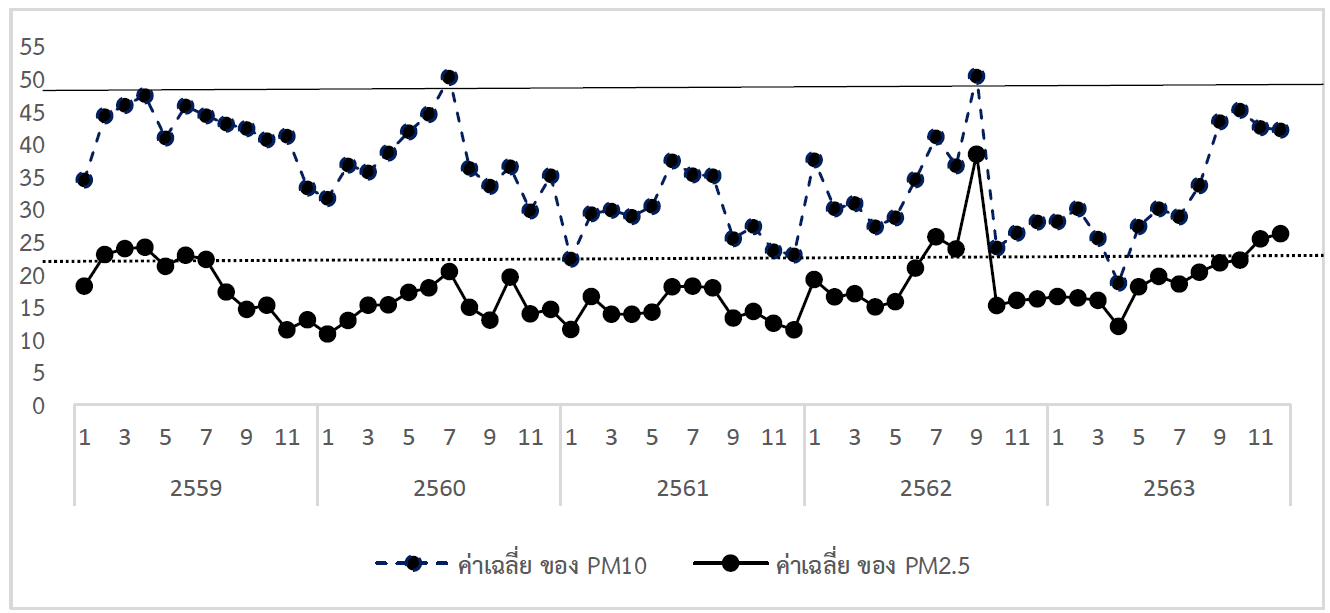
This retrospective study aimed to study the PM10 and PM2.5 air pollution levels and to determine the relationships between PM10 and PM2.5 and hospital visits for respiratory diseases among people living in Hat Yai City, Songkhla province. Concentrations of PM10 and PM2.5 were collected from the pollution control department (AQI index). The meteorological data was collected from the meteorological office in Songkhla province. The number of hospital visits with respiratory diseases (ICD10; J00 – J99) was collected from hospital records between 1st January 2016 and 31st December 2020. Data analysis used distributed lag non-linear models (DLNMS) with spline and generalized additive models (GAM) to estimate the association and estimate lag time 0 - 7. The results showed that:
1. The average amounts of PM10 and PM2.5 were 34.83 µg/m3 and 17.64 µg/m3, respectively.
2. An increase in PM10 and PM2.5 in every 10 µg/m3 were related to an increase in the number of hospital visitors with respiratory diseases. Exposure to PM10 increases the risk of hospital visits with respiratory diseases after six days of exposure (RR=1.22, 95% CI=1.18-1.26). Similarly, PM2.5 particles increasing every 10 µg/m3 was related to hospital visits with respiratory diseases after exposed 6 days passed (RR=1.09, 95% CI=1.03-1.15).
In conclusion, the increasing concentrations of PM10 and PM2.5 are associated with the increasing number of hospital visitors with respiratory diseases. According to this, we should impart knowledge about health prevention from air pollution. Furthermore, the environmental control organization should have an air pollution control policy to reduce the source of air pollution helping decline the respiratory health effects on the population.
References
Bilheem, S., Choosong, T., Sriplung, H., Eungpoonsawat, W., Kongkamol, C., Ingviya, T. & Soramad J. (2022). The spatio-temporal epidemiology of asthma patient visits in relation to meteorological parameters and air pollution factors as a result of seasonal change in Songkhla Province. Journal of Health Science and Medical Research, 40(1), 67–84.
Denduangchai, S. (2020). Correlation between the Daily Fine Particulate Matter (PM2.5) Level and the Number of Visits With Respiratory and Cardiovascular Diseases at Ratchaburi Hospital, Amphoe Meung, Ratchaburi Province. A Dissertation Submitted in Partial Fulfillment of the Requirement for the Degree of Master of Science in health Research and Management Department of Preventive and Social Medicine Faculty of Medicine, Chulalongkorn University, Bangkok. (in Thai)
Environment and Pollution Control Office 15 (Phuket), (2018). Smoke Haze in Southern Thailand. Phuket: Ministry of Natural Resources and Environment. Retrieved October 14, 2023 from https://epo15.go.th/news/detail/69. (in Thai)
Google Maps. (2023). Hat yai subdistrict. Google Website. Retrieved April 30, 2023 from https://www.google.co.th/maps/place (in Thai)
Grippo, A., Zhang, J., Chu, L., Guo, Y., Qiao, L., Zhang, J., et al. (2018). Air pollution exposure during pregnancy and spontaneous abortion and stillbirth. Reviews on Environmental Health, 33(3), 247–264.
Hat Yai municipality. (2023). Hat Yai basic information. Hat Yai: Hat Yai Municipality. Retrieved October 14, 2023 from https://www.hatyaicity.go.th/frontpage. (in Thai)
IQAir. (2023). Air Quality in Bangkok: Air Quality Index and PM2.5 Air Pollution in Bangkok. Retrieved November, 22, 2023 from https://www.iqair.com/thailand/Bangkok. (in Thai)
Jiraro, T. (2023). Unclear Sky in Hat Yai Was not Smoke from Indonesia but Cause by Poor Ventilation. Hat Yai: National News Bureu of Thailand. Retrieved April 25, 2023 from https://thainews.prd.go.th/th/news/detail/TCATG230419133732372. (in Thai)
Laithaisong, T. & Tultrairatana S. (2020). Acute effect of PM2.5 from biomass burning on asthma-related hospital visits in Mae Sot, Tak province of Thailand: A time-series study. Journal of Preventive Medicine Association of Thailand, 10(1), 36–48. (in Thai)
Pollution Control Department. (2023). Air Quality Index of Thailand Law in 2023. Bangkok. Ministry of Natural Resources and Environment. Retrieved April 11, 2023 from https://www.pcd.go.th/laws/29909. (in Thai)
Pongkaset, A., Supapvanich, C. & Sonbut, J. (2020). Meteorological factors related to PM10 and health risk assessment for resident exposed to PM10 in Yala city, Yala province. The Public Health Journal of Burapha University, 15(2), 39–49. (in Thai)
Priyankara, S., Senarathna, M., Jayaratne, R., Morawska, L., Abeysundara, S., Weerasooriya, R., et al. (2021). Ambient PM2.5 and PM10 exposure and respiratory disease hospitalization in Kandy, Sri Lanka. International Journal of Environmental Research and Public Health, 18(18), 9617. doi.org/10.3390/ijerph18189617
Pun, V. C., Kazemiparkouhi, F., Manjourides, J. & Suh, H. H. (2017). Long-term PM2.5 exposure and respiratory, cancer, and cardiovascular mortality in older US adults. American Journal of Epidemiology, 186(8), 961–969.
Sahanavin, N., Tantrakarnapa, K. & Prueksasit, T. (2016). Ambient PM10 and PM2.5 concentrtions at different high traffic-related street configurations in Bangkok, Thailand. Southeast Asian J Trop Med Public Health, 47(3), 1-8.
Schultz, E. S., Litonjua, A. A. & Melén, E. (2017). Effects of long-term exposure to traffic-related air pollution on lung function in children. Current Allergy and Asthma Reports, 17(6), 1-13.
Teewunda, D., Tawatsupa, B., Punnasiri, T. & Chatwilai, N. (2021). The study on association between air pollution and outpatient department visits and mortality in Thailand. Thailand Journal of Health Promotion and Environmental Health, 44(3), 103-114. (in Thai)
Teng, J., Li, J., Yang, T., Cui, J., Xia, X., Chen, G., et al. (2022). Long-term exposure to air pollution and lung function among children in China: association and effect modification. Frontiers in Public Health, 10, 1-13.
Tiotiu, I.A., Novakova, P., Nedeva, D., Chong-Neto, J.H., Novakova, S., Steiropoulos, P. et al. (2020). Impact of air pollution on asthma outcomes. International Journal of Environmental Research and Public Health, 17(17), 1-29.
Vichit-Vadakan, N. & Vajanapoom N. (2011). Health impact from air pollution in Thailand: current and future challenges. Environmental Health Perspectives, 119(5), 197–198.
Winalai, C., Nanthasen, S., and Chadsuthi, S. (2022). The effect of weather on PM2.5 in Bangkok area and Bangkok metropolitan region using machine learning. Life Sciences and Environment Journal, 23(2), 409–421. (in Thai)
World Health Organization. (2021). WHO Air Quality Guidelines. Geneva: World Health Organization Headquarters. Retrieved January 8, 2023 from https://www.c40knowledgehub.org/s/article/ WHO-Air-Quality-Guidelines?language=en_US.
World Health Organization. (2022). Ambient (Outdoor) Air Pollution. Geneva: World Health Organization Headquarters. Retrieved January 8, 2023 from https://www.who.int/news-room/fact-sheets/detail/ ambient-(outdoor)-air-quality-and-health.
World Health Organization. (2023). Chronic Obstructive Pulmonary Disease (COPD). Geneva: World Health Organization Headquarters. Retrieved November 20, 2023 from https://www.who.int/news-room/fact-sheets/detail/chronic-obstructive-pulmonary-disease-(copd).
World Health Organization. (2023). Health Impact Assessments. Geneva: World Health Organization Headquarters. Retrieved May 13, 2023 from https://www.who.int/tools/health-impact-assessments.
Xing, Y. F., Xu, Y. H., Shi, M. H. & Lian, Y. X. (2016). The impact of PM2.5 on the human respiratory system. Journal of Thoracic Disease, 8(1), E69-E74.
Young, M. T., Sandler, D. P., DeRoo, L. A., Vedal, S., Kaufman, J. D. & London, S. J. (2014). Ambient air pollution exposure and incident adult asthma in a nationwide cohort of U.S. women. American Journal of Respiratory and Critical Care Medicine, 190(8), 914–921.
Downloads
Published
Issue
Section
License
Copyright (c) 2023 The Southern College Network Journal of Nursing and Public Health

This work is licensed under a Creative Commons Attribution-NonCommercial-NoDerivatives 4.0 International License.
1. บทความหรือข้อคิดเห็นใด ๆ ที่ปรากฏในวารสารเครือข่าย วิทยาลัยพยาบาลและการสาธารณสุขภาคใต้ ที่เป็นวรรณกรรมของผู้เขียน บรรณาธิการหรือเครือข่ายวิทยาลัยพยาบาลและวิทยาลัยการสาธารณสุขภาคใต้ ไม่จำเป็นต้องเห็นด้วย
2. บทความที่ได้รับการตีพิมพ์ถือเป็นลิขสิทธิ์ของ วารสารเครือข่ายวิทยาลัยพยาบาลและการสาธารณสุขภาคใต้