A Model for Developing Efficiency Related to Sustainability among Nursing Instructors in Colleges under Praboromarajchanok Institute
Keywords:
Efficiency, Sustainability, Nurse Instructors, Nursing CollegeAbstract
This mixed methods design research and development study aimed to create a model for developing the efficiency of nursing instructors in order to promote the sustainability of the nursing colleges under the jurisdiction of Praboromarajchanok Institute. The research was conducted in 4 stages. The first stage was to study the competencies of nursing instructors in what regards sustainability. The sample group consisted of 272 people, including directors, deputy directors, work supervisors, and practical instructors. Participants were randomly selected using the stratified sampling method. Data were collected using questionnaires, and analyzed using descriptive statistics and stepwise multiple regression analysis statistics. The second stage was to study the guidelines for developing nursing instructors’ competencies. The sample was a group of 4 qualified persons. The instrument was a semi-structured interview form. There was also an observation visit at the two best agencies to study their practices, using a reporting form and a document study form. Data were analyzed using content analysis. The third stage was to draft the model and check its suitability by 9 experts. The fourth stage was an evaluation of the developed model. The sample consisted of 154 people, including the directors, deputy directors, supervisors and instructors in nursing colleges in the northern region of Thailand. Stratified sampling method was applied. Data were collected using questionnaires and analyzed using descriptive statistics. The results of the research found as follows:
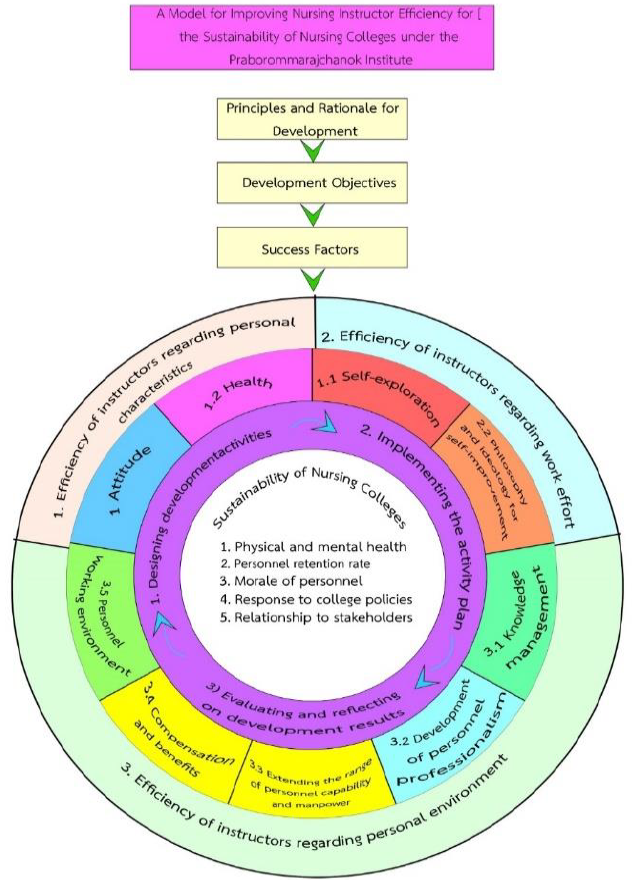
1. The competencies of nursing instructors affecting the sustainability were divided into 9 aspects, namely: a) health, b) attitude, c) self-evaluation, d) philosophy and ideology for self-development, e) knowledge management, f) development of personnel professionalism, g) capability and manpower of personnel, h) compensation and benefits, and i) personnel working environment.
2. The guidelines for developing the efficiency of nursing instructors were divided into three stages: designing development activities, implementing the activity plan, and evaluating and reflecting on the development outcome.
3. The model consisted of principles and rationale, objectives, success factors, components of instructor efficiency, development guidelines, and the sustainability of the colleges.
4. The appraisal of the model's suitability was at a high level (M=4.04, SD=0.70). The feasibility and benefits assessment was also at a high level (M=05, 4.40; SD=0.82, 0.47, respectively).
Administrators might arrange competitions and give awards for the development of nursing instructors’ efficiency as an incentive for continuous improvement.
References
Akarathitipong, J, (2013). Human Resource Development. Phra Nakhon Si Ayutthaya: Faculty of Management Science, Phranakhon Si Ayutthaya Rajabhat University, Ayutthaya.
Association of Professional Development Networks for Teachers and Higher Education Organizations of Thailand. (2023). Guide for Requesting Teacher Competency Assessments According to the Guidelines for Developing the Quality of Teachers to Promote the Achievement of Results Learning According to the Higher Education Qualification Standards 2023. Retrieved December 12, 2023 from https://www.thailandpod.org/doc/thailand_PSF/20Thailand-PSF.pdf
Certo, S. C. (2000). The Efficiency Development of Operation. Retrieved on June 11, 2020 from http://www.thailandindustry.com/onlinemag/view2.php?id=771§ion=17&issues=74
Chotimani, S. (2011). How to Manage Knowledge to be Effective in all Systems. Bangkok: National Productivity Institute. (in Thai)
Graham, C. R. (2013). Emerging practice and research in blended learning. In M. G. Moore (ED), Handbook of Distance Education (3rd ed.). New York: Routledge.
Higher Education Act 2019. (2019). Roles and Duties of Higher Education Institutions. Office of the Council of State, 7.
Keeves, P. J. (1988). Educational Research. (Methodology and Measurement: An International Handbook). Oxford: Pergamon Press.
Laksana, S. (2009). Development of Work Efficiency. (6th ed). Bangkok: Faculty of Management Science, Suan Sunandha Rajabhat University. (in Thai)
Mahaputt, C. (2016). Living by Sufficiency Economy Philosophy for Teachers. Chonburi: Chonburi Printing. (in Thai)
Ministry of Public Health. (2019). Strategic plan Ministry of Public Health fiscal year 2019 under the 20-year national strategic plan (public health). Nontaburi: Ministry of Public Health.
Nursing Council (2017). Report on the Results of The Quality Assessment of Education. Thailand Nursing and Midwifery Council. (in Thai)
Nursing Council Announcement, (2020). The regarding the guidelines for long-distance nursing (Tele-nursing). (2020, 27 November). Government Gazette, 138(33), 49-51. (in Thai)
Office of the State Economic and Social Development Committee. (2012). From the Philosophy of Sufficiency Economy to Practice for more than a Century. Bangkok: Daoluke Communication Co., Ltd.
Payutto, P. (2018). Sustainable Development, 21st Printing. Nakhon Pathom: KMUTT. (in Thai)
Pender, N. J. (1966). Health Promotion in Nursing Practice (3rd ed.). Norwalk: Connecticut: Appleton & Lange.
Permphol, K. (2009). Development of Work Efficiency. Bangkok: Boonsiri Printing Co., Ltd. (in Thai).
Praboromarajchanok Institute (2017). Human Resource Management. Nonthaburi: Praboromarajchanok Institute.
Rerkkham, S. (2018). Human Resource Development, Principles and Applications. Chiang Mai: Siam Printnana Co., Ltd. (in Thai)
Sattham, D. & Sriruecha, C. (2019). Organizational atmosphere and organizational support that affects performance according to quality criteria and primary care service performance of public health officers. Tambon Health Promoting Hospital Chaiyaphum Province. Journal of Public Health Research, Khon Kaen University, 12(1), 41-50. (in Thai)
Sriplang, T. (2013). The future of human resource work with the creation of business sustainability. Journal of HR intelligence, 8(1), 68-73. (in Thai)
Sustainable development goals. (2015). United Nations Sustainable Development. Retrieved November 25, 2015 from https://www.un.org/africarenewal/magazine/issue/december-2015
Thirawanatphong, P. & Boonprom, P. (2015). Development of teacher potential in higher education institutions. Academic Journal of Songkhla Rajabhat University, 8(1), 1-14. (in Thai)
Vroom, V. H. (1964). Work and Motivation. New York: John Wiley and Sons.
Yamane, T. (1970). Statistics: An Introductory Analysis (3rd ed.). New York: Harper and Row Publication.
Downloads
Published
Issue
Section
License
Copyright (c) 2023 The Southern College Network Journal of Nursing and Public Health

This work is licensed under a Creative Commons Attribution-NonCommercial-NoDerivatives 4.0 International License.
1. บทความหรือข้อคิดเห็นใด ๆ ที่ปรากฏในวารสารเครือข่าย วิทยาลัยพยาบาลและการสาธารณสุขภาคใต้ ที่เป็นวรรณกรรมของผู้เขียน บรรณาธิการหรือเครือข่ายวิทยาลัยพยาบาลและวิทยาลัยการสาธารณสุขภาคใต้ ไม่จำเป็นต้องเห็นด้วย
2. บทความที่ได้รับการตีพิมพ์ถือเป็นลิขสิทธิ์ของ วารสารเครือข่ายวิทยาลัยพยาบาลและการสาธารณสุขภาคใต้