Factors Influencing Risk Perceptions and Protective Behaviors of Cosmetic Product Use among High School Students: A Case Study from Songkhla Province
Keywords:
Cosmetic Products Use, High School Students, Predisposing Factors, Enabling Factors, Reinforcing Factors, Risk Protective BehaviorsAbstract
This predictive correlational research design aimed to determine the level of risk perceptions and protective behaviors towards cosmetic product use, and factors influencing risk protective behaviors of cosmetic product use among students from a big high school in Songkhla Province. Sample were 370 high school students, recruited by stratified sampling method.Instrument was a set of questionnaires, which were all tested for content validity by a panel of 3 experts, yielding IOC ranging from .67-1.00. Questionnaire of cosmetic product knowledge was tested for reliability by KR-20, yielding a value of .71. Other Questionnaires were tested for reliability by cronbach's alpha coefficient, yielding a value of between .71-.92. Data were analyzed using descriptive statistics, as well as stepwise multiple regression analysis. Research results were as follows.
1. Risk perceptions and protective behaviors towards cosmetic product use were at a moderate level (M=2.87, SD=0.31). Aspect of product brand selection had the highest mean score (M=3.08, SD=0.57), followed by aspect of loyalty to product brand (M=2.98, SD=0.54). Aspect of expensive product selection had the least mean score (M=2.68, SD=0.38).
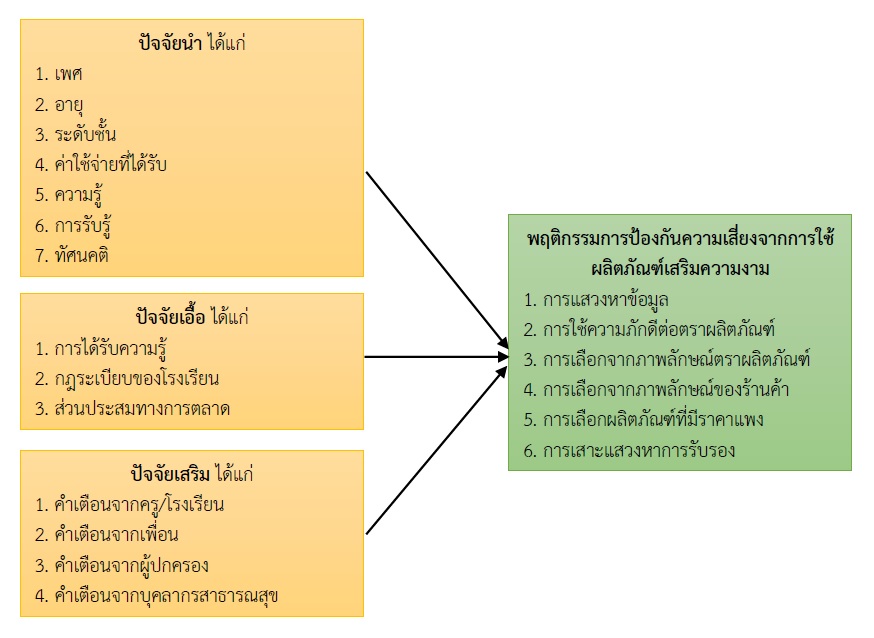
2. The most influential factor of risk perceptions and protective behaviors towards cosmetic product use was education on hazards or consequences of abusive cosmetic product use (Beta=.320), followed by general attitude towards cosmetic products (Beta=.244) and cosmetic product knowledge (Beta=.167). These 3 factors could together predict 25.80% (R2=.258, p<.001) of the behaviors.
Therefore, schools and community nurses should plan and develop a model to encourage students to gain knowledge, good attitude and appropriate risk perceprions and protective behaviors about cosmetic product use.
References
Aphisamacharayothin, P. (2017). Factors Effecting to Beauty Awareness and Unstandardized Cosmetic Used Hehaviors of Thai Women. Thaksin University Library Journal, 6, 194-216. (in Thai)
Chayasoontorn, U. (2015). Factors Influencing Cosmetic Purchasing Behavior of Female Students of Rajamangala University of Technology Rattanakosin, SalayaArea, Nakhon Pathom Province. Master of Business Administration (General Management). Dhonburi Rajabhat University. (in Thai)
Chotthitaporn, N., Klaewkla, J., & Sompopcharoen, M. (2019). Factors Affecting to Purchasing Decision on Dietary Supplement Products for Beauty through Internet among Professional Nurses. Thai Red Cross Nursing Journal, 12(2), 151-164. (in Thai)
Chumpoo, N. (2017). Media Exposure Behaviors and Word of Mouth of Health Products. Master of Arts. Thammasat University. (in Thai)
Food and Drug Administration. (2019). Guidelines for Cosmetic Advertising. Nonthaburi: Ministry of Public Health. (in Thai)
Food and Drug Administration. (2019). Information of the Center for Monitoring and Complaints of Health Supplements. Retrieved November 20, 2022 from https://www.fda.moph.go.th/sites/HPSC/SitePages/Result.aspx. (in Thai)
Green, L. W., & Kreuter, M. W. (2005). Health Program Planning: An Educational and Ecological Approach (4thed). New York: McGraw-Hill.
Hair, F. J., Black, C. W., Babin, J. B., & Anderson, E. R. (2019). Multivariate Data Analysis (7th ed). New Jersey: Pearson Education.
Jaidee, J. (2015). The Relationships among Female Consumers’ Knowedge, Perceived Risk and Buying Behaviors of The Skin Whitening Lotion Products. Master of Communication Arts. Burapha University. (in Thai)
Khieokhachee, S., & Surasondhi, K. (2017). Exposure to Information, Knowledge, and Preparation for Languages and Cultures toward ASEAN Community of Thai Adolescents in Bangkok. Journal of Mass Communication, 6(2), 123-148. (in Thai)
Klanruangsang, P., Sompopcharoen, M., & Aimyong, N. (2018). Decision Making About Skin Whitening Products among Undergraduate Student in Bangkok. KKU Research Journal (Graduate Study), 18(1), 13-23. (in Thai)
Kongwong, R., & Wattananamkul, V. (2011). A Study of “Harmful Cosmetics” Usage Behavior among Female Teenagers in Ubon Ratchathani Province. Isan Journal of Pharmaceutical Sciences, 7(1), 76-87. (in Thai)
Krejcie, R. V., & Morgan, D. W. (1970). Determining Sample Size for Research Activities. Educational and Phychological Measurement, 30(3), 607-610.
Kummabu, J., Sinsiri, J., Sangprasert, P., & Numkham, L. (2012). Community Health Nursing. Bangkok: Pim Suay Co., Ltd. (in Thai).
Muenprasertdee, S. (2014). Factors that Affect Consumer Behavior Based on Current Trends of Consumers in Bangkok Metropolitan Area. Master of Education degree in Business Administration. Bangkok University. (in Thai)
Nissawong, S. (2011). Behavior of Extravagance. Veridian E-Journal SU, 4(1), 275-293. (in Thai)
Onrak, R. (2021). A Teacher of One Large High School in Songkhla Province. Interview. (in Thai)
Pender, N. J., Murdaugh, C. L., & Parsons, M. A. (2006). Health Promotion in Nursing Practice. (4th ed). New Jersey: Pearson Education, Inc.
Ruangying, J., Jorajit, S., & Janyam, K. (2016). Food Consumption Behavior of Adolescents in Songkhla Province: Synthesis of Literacy and Factors Influencing Food Consumption Behavior. Journal of Liberal Arts, Prince of Songkla University, Hat Yai Campus, 8(1), 245-264. (in Thai)
Schiffman, L. G., & Kanuk, L. L. (2010). Cosumer Behavior (10th ed). New Jersey: Prentice Hall.
Silpcharu, T. (2017). Research and Statistical Data Analysis with SPASS and AMOS (17th ed). Bangkok: Business R & D. (in Thai)
Songklang, S., & Yangyuen, S. (2020). Correlations Between Social Environment Factors and Alcohol Use among Adolescents. The Southern College Network Journal of Nursing and Public Health, 7(1), 32-44. (in Thai)
Thiengkhamdee, N., Chantawong, C., & Homsin, P. (2015). Factors Influencing Work-Relation Prevention Behaviors of Garbage Collectors in Banglamung District Chonburi Province. Journal of Public Health Nursing, 29(1), 43-55. (in Thai)
Thongmeekhaun, T., Sateuw, S., & Paekaew, J. (2018). Correlation and Predictive Power of Risk Perception affecting Risk Protection Behaviors from Using Cosmetic Products among Nursing Students. Nursing Journal of the Ministry of Public, 28(2), 94-106. (in Thai)
Downloads
Published
Issue
Section
License
Copyright (c) 2023 The Southern College Network Journal of Nursing and Public Health

This work is licensed under a Creative Commons Attribution-NonCommercial-NoDerivatives 4.0 International License.
1. บทความหรือข้อคิดเห็นใด ๆ ที่ปรากฏในวารสารเครือข่าย วิทยาลัยพยาบาลและการสาธารณสุขภาคใต้ ที่เป็นวรรณกรรมของผู้เขียน บรรณาธิการหรือเครือข่ายวิทยาลัยพยาบาลและวิทยาลัยการสาธารณสุขภาคใต้ ไม่จำเป็นต้องเห็นด้วย
2. บทความที่ได้รับการตีพิมพ์ถือเป็นลิขสิทธิ์ของ วารสารเครือข่ายวิทยาลัยพยาบาลและการสาธารณสุขภาคใต้