การพัฒนาโปรแกรมกลุ่มการดูแลแบบเกื้อกูลบนพื้นฐานของวัฒนธรรมไทย สำหรับผู้สูงอายุสมองเสื่อมที่มีปัญหาพฤติกรรมและจิตใจ
คำสำคัญ:
การดูแลแบบเกื้อกูล, วัฒนธรรมไทย, ผู้สูงอายุสมองเสื่อมที่มีปัญหาพฤติกรรมและจิตใจบทคัดย่อ
งานวิจัยและพัฒนานี้เพื่อพัฒนาโปรแกรมกลุ่มการดูแลแบบเกื้อกูลบนพื้นฐานของวัฒนธรรมไทยสำหรับผู้สูงอายุสมองเสื่อมที่มีปัญหาพฤติกรรมและจิตใจ มี 3 ระยะ คือ ระยะที่ 1 ศึกษาความต้องการในการดูแลของผู้สูงอายุสมองเสื่อมที่มีปัญหาทางพฤติกรรมและจิตใจ กลุ่มตัวอย่าง คือ ผู้สูงอายุสมองเสื่อม ฯ และผู้ดูแลหลัก 5 ครอบครัว ผู้เชี่ยวชาญการดูแลผู้สูงอายุสมองเสื่อม 12 คน เก็บข้อมูลโดยการสนทนากลุ่ม และวิเคราะห์ข้อมูลด้วยการวิเคราะห์เนื้อหา ระยะที่ 2 พัฒนาโปรแกรมกลุ่มการดูแลแบบเกื้อกูลบนพื้นฐานของวัฒนธรรมไทยสำหรับผู้สูงอายุสมองเสื่อม ฯ และระยะที่ 3 ศึกษาประสิทธิผลของโปรแกรม ฯ กลุ่มตัวอย่าง คือผู้สูงอายุสมองเสื่อมฯ และผู้ดูแล จำนวน 64 ครอบครัว สุ่มเข้ากลุ่มทดลองและกลุ่มควบคุมกลุ่มละ 32 ครอบครัว เครื่องมือที่ใช้ในการเก็บรวบรวมข้อมูล คือ แบบวัดคุณภาพชีวิต วิเคราะห์ข้อมูล ด้วยสถิติ Paired t-test และ Independent t-test ผลการวิจัย พบว่า
1. ความต้องการในการดูแลของผู้สูงอายุสมองเสื่อม ประกอบด้วย 1) การส่งเสริมทักษะการดูแลตนเอง 2) การส่งเสริมการจัดการอารมณ์/ความเครียด 3) การส่งเสริมทักษะการสร้างสัมพันธภาพทางสังคม และ 4) การสนับสนุนส่งเสริมให้มีการจัดสิ่งแวดล้อมเพื่อการเยียวยา
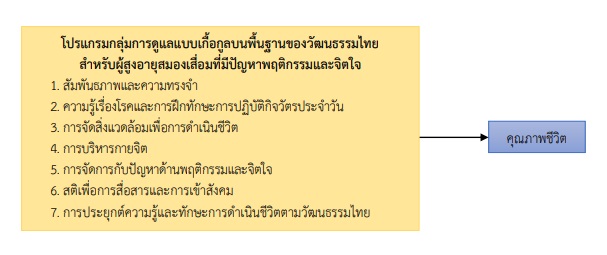
2. โปรแกรมกลุ่มการดูแลแบบเกื้อกูลบนพื้นฐานของวัฒนธรรมไทยสำหรับผู้สูงอายุสมองเสื่อม ฯ ประกอบด้วย 7 กิจกรรม ๆ ละ 60 - 90 นาที สัปดาห์ละ 1 ครั้ง ครั้งละ 2-3 กิจกรรม รวม 3 สัปดาห์ ดังนี้ 1) สัมพันธภาพและการฟื้นฟูความทรงจำ 2) ความรู้เรื่องโรคและการปฏิบัติกิจวัตรประจำวัน 3) การจัดสิ่งแวดล้อมเพื่อการดำเนินชีวิต 4) การบริหารกายจิต 5) การจัดการปัญหาพฤติกรรมและจิตใจในผู้สูงอายุสมองเสื่อม 6) สติเพื่อการสื่อสารและการเข้าสังคม และ 7) การประยุกต์ความรู้และทักษะการดำเนินชีวิตตามวัฒนธรรมไทย
3. ค่าเฉลี่ยคุณภาพชีวิตโดยรวม ภายหลังการเข้าร่วมโปรแกรมฯ 1 เดือน พบว่า กลุ่มทดลองสูงกว่ากลุ่มควบคุมอย่างมีนัยสำคัญทางสถิติที่ระดับ.01 (t=3.139; p=.002) และค่าเฉลี่ยคุณภาพชีวิตโดยรวมภายในกลุ่มทดลอง หลังเข้าร่วมโปรมแกรมฯ 1 เดือน สูงกว่า ก่อนเข้าร่วมร่วมโปรแกรมฯ อย่างมีนัยสำคัญทางสถิติที่ระดับ .001 (t=5.888; p<.001)
การเสริมสร้างคุณภาพชีวิตผู้สูงอายุสมองเสื่อมที่มีปัญหาทางพฤติกรรมและจิตใจ ควรเป็นการบำบัดแบบกลุ่มที่มีทั้งผู้ดูแลและผู้สูงอายุร่วมแลกเปลี่ยนประสบการณ์ และสอดคล้องกับวัฒนธรรมของผู้สูงอายุสมองเสื่อม ฯ
เอกสารอ้างอิง
Adlbrecht, L., Bartholomeyczik, S., Hildebrandt, C. & Mayer, H. (2021). Social Interactions of Persons with Dementia Living in Special Care Units in Long-Term Care: A Mixed-Methods Systematic Review. Dementia, 20(3), 967-984. http://doi: 10.1177/1471301220919937.
Baharudin, A. D., Din, N. C., Subramaniam, P. & Razali, R. (2019). The Associations Between Behavioral Psychological Symptoms of Dementia (BPSD) and Coping Strategy, Burden of Care and Personality Style among Low-Income Caregivers of Patients with Dementia. BMC Public Health, 19(Suppl 4), 447. http://doi.org/10.1186/s12889-019-6868-0.
Bandura, A. (1976). Social Learning Theory. Englewood Cliffs, NJ: Prentice Hall.
Barreto, P. D, Demougeot, L., Pillard, F., Lapeyre-Mestre, M. & Rolland, Y. (2015). Exercise Training for Managing Behavioral and Psychological Symptoms in People with Dementia: A Systematic Review and Meta-Analysis. Ageing Research Reviews, 24, 274–285. http://doi: 10.1016/j.arr.2015.09.001
Bernard, H. (2000). Social Research Methods: Qualitative and Quantitative ApproachesSage, Thousand Oaks.
Braun, A., Trivedi, D. P., Dickinson, A. Hamilton, L., Goodman, C., Gage, H., et al. (2019). Managing Behavioural and Psychological Symptoms in Community Dwelling Older People with Dementia: A Systematic Review of Qualitative Studies. Dementia, 18(7–8), 2950–2970. http://doi: 10.1177/1471301218762856.
Chaichumni, N. (2014). The Effect of a Thai Culturally-Based Mutual Support Program on Social Functioning of Persons with Schizophrenia. (Unpublished Doctoral Dissertation). Prince of Songkla University, Songkhla, Thailand. (in Thai)
Chapman, K. R., Tremont, G., Malloy, P. & Spitznagel, M. B. (2020). The Role of Sexual Disinhibition to Predict Caregiver Burden and Desire to Institutionalize among Family Dementia Caregivers. Journal of Geriatric Psychiatry and Neurology, 33(1), 42–51. http://doi: 10.1177/0891988719856688
Chien, W. T., Norman, I. & Thompson, D. R. (2006). Perceived Benefits and Difficulties Experienced in a Mutual Support Group for Family Carers of People with Schizophrenia. Qualitative Health Research, 16(7), 962-981.
Chien, W. T. & Norman, I. (2009). The Effectiveness and Active Ingredients of Mutual Support Groups for Family Caregivers of People with Psychotic Disorders: A literature Review. International Journal of Nursing Studies, 46, 1604-1623. http://doi: 10.1016/j. ijnurstu. 2009.04.003
Cohen, J. (1988). Statistical Power Analysis for the Behavioral Sciences. (2nd ed.). Hillsdale, NJ: Lawrence Erlbaum Associates, Publishers.
Douglass, C., Keddie, A., Brooker, D. & Surr, C. (2010). Cross-Cultural Comparison of the Perceptions and Experiences of Dementia Care Mapping "Mappers" in the United States and the United Kingdom. Journal of Aging and Health, 22(5), 567-588. http://doi:10.1177/0898264310362541
Feast, A., Orrell, M., Charlesworth, G, Melunsky, N., Poland, F. & Moniz-Cook, E. (2016). Behavioural and Psychological Symptoms in Dementia and the Challenges for Family Carers: Systematic Review. The British Journal of Psychiatry, 208, 429–434. http://doi: 10.1192/bjp.bp.114.153684
Forbes, D., Forbes, S. C, Blake, C. M., Thiessen, E. J. & Forbes, S. (2015). Exercise Programs for People with Dementia. Cochrane Database of Systematic Reviews, (4), CD006489. http://doi: 10.1002/14651858.CD006489.pub4.
Galinsky, M. J. & Schopler, J. H. (1995). Support Groups: Current Perspectives on Theory and Practice. New York, NY: Harworth Press.
Gitlin, L. N., Piersol, C. V., Hodgson, N., Marx, K., Roth, D. L., Johnson, D., et al. (2016). Reducing Neuropsychiatric Symptoms in Persons with Dementia and Associated Burden in Family Caregivers using Tailored Activities: Design and Methods of a Randomized Clinical Trial. Contemp Clin Trials, 49, 92–102. http://doi: 10.1016/j.cct.2016.06.006.
Hsu, T. J., Tsai, H. T., Hwang, A. C., Chen, L. Y. & Chen, L. K. (2017). Predictors of Non-Pharmacological Intervention Effect on Cognitive Function and Behavioral and Psychological Symptoms of Older People with Dementia. Geriatrics & Gerontology International, 17(Suppl 1), 28-35. http://doi: 10.1111/ggi.13037. PMID: 28436192.
Kerpershoek, L., de Vugt, M., Wolfs, C., Woods, B., Jelley, H., Orrell, M., et al. (2018). Needs and Quality of Life of People with Middle-Stage Dementia and Their Family Carers from the European Act if Care Study. When Informal Care Alone May Not Suffice. Aging & Mental Health, 22(7), 897-902. https://doi.org/10.1080/13607863.2017.1390732.
Livingston, G., Johnston, K., Katona, C., Paton, J. & Lyketsos, C. G. (2005). Systematic Review of Psychological Approaches to the Management of Neuropsychiatric Symptoms of Dementia. American Journal of Psychiatry, 162, 1996–2021.
Macleod, S. H., Elliott, L. & Brown, R. (2011). What Support can Community Mental Health Nurses Deliver to Carers of People Diagnosed with Schizophrenia? Findings from a Review of the literature. International Journal of Nursing Studies, 48(2011) 100–120. http://doi: 10.1016/j.ijnurstu.2010.09.005
Mahatnirunkul, S., Tantipiwattanaskul, W., Wongsuwan, K., & Prommanajirangkul, W. (1998). Comparison of the WHOQOL-100 and the WHOQOL-BREF (26items). Journal of Mental Health Thailand, 5, 4-15. (In Thai)
O'Dwyer, S. T., Moyle, W., Zimmer-Gembeck, M. & De Leo, D. (2016). Suicidal Ideation in Family Carers of People with Dementia. Aging and Mental Health, 20(2), 222-230. http://doi: 10.1080/13607863.2015.1063109.
Pijl-Zieber, E. M., Awosoga, O., Spenceley, S., Hagen, B., Hall, B. & Lapins, J. (2018). Caring in the Wake of the Rising Tide: Moral Distress in Residential Nursing Care of People Living with Dementia. Dementia, 0(0), 1–22. http://doi: 10.1177/1471301216645214
Phothisita, C. (2011). The Science and Art of Quality Study. (5th ed.). Bangkok: Amarin Print and Blushing. (In Thai)
Quinn, C., Clare, L. & Woods, R. T. (2015). Balancing Needs: The Role of Motivations, Meanings and Relationship Dynamics in the Experience of Informal Caregivers of People with Dementia. Dementia, 14(2), 220-237. http://doi. org/10.1177/1471301213495863
Schoenmakers, B., Buntinx, F. & DeLepeleire, J. (2010). Supporting the Dementia Family Caregiver: The Effect of Home Care Intervention on General Well-Being. Aging and Mental Health, 14, 44–56. http://doi: 10.1080/13607860902845533.
Sopina, E., Sorensen, J., Beyer, N., Hasselbalch, S. G. & Waldemar, G. (2017). Cost Effectiveness of a Randomized Trial of Physical Activity in Alzheimer's Disease: A Secondary Analysis Exploring Patient and Proxy-Reported Health-Related Quality of Life Measures in Denmark. BMJ Open, 7(6), e015217. http://doi: 10.1136/ bmjopen-2016-015217.
Yoddanan-Attigg, B. & Tangchonlatip, K. (2009). Qualitative Data Analysis: Recording Information, Interpreting and Finding Meaning. Bangkok: Chino. (In Thai)
Wilson, J. (1995). How to Work with Self-Help Group: Guidelines for Professionals’ Arena. Alder Shot, Hants: United State of Kingdom, England.
World Health Organization. (2017). Global Action Plan on the Public Health Response to Dementia 2017 – 2025, WHO Document Production Services, Geneva, Switzerland. Retrieved September 25, 2021, from https://apps.who.int/iris/bitstream/handle/10665/259615/9789241513487-eng.pdf
World Health Organization. (2021). Dementia: Fact Sheet. Retrieved September 25, 2021, from https://www.who.int/en/news-room/fact-sheets/detail/dementia.
ดาวน์โหลด
เผยแพร่แล้ว
ฉบับ
ประเภทบทความ
สัญญาอนุญาต
ลิขสิทธิ์ (c) 2022 วารสารเครือข่ายวิทยาลัยพยาบาลและการสาธารณสุขภาคใต้

อนุญาตภายใต้เงื่อนไข Creative Commons Attribution-NonCommercial-NoDerivatives 4.0 International License.
1. บทความหรือข้อคิดเห็นใด ๆ ที่ปรากฏในวารสารเครือข่าย วิทยาลัยพยาบาลและการสาธารณสุขภาคใต้ ที่เป็นวรรณกรรมของผู้เขียน บรรณาธิการหรือเครือข่ายวิทยาลัยพยาบาลและวิทยาลัยการสาธารณสุขภาคใต้ ไม่จำเป็นต้องเห็นด้วย
2. บทความที่ได้รับการตีพิมพ์ถือเป็นลิขสิทธิ์ของ วารสารเครือข่ายวิทยาลัยพยาบาลและการสาธารณสุขภาคใต้