The The Effectiveness of Storytelling to Enhance the Development of the Executive Function (EF) in Preschool-Aged Children: A Meta-Analysis
Keywords:
Executive Function, EF, Preschool-Aged Children, StorytellingAbstract
The aim of this meta-analysis research was to evaluate the effectiveness of storytelling on the development of preschool-aged children's executive function (EF). Many studies, published between 2011 and 2021, were reviewed. And so were deriving research from electronic databases: PubMed, CINAHL, Scopus, ScienceDirect, Clinical key, Thai Jo, Thai list, and manual queries. The tools used included: 1) Prisma gridline, 2) inclusion & exclusion criteria (PICO), 3) Critical Appraisal Checklist, 4) JBI data extraction tool, and 5) software for meta-analysis. Accordingly, with the data extraction and critical appraisal of research, two researchers worked independently from each other, prior to discussing the conclusions. Inconclusive data were assessed by a third researcher, for a critical appraisal of evidence, using the concept of meta-analysis from the Joanna Briggs Institute (JBI SUMARI software), notably by using the standardized mean difference.
All research reports were quantitative research (n=8). The key point of this study was storytelling which provided a passionate and productive experience in improving the brain skills of preschoolers. Results consisted of three forms:
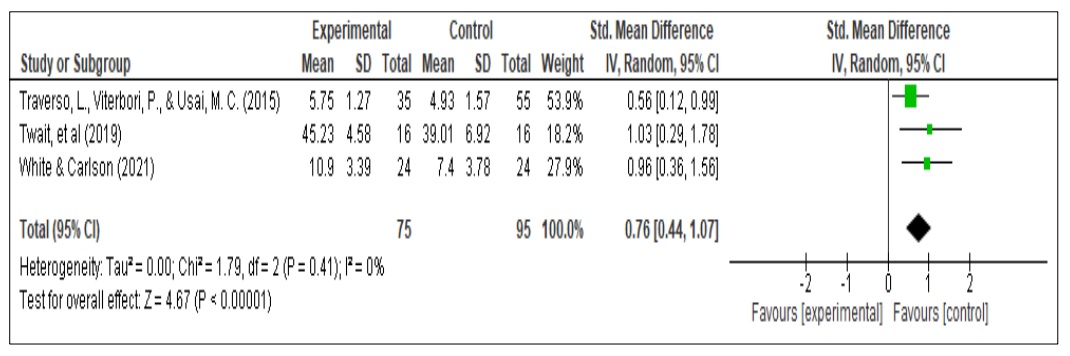
1. assessment patterns based on observations of children's behavior while they are active (odds ratio of 0.76; 95%; confidence Interval (CI) between 0.44-1.07; P< 0.00001),
2. assessment models from parents’ or class teachers’ inquiries divided into two main areas: a) assessing brain skills development in administrative thinking (Odd ratio 1.42; 95% Confidence Interval (CI) 0.99-1.86; P<0.00001 and b) assessing brain impairment (odds ratio of 1.80 (95%), and confidence interval (CI) between 2.32-1.28 (P<0.00001), and finally,
3. brain evaluation models with brain wave evaluation. The overall conclusion of this study found that the storytelling process is characterized by the fact that there is two-way communication between the narrators and the listeners, the insertion of good morals, and, the duration of the activity ranges from 5 to 24 weeks.
This research can be used to encourage children to listen to stories that reinforce executive thinking. Each narrative should have a sequence of steps, stimulating learning and motivating using devices that interest the child.
References
Artsiri, S., Vanno, V., (2018). Effect of Sequential Storytelling Program on Executive Functions of Preschoolers. Serial on the Psychology & the Behavioral Sciences, 18-21. Retrieved July 25, 2021, from: http://papers.iafor.org/ wpcontent. (in Thai).
Bureau of Reproductive Health Department of Health. (2020). Statistics of Teenage Mothers: 2020. Retrieved May 1, 2021, from https://rh.anamai.moph.go.th/th/home?language=th.
Center on the Developing Child. (2018). Building the Brain’s “Air Traffic Control” System: How Early Experiences Shape the Development of Executive Function. Working Paper 11. Retrieved May 1, 2020, from http://www.developingchild.harvard.edu.
Chukleing, K., Petsate, T., & Khwunma, K (2019). The Development of Executive Function For Preschool Children Through Stem Education Learning Experience Provision on Local Thai Dessert 4 Region Cooking Activities Bachelor of Education Program in Early Childhood, Suan dusit University. (in Thai)
Department of Health Ministry of Public Health. (2018). Annual Performance Report 2018. Retrieved July 25, 2021, from http://hp.anamai.moph.go.th/event
Dheeraluk, N., Juthamas, H., & Warakorn, S., (2018). The Effects of Storytelling Based on the Royal Guidance of King Rama XI Program on Executive Functions of the Brain in Early Childhood. Journal of Educational Measurement, 24(2), 62-78.
Diamond, A., & Lee, K. (2011). Interventions Shown to Aid Executive Function Development in Children 4 to 12 Years Old. Science New York, 333(6045), 959-964. doi.org/10.1126/science.1204529
Diamond, A., (2012). Activities and Programs That Improve Children’s Executive Functions. Association For Psychological Science, 21, 335-341.
Esterhuizen, S. (2014). Improving Some Cognitive Functions, Specifically Executive Functions in Grade R Learners. South African Journal of Childhood Education, 4(1), 178-181
Jinnatanapong, D., Chumchua, V., Chutabhakdikul, N., & Thanasetkorn, P., (2015). The Impact of the 101s Storybook Intervention Program on Executive Function, The 101s Social-Emotional Skills, and School Achievement in Preschoolers. [serial on the Internet]. 2015 [cited 2019 NOV 13]. Retrieved from: http://papers.iafor.org/wpcontent/uploads/papers/acp2015/ACP2015_11414.pdf.(in Thai).
Lockwood, C., Porrit, K., Munn, Z., Rittenmeyer, L., Salmond, S., Bjerrum, M., et al. (2017). Joanna Briggs Institute Reviewer's Manual The Joanna Briggs Institute. Retrieved May 1, 2020, Retrieved from https://reviewersmanual.joannabriggs.org
Mektrairat, W., & Chaiwanna, S. (2020). The Effects of the 3R Process of Reading Activity Packages by the Parents to Enhance the Executive Function of Early Childhood, Thailand. Thailand. Psychology Research and Behavior Management, 14(3), 134-147.
Moher, D., Altman, D. G., Liberati, A., & Tetzlaff, J. (2011). Prisma Statement. Epidemiology, 22(1), 128. https://doi.org/10.1097/ede.0b013e3181fe7825
National Electronics and Computer Technology Center (NECTEC). (2020). “Internet Usage in Thailand.” Retrieved January 4, 2019, from: http://internet. nectec.or.th/webstats/internetuser.iir?Sec= internetuser.
Phapol, K. (2020). Research The Activities Arrangement Shadow Puppets Tales That Affect Executive Function for Early Childhood. Journal of Educational Studies, 14(1), 100-113. (Thailand)
Solemani, H., & Akbari, M. (2013). The Effects of Storytelling on Children is Learning English Vocabulary: A Case in Iran. International Research Journal of Applied and Basic Sciences, 5(1), 104-113.
Thibodeau, R. B., Gilpin, A. T., Brown, M. M., & Meyer, B. A. (2016). The Effects of Fantastical Pretend-Play on the Development of Executive Functions: An Intervention Study. Journal of Experimental Child Psychology, 10(1), 120-138.
Toncharoen, R., Junson, J., & Boontaisong, K. (2021). Executive Functions Development of Kindergarten Students at Bansomdejchaopraya Rajabhat University Demonstration School (Early Childhood) Learning Through Storytelling Activities, Rhythmic Movement Activities and Creative Art Activities, Thailand. Journal of Research and Development Institute, 6(2), 163–177.
Traverso, L., Viterbori, P., & Usai, M. C. (2015). Improving Executive Function in Childhood: Evaluation of a Training Intervention for 5-Year-Old Children. Frontiers in Psychology, 6, 525. https://doi:10.3389/fpsyg.2015.00525
Twait, E., Farah, R., Shamir, N., & Horowitz-Kraus, T. (2019). Dialogic reading vs Screen Exposure Intervention is Related to Increased Cognitive Control in Preschool-Age Children. Acta Paediatrica, 108(11), 1993–2000. Retrieved from https://doi.org/10.1111/apa.14841
White, R. E., & Carlson, S. M. (2021). Pretending with Realistic and Fantastical Stories Facilitates Executive Function in 3-Year-Old Children. Journal of Experimental Child Psychology, 207, 105090. Retrieved from https://doi.org/10.1016/j.jecp.2021.105090 N2
World Health Organization. (2019). WHO Releases New International Classification. Retrieved from www.WHO. .int/social_determinants/ sdh_definition/en. /18-07-2020
Downloads
Published
Issue
Section
License
Copyright (c) 2022 The Southern College Network Journal of Nursing and Public Health

This work is licensed under a Creative Commons Attribution-NonCommercial-NoDerivatives 4.0 International License.
1. บทความหรือข้อคิดเห็นใด ๆ ที่ปรากฏในวารสารเครือข่าย วิทยาลัยพยาบาลและการสาธารณสุขภาคใต้ ที่เป็นวรรณกรรมของผู้เขียน บรรณาธิการหรือเครือข่ายวิทยาลัยพยาบาลและวิทยาลัยการสาธารณสุขภาคใต้ ไม่จำเป็นต้องเห็นด้วย
2. บทความที่ได้รับการตีพิมพ์ถือเป็นลิขสิทธิ์ของ วารสารเครือข่ายวิทยาลัยพยาบาลและการสาธารณสุขภาคใต้