Development of Blended Learning in Medical Coding III Course for Students in Diploma Medical Record Science
Keywords:
Instructional Design, Blended Learning, Medical Coding CourseAbstract
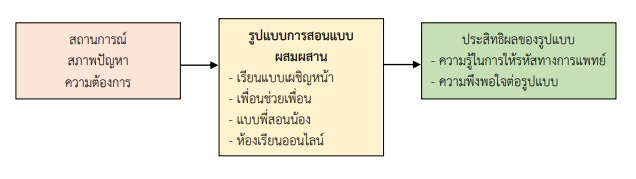
This research and development study aimed to analyze situations, problems, and needs prior to developing a blended learning model, and evaluating its effectiveness in the medical coding III course for the medical record diploma. The study was divided into 3 steps: 1) analyze the situations, problems, and needs for teaching the medical code III course, 2) develop a blended learning model and have it verified by 3 experts, 3) evaluate the effectiveness of the blended learning medical code III on 207 students (100 students in the control group and 107 in experimental group). The research tools were a knowledge quiz and a satisfaction assessment form, with a content validity of .67 -1.00, KR-20 reliability of 0.90, and a Cronbach’s alpha coefficient of 0.84. The data were analyzed using descriptive statistics and independent t-test. The results were as follows.
1. Teaching and learning situations were theoretical-based lectures on the medical code handbook (ICD-10), practice on clinical coding from case studies, and quizzes in each chapter. The students were not interested in the subject. In addition, there were many students in the class which led to difficulties for students to access teachers.
2. Blended learning model in the medical coding III course consisted of face-to-face learning, peer-assisted learning, peer teaching method, and Google classroom.
3. After using the blended learning model in medical coding III course, the student’s knowledge was higher (M=57.08, SD=8.14) than before (M=44.52, SD=6.98) significantly (p<.001). In addition, satisfaction on blended learning was at the highest level (M=4.50, SD=0.21).
The developed blended learning model might be applied and adapted according to subjects and learners.
References
Bonk, C. J., & Graham, C. R. (2004). Handbook of Blended Learning: Global Perspectives, San Francisco, CA: Pfeiffer Publishing.
Chitrakorn, A. (2019). Development of Collaborative Blended Learning Using Future Problem Solving Techniques to Promote Creativity in Graphic Design on Instructional Media of Pre-service Teacher Students, Silpakorn University. Silpakorn University Journal, 37(1), 23-42. (in Thai)
Hair, F. J., Black, C. W., Babin, J. B., & Anderson, E. R. (2019). Multivariate Data Analysis. (7th ed). New Jersey: Pearson Education.
Hongsamad, Y. & Limtasiri, O. (2021). The Comparison of Academic Achievement and Satisfaction on Solution topic of Mathayomsuksa 2 Students Between the Online Learning by Google Classroom and Traditional Method. Faculty of Education, Ramkhamhaeng University. Journal of Educational Innovation and Research, 5(2), 355-370. (in Thai)
Kachapai, M., Onming, R., Pradubwate, R., & Wongyounoi, S. (2015). The Development of A Blended Instruction Model to Enhancing Knowledge and Competencies on Educational Invovation and Information Technology for Bachelor of Education Students Srinakharinwirot University. Social Sciences Research and Academic Journal, 29(1), 71-86. (in Thai)
Khlaisri, P. (2017). Development of the Instructional Model using Blended Learning and Metacognition for Faculty of Education Students in Rajabhat University in the Northeastern. Doctoral Dissertation in Curriculum and Instruction, Department of Curriculum and Instruction Collage of Education Sciences, Dhurakij Pundit University. (in Thai)
Medical Record Department. (2020). Diploma of Medical Record (Revised in 2018). Nonthaburi. Kanchanabhishek Institute of Medical and Public Health Technology. (in Thai)
Muangkaew, R., Sutthirat, C., & Panawong, C. (2019). The Development of Blended Learning Instructional Model Based on Research-Based Learning Approach to Enhance Research Competency of Nursing Students. Journal of Health and Nursing Education, 22(2), 74-92. (in Thai)
National Gazette. (2013). Announcement of the Ministry of Education on the National Vocational Education Qualifications Framework, 2513. 130. (2013, February 18). (in Thai)
Saaikhwa, B., Boonthum, P. & Jaisanid, P. (2017). Developing Ethnic Students’s English Speaking Skills Through the Use of Peer-Assisted Learning Activities. Graduate school Journal Chiang Rai Rajabhat University, 10(3), 77-86. (in Thai)
Sengsri, S. (2013). Practice of Educational Research and Development Acquisition by Students Teaching Students Activity. Journal of Education Naresuan University, 13(2), 128–137. (in Thai)
Strategy and Planning Division, Office of the Permanent Secretary. (2016). 20-Year National Strategic Plan on Public Health. Nontaburi. Ministry of Public Health. (in Thai)
Sukiem, P. (2012). The Result of Blended Learning a Topic of Civisim for Prathomsuksa 5 Students. Master degree in Educational Technology and Communications, Faculty of Teachnical Education Rajamangala University of Technology Thanyaburi. (in Thai)
Sukkasem, S., Sittiwong, T., & Jiravarapong, B. (2019). Development of Blended Learning Model in Introduction to Computer Information Science Course for Undergraduate Students. Journal of Education Naresuan University, 21(4), 317-328. (in Thai)
Wongsinudom, P., & Autthawuttikul, S. (2016). The Development of Tutorial Application on Tablet with Peer-to-Peer Learning Affecting Learning Together of the Third Grade Students in Petchaburi. Veridian E-Journal, Silpakorn University, 9(3), 588-601.
Yimyam, S., Charuwatcharapaniskul, U., Chareonsanti, J., Indarangkura Na Ayutthaya, A., Xuto, P., & Chaloumsuk, N. (2017). Developing on Blended Learning for Developing the 21st Century Learning Skill. Nursing Journal, 42(Special Edition), 129-140. (in Thai)
Downloads
Published
Issue
Section
License
Copyright (c) 2022 The Southern College Network Journal of Nursing and Public Health

This work is licensed under a Creative Commons Attribution-NonCommercial-NoDerivatives 4.0 International License.
1. บทความหรือข้อคิดเห็นใด ๆ ที่ปรากฏในวารสารเครือข่าย วิทยาลัยพยาบาลและการสาธารณสุขภาคใต้ ที่เป็นวรรณกรรมของผู้เขียน บรรณาธิการหรือเครือข่ายวิทยาลัยพยาบาลและวิทยาลัยการสาธารณสุขภาคใต้ ไม่จำเป็นต้องเห็นด้วย
2. บทความที่ได้รับการตีพิมพ์ถือเป็นลิขสิทธิ์ของ วารสารเครือข่ายวิทยาลัยพยาบาลและการสาธารณสุขภาคใต้