Student Nurses Experiences in Gerontology Nursing Practicum by Integrating Teaching and Learning with Academic Services
Keywords:
Experience, Junior Nursing Students, Service-Based LearningAbstract
This qualitative research aimed to explore experiences of nursing students with integrated service-based learning in gerontological nursing course. The participants were 40 third year nursing students enrolled in a three-week gerontological nursing practicum. Focus group discussions, in-depth interviews, and reflection record were conducted at two weeks after course completion.
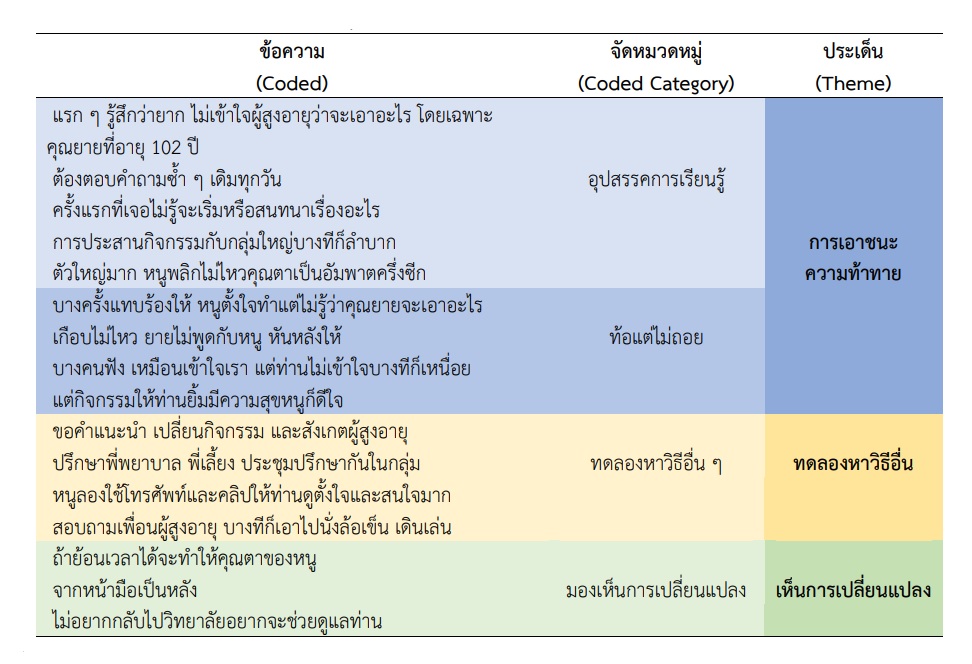
A thematic was performed. Three themes represented nursing students’ experiences with integrated service-based learning: overcoming the challenges, exploring alternatives, and transforming oneself towards better care of the older persons.
We recommend integrated service-based learning using active learning and diverse activities to transform students’ experiences.
References
Belarmino, J. A. & Bahle-Lampe A. (2019). A Preliminary Historical Report on Embracing Online Education in Occupational Therapy. Open Journal of Occupational Therapy (OJOT), 7(3), 1.
Bubnys, R. (2019). A Journey of Self-Reflection in Students’ Perception of Practice and Roles in the Profession. Sustainability, 11(194), 1-17.
Burgh, G. & Nichols, K. (2012). The Parallels Between Philosophical and Scientific Inquiry: Implication for Science Education. Educational Philosophy and Theory, 44(10), 1045-1059.
Center for Community-Engaged Learning, University of Minnesota. (2011). Benefit of Service Learning. Retrieved November 10, 2020 from http://ccel-app.umn.edu/info/benefits.html
Creswell, W. J. (2012). Educational Research Planning, Conducting, and Evaluating Quantitative and Qualitative Research. Fourth ed, Boston: Peason.
Jeong, S. & McMillan, M. (2015). Work Integrated Learning (WIL): Integrating Frameworks for Education and Practice. Journal of Problem-Based Learning, 2(1), 1-10
Kanyaprasit, K. (2015). The Main Characteristics of the Search for Knowledge. (5 Essential feature of inquiry). Retrieved June 10, 2021 from http://sciedcenter.swu.ac.th/Portals/25/Documents/News/5Essentialfeaturesofinquiry_Kamonwan.pdf?timestamp=1434440007462. (in Thai).
Maneewan, K., Thin-uan, P., Lorga, T. & Intharacha, W. (2017). Contract Inquiry and Activity-Based Learning (CIA Learning) In Activity-Based Learning Course. ANPOR Annual Conference, 127-136.
Nijanet. C. (2015) Learning Through Social Service: an Alternative to Serving Society. of the University. Surat Thani Rajabhat Journal, 5(1), 1-32. (in Thai).
Parmelee, D., Michaelsen, K. L., Cook, S. & Hudes. D. P. (2012). Team-Based Learning: A Practical Guide: AMEE Guide No. 65. Medical Teacher, 34: e275–e287.
Pittard, B. (2010). Teaching Style Using Inquiry-Based Learning on Legal Matters Related to the Practice of Nursing Profession. Journal of Nursing, Ministry of Public Health, 25(2), 116-129. (in Thai).
Riessman, C. K. (2005). Narrative Analysis. In: Narrative, Memory & Everyday Life. University of Huddersfield, Huddersfield, 1-7.
Robinder, E. K. (2012). Service Learning as Civic Pedagogy: A Narrative Inquiry Exploring the Community College Student Experience. A Dissertation Submitted in Partial Fulfillment of the Requirement for the Doctor of Philosophy, Colorado State University Fort Collins, Colorado
Sastrapruek, S. (2017). Teaching and Learning Management in the 21st Century with a Reverse Classroom Model for Improve Learning and Innovation Skills service. journal Prince of Songkla University 28(1), 100-108. (in Thai).
Sirisupalak, P. (2013). Teaching Nursing Students to Develop Critical Thinking Skills. Journal of Boromarajonani College of Nursing, Nakhon Ratchasima, 19(2), 5-19. (in Thai).
Wiriyawit, N. (2018). Service Learning: An alternative for University Engagement. Surat Thani Rajabhat Journal, 5(1), 1-32. (in Thai).
Downloads
Published
Issue
Section
License
Copyright (c) 2022 The Southern College Network Journal of Nursing and Public Health

This work is licensed under a Creative Commons Attribution-NonCommercial-NoDerivatives 4.0 International License.
1. บทความหรือข้อคิดเห็นใด ๆ ที่ปรากฏในวารสารเครือข่าย วิทยาลัยพยาบาลและการสาธารณสุขภาคใต้ ที่เป็นวรรณกรรมของผู้เขียน บรรณาธิการหรือเครือข่ายวิทยาลัยพยาบาลและวิทยาลัยการสาธารณสุขภาคใต้ ไม่จำเป็นต้องเห็นด้วย
2. บทความที่ได้รับการตีพิมพ์ถือเป็นลิขสิทธิ์ของ วารสารเครือข่ายวิทยาลัยพยาบาลและการสาธารณสุขภาคใต้