Dengue Hemorrhagic Fever Prevention and Control: New and Efficient Strategies Applied in Four Districts of Eastern Tak Province
Keywords:
Strategy, DHF, Prevention, Control, Dengue Hemorrhagic FeverAbstract
This mixed methods research aimed to study the health behaviors of people in their prevention activities for control of dengue hemorrhagic fever (DHF), it is to say: conditions, efficiency, and factors related for prevention and control of DHF, as well as developing and evaluating the efficiency strategies for prevention and control of DHF.
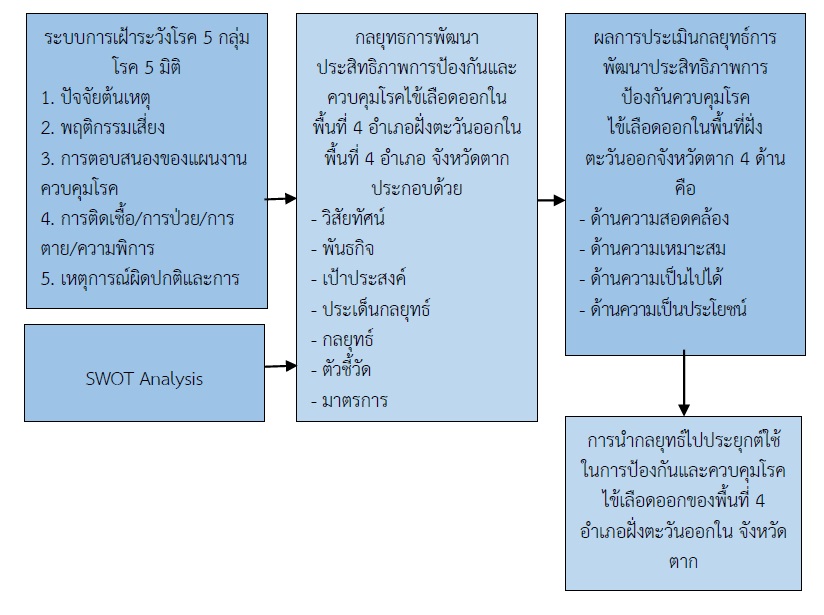
The study was divided in three phases. First phase consisted in collecting data by studying documentation as well as by focus group discussions and a questionnaire on efficiency, factors related for prevention, and general conditions in control of DHF. The second phase was dedicated to workshops for developing strategies in the prevention and control of DHF in four of eastern districts in Tak Province. Last phase was having the strategies evaluated by 19 experts so to assess their consistency, suitability, feasibility and utility. The data were analyzed by using percentage, standard deviation and content analysis. The findings showed as follows.
1. The people’s health behaviors for control and prevention of DHF consisted of survey the larva, destroy mosquito breeding site, but lacking of continuity put them at risk. People lacked of awareness in eliminating larva and mosquito breeding sites. They perceived that the DHF prevention and control was the duty of public health officials and village health volunteers.
2. The significant strategies developed to solve the problems were as follows: 1) increasing the competency of personnel in proactive dengue fever prevention and control work, 2) adjusting the resource availability management mechanism for dengue fever prevention and control according to the criteria and performance indicators, 3) developing management systems and mechanisms for disease surveillance and prevention of dengue fever through a quality cycle, 4) modifying the monitoring, inspection, and evaluation system in managing dengue fever through a visual information system, and 5) strengthening the coordination mechanisms in the management of dengue fever.
3. The strategies implemented for developing the effectiveness of DHF prevention and control were consistent, appropriate, feasible, and useful at the highest level.
Participatory action research and a study on the results of using this strategy should be conducted to develop further strategies.
References
Chadthong, K., ChooChom, O., Pakbongkoch, C. & Soadmanee, O., (2011). The Development of a Dengue Hemorrhagic Fever Prevention Model in Nacha-Ung Community, Chumphon Province, Thailand. Journal of Behavioral Science, 17(1), 79-92. (in Thai)
Chokekerd, P., (2018). Strategic Implementation of Dengue Hemorrhagic Fever Prevention and Control by Multisectoral Participation in Chiang Mai Province. Journal of Preventive Medicine Association of Thailand, 8(2), 326-338. (in Thai)
Chumpu, S., Khamsemanan, N. & Nattee, C. (2019). The Association Between Dengue Incident and Provincial-Level Weather Variables in Thailand from 2001 to 2014. PLos ONE, 14(12), 1-27.
Cronbach, L. J. (1951). Coefficient Alpha and the Internal Structure of Tests. Psychometrika, 16, 297-334.
Department of Disease Control. (2015). Manual of Dengue Hemorrhagic Fever Academic for Medical and Public Health. Aksorn Graphic and Design Publishing Limited Partnership. Bangkok. (in Thai)
Department of Disease Control. (2018). Dengue Hemorrhagic Fever Forecast Report. Department of Disease Control. Nonthaburi. (in Thai)
Department of Disease Control. (2022). Dengue Prognosis Report 2019. Retrieved from https://www.pidst.or.th/A1271.
Jaipakdee, B. (2010). The Effect of Prevention and Control of Dengue Hemorrhagic Fever of Sub-District Health Center in Ubon Ratchathani Province. Master of Public Health. Ubon Ratchathani Rajaphat University. (in Thai)
Krejcie, R. V. & Morgan, E. W. (1970). Determining Sample Size for Research Activities. Educational and Psychological Measurement, 30, 608-609.
Meenaphan, H. (2007). Principle on Project Evaluation: Theory and Procedure on Project Feasibility. Chulalongkorn University Press. Bangkok. (in Thai).
Naknoi, W., Chaowakeeratipong, T. & Polprasert, P. (2016). The Development of Management Strategies for Tambon Health Promoting Hospitals, Tak Province. Journal of Education Naresuan University, 18(2), 106-117. (in Thai)
Pan American Health Organization. (2018). Integrated Management Strategy for Dengue Prevention and Control in the Region of the Americas. PAHO, Washington, D.C.
Phonprasert, W. (2011). Concepts of Strategic Management in Strategic Management in Hospital Administration. Sukhothai Thammathirat Open University. Nonthaburi. (in Thai).
Phromsunkkhaha, B. (2019). Factors Prediction Dengue Hemorrhagic Fever Prevention and Control Behavior among People in Ban-Thakwai Health Promotiong Hospital, Khaochaison District, Phatthalung Province. Journal of Health Science Thaksin University, 1(1), 23-31. (in Thai)
Ponrachom, C., Sriboonthip, N. & Wangkahart, A. (2018). Casual Factors of Dengue Hemorrhagic Fever Protection Behaviors of People Living at the Frontier of Thailand and Republic of Union of Myanmar: Qualitative Research. Phetchabun Rajabhat Journal, 20(1), 46-55. (in Thai)
Rakhmani, A. N., Limpanont, Y., Kaewkungwal, J. & Okanurak, K. (2018). Factors Associated with Dengue Prevention Behaviour in Lowokwaru, Malang, Indonesia: a Cross-Sectional Study. BMC Public Health, 18, 619.
Rather, I. A., Parray, H. A., Lone J. B, Paek W. K., Lim, J., Bajpai, V. K. & Park, Y. H. (2017). Prevention and Control Strategies to Counter Dengue Virus Infection. Front Cell Infect Microbiol, (25), 1-8.
Sayavong, C., Chompikul J., Wongsawass S. & Rattanapan C., (2015). Knowledge, Attitudes and Preventive Behaviors Related to Dengue Vector Breeding Control Measures among Adults in Communities of Vientiane, Capital of the Lao PDR. J Infect Public Health, 8(5), 466-73.
Seesaad, B. (1995). Satatistics of Research (2nd ed.) Bankok: Suwiriyasan. (in Thai)
Sombutsavat, R. (2017). The Appication of Indigenous Knowledge To Prevent Dengue Hemorrhagic Fever by Community Networks in Northeastern Thailand. Journal of MCU Social Science Review, 6(2), 117-128. (in Thai).
Sripetchwandee, N., Jongrungrotsakul, W. & Klongpanich, S. (2017). Lesson Learned from Healthy Public Policy: The case study of Control and Prevention of Dengue Hemorrhagic Fever Through Community Participation. Nursing Journal, S(1), 117-127. (in Thai)
Tidthian, U., Patcharanarumol, W., Thidthian, W., Panichkriagkrai, W., Ardkhien, W., Daengsa-ard, E. & Thougbu, T. (2017). Roles of Surveillance and Rapid Response Team (SRRT) for Initial Dengue Fever control: A case study in the 2nd Health region. Journal of Health Science, 26(1), S54-S63. (in Thai).
Viennet, E., Ritchie, E. S., Williams, C. R., Faddy, H. M. & Harley, D. (2016). Public Health Responses to and Challenges for the Control of Dengue Transmission in High-Income Countries: Four Case Studies. PLos Neg Trop Dis, 10(9), 1-33.
Wongsasul, N., Peanchana, A. & Akakul, T. (2016). A Development of the Dengue Hemorrhagic Fever Preventive Model in the Communities of Tambon Kumnumsaep in Ubon Ratchathani’s Warinchamrap District. UBRU Journal for Public Health Research, 5(1), 41-52. (in Thai)
World Health Organization. (2008). Framework for Implementing Integrated Vector Management (IVM) at District Level in the South-East Asia Region. A Step-by-Step Approach. Geneva.
World Health Organization. (2012). Global Strategy for Dengue Prevention and Control 2012-2020. WHO library. France.
World Health Organization. (2014). Global Health Estimates 2014 Summary Tables: Deaths by Cause, Age and Sex, by World Bank Income Group Category, 2000–2012. http://www.who.int/healthinfo/global_burden_disease/en/. [Accessed: 04 May 2021];
Downloads
Published
Issue
Section
License
Copyright (c) 2023 The Southern College Network Journal of Nursing and Public Health

This work is licensed under a Creative Commons Attribution-NonCommercial-NoDerivatives 4.0 International License.
1. บทความหรือข้อคิดเห็นใด ๆ ที่ปรากฏในวารสารเครือข่าย วิทยาลัยพยาบาลและการสาธารณสุขภาคใต้ ที่เป็นวรรณกรรมของผู้เขียน บรรณาธิการหรือเครือข่ายวิทยาลัยพยาบาลและวิทยาลัยการสาธารณสุขภาคใต้ ไม่จำเป็นต้องเห็นด้วย
2. บทความที่ได้รับการตีพิมพ์ถือเป็นลิขสิทธิ์ของ วารสารเครือข่ายวิทยาลัยพยาบาลและการสาธารณสุขภาคใต้