The Effects of a New Nursing Care with Music Program Based on King’s Theory of Goal Attainment on Amphetamine Craving among Male Adolescents
Keywords:
Amphetamine Addiction, Male Adolescents, Nursing Care, Amphetamine Craving, King’s Theory of Goal Attainment, Music ProgramAbstract
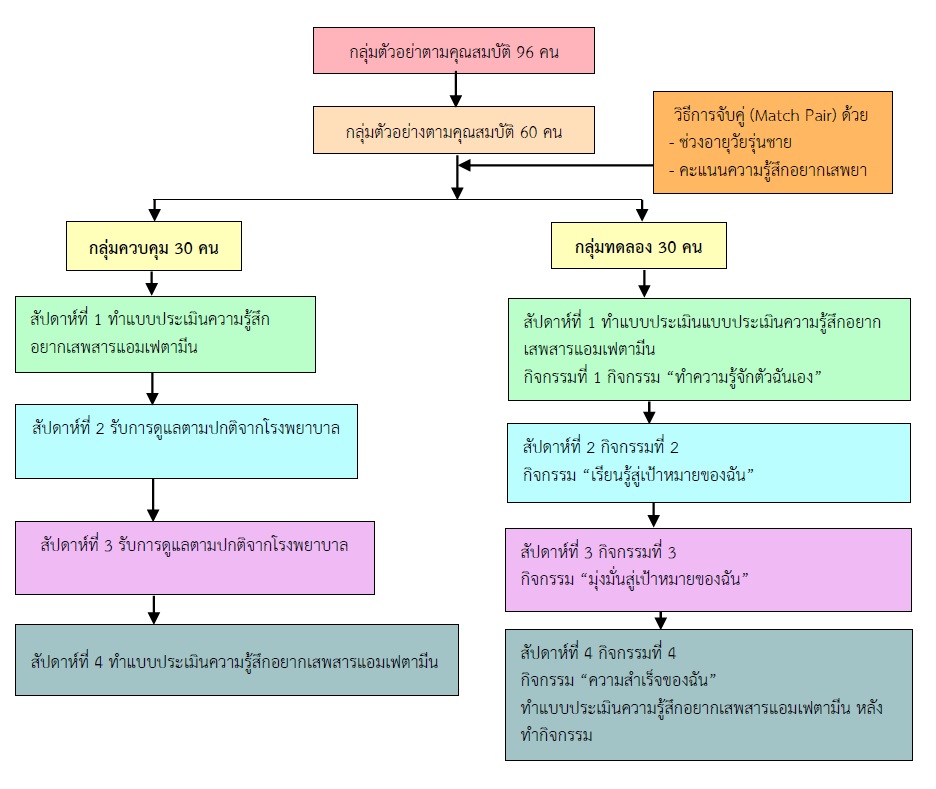
This quasi-experimental two-group pretest-posttest research aimed to examine the effect of nursing care program on amphetamine craving, according to King’s theory of goal attainment with music. Participants comprised 60 male adolescents diagnosed by ICD 10, aged 18-21 years, and undergoing treatment as outpatients in a psychiatric hospital of Southern Thailand. The participants were assigned into matched pairs, based on their age and amphetamine craving score of adolescent amphetamine addicts, then allocated to one or other of 2 groups (30 participants/group). Research instruments consisted of: 1) the nursing care according to King’s theory of goal attainment with music program, including individual activities (4 activities of 45-60 minutes each, once a week and continually for 4 weeks; 2) a demographic data questionnaire; as well as 3) an amphetamine craving questionnaire. Content validity of 3 instruments was verified by 3 experts. Reliability of the amphetamine craving questionnaire was analyzed using Cronbach’s Alpha coefficient, yielding a value of .89. Data were analyzed using descriptive statistics, Chi-square, Wilcoxon signed-rank test, Mann-Whitney test, and Independent t-test. The results showed that,
After participating in the program, the median score of amphetamine craving, among adolescents with amphetamine addiction, was significantly lower than that before (z=-4.78, p<.001). In addition, the median score of amphetamine craving among adolescents, after participating in the program, was significantly lower than that of participants who were receiving usual care (z= -6.74, p<.001).
The results of this new nursing care program, created accordingly with King’s theory of goal attainment, with music program, can decrease amphetamine craving among adolescents with amphetamine addiction. Therefore, nurses should implement the program in outpatient clinics at hospitals.
References
American Music Therapy Association. (2010). About Music Therapy & AMTA. Retrieved May 15, 2019 from http://www.musictherapy.org/about/quotes.
Blood, A. J. (2001). Intensely Pleasurable Responses to Music Correlate with Activity in the Brain Regions Implicated in Reward and Emotion. Proceedings of the National. Academy of Sciences, 98(11), 818-823.
Blum, K. (2010). Do Dopaminergic Gene Polymorphisms Affect Mesolimbic Reward Activation of Music Listening Response Therapeutic Impact on Reward Deficiency Syndrome (RDS). Medical Hypotheses, 74(3), 513-520.
Boromarajonani National Institute for Drug Addiction Treatment and Rehabilitation. (2019). Treatment Information Drug Patients of the Boromarajonani National Institute of Drug Addiction Treatment and Rehabilitation. Statistical data. Retrieved May 15, 2019 from http://www.pmnidat.go.th/thai/index.php?option=com_content&task=category§ionid=2&id=9&Itemid=51.
Carolyn, J. M., & Patricia, A. H. (2009). The Theory of Music, Mood and Movement to Improve Health Outcomes. Journal of Advanced Nursing, 65(10), 2249-2257.
Cevasco, A. M., Kennedy, R., & Generally, N. R. (2005). Comparison of Movement-to-Music, Rhythm Activities, and Competitive Games on Depression, Stress, Anxiety, and Anger of Females in Substance Abuse Rehabilitation. Journal of Music Therapy, 43(1), 64-80.
Chaiudomsuk, K., Paholpak, P., Vadhanavikkit, P., & Aphisitphinyo, S. (2017). Psychiatry. Khon Kaen. Klungnana Printing Press. (in Thai).
Changchana, W. (2020). Music Therapy: Calmness of Meditation Towards Unlimited Imagination. Bansomdej Music Journal, 2(1), 119-134.
Choombuathong, A., Yimnoi, C., & Samma, C. (2017). Music Therapy. Huachiew Chalermprakiet Science and Technology Journal, 3(2), 77-87.
Department of Mental Health. (2019). Results of a Survey of Information on Cultural Situation Statistics of Thai Children and Youth. Mental Health Articles. Retrieved June 21, 2019 from https://www.dmh.go.th/news-dmh/view.asp?id=28478
Ghetti, C., Chen, X. J., Brenner, A. K., Hakvoort, L. G., Lien, L., Fachner, L., et al. (2022). Music Therapy for People with Substance Use Disorder (Review). Cochrane Database of Systematic Review, 5(4). DOI: 10.1002/14651858.CD012576.pub3.
Kalayasiri, R. (2018). Addiction & Psychiatric Complications. Bangkok: Chulalongkorn University.
King, I. M. (1981). A Theory for Nursing: Systems, Concept, Process. New York: A Wiley Medical Publication.
Koelsch, S. (2015). Music-Evoked Emotions: Principles, Brain Correlates and Implications for Therapy. Annals of the New York Academy of Sciences, 1337, 193–201.
Koob, G. F., & Volkow, N. D. (2016). Neurobiology of Addiction: A Neurocircuitry Analysis. Lancet Psychiatry, 3(8), 760-773
Ministry of Public Health. (2018). Community Based Treatment and Care. Samut Sakhon: Born To Be Publishing. (In Thai)
Moore, S. K. (2013). A Systematic Review on the Neural Effects of Music on Emotion Regulation: Implications for Music Therapy Practice. Journal of Music Therapy, 50(3), 198–242.
Pattrakorn, A., & Chaipichitpan, C. (2015). The Effect of FAST Model for Addition Patients in Thanyarak Institute. Journal Psychiatric Association Thailand, 60(1), 71-81.
Raabe, A., Grusser, S. M., Wessa, M., Podschus, J., & Flor, H. (2005). The Assessment of Craving: Psychometric Properties, Factor Structure and a Revised Version of the Alcohol Craving Questionnaire (ACQ). Addiction, 100, 227-234.
Redish, A. D. (2004). Addiction as a Computational Process Gone Awry. Science, 306, 1944-1947.
Saarikallio, S. H., Randall, W. M., & Baltazar, M. (2020). Music Listening for Supporting Adolescents’Sense of Agency in Day Life. Frontiers in Psychology, 10, 1-11.
Short, A. D. L., & Dingle, G. A. (2016). Music as an Auditory Cue for Emotions and Cravings in Adults with Substance Use Disorders. Psychological of Music, 44(3), 559-573.
Silverman, M. J. (2012). Effects of Group Songwriting on Motivation and Readiness for Treatment on Patients in Detoxification: A Randomized Wait-list Effectiveness Study. Journal of Music Therapy, 49(4), 414–429.
Silverman, M. J. (2011). Effect of Music Therapy on Change Readiness and Craving in Patients on a Detoxification Unit. Journal of Music Therapy, 48(4), 509-531.
Srisatidnarakul, B. (2010).The Methodology in Nursing Research. Bangkok: You and I intermedia. (in Thai).
Suansaranrom Hospital. (2020). Statistical Psychiatric Patients’ Reports. Retrieved May 15, 2019 from https://www.suansaranrom.go.th
Thanoi, S. (2017). Brain and Neurotransmitters: Abnormalities in Drug Addition. Phitsanulok: Naresuan University Publishing House. (In Thai)
Ungwitayatorn, J. (2017). Listen to Music Rejoice. Pharmacy, Mahidol University, Retrieved May 15, 2019 from https://www.pharmacy.mahidol.ac.th/knowledge/files/0395.pdf.
Yinger, O. S., & Gooding, L. (2014). Music Therapy and Music Medicine for Children and Adolescents. Child and Adolescent Psychiatric Clinics of North America, 23(3), 535-553.
Downloads
Published
Issue
Section
License
Copyright (c) 2023 The Southern College Network Journal of Nursing and Public Health

This work is licensed under a Creative Commons Attribution-NonCommercial-NoDerivatives 4.0 International License.
1. บทความหรือข้อคิดเห็นใด ๆ ที่ปรากฏในวารสารเครือข่าย วิทยาลัยพยาบาลและการสาธารณสุขภาคใต้ ที่เป็นวรรณกรรมของผู้เขียน บรรณาธิการหรือเครือข่ายวิทยาลัยพยาบาลและวิทยาลัยการสาธารณสุขภาคใต้ ไม่จำเป็นต้องเห็นด้วย
2. บทความที่ได้รับการตีพิมพ์ถือเป็นลิขสิทธิ์ของ วารสารเครือข่ายวิทยาลัยพยาบาลและการสาธารณสุขภาคใต้