Development of a New MOPH ED Triage model for Emergency Departments of Yala Hospital Network
Keywords:
Emergency Department, Screening Model, Yala Hospital NetworksAbstract
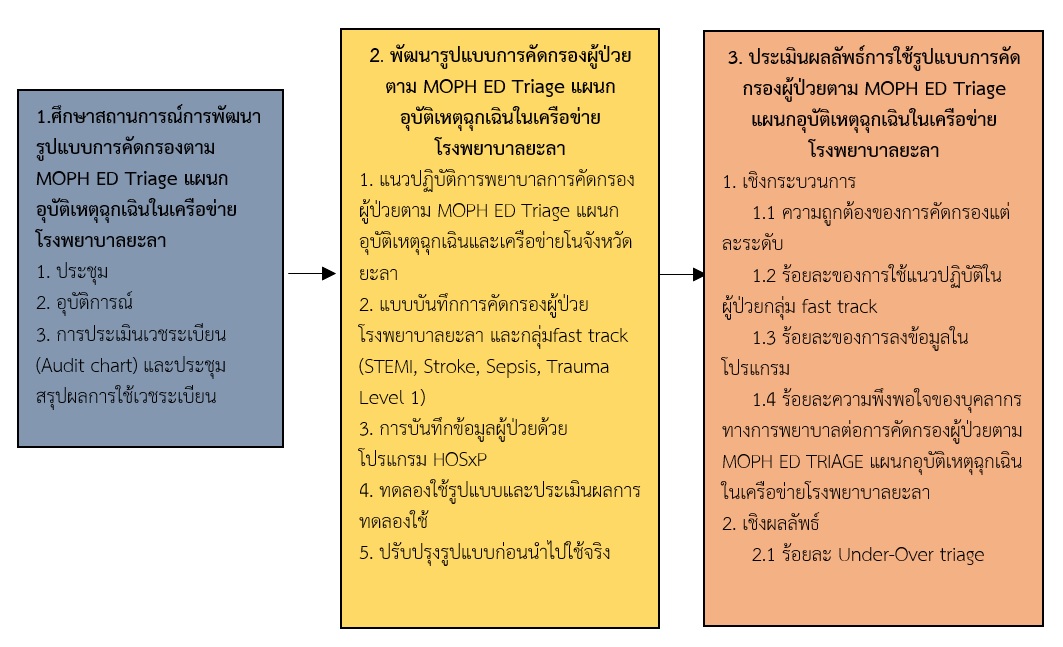
This developmental research, based on MOPH ED Triage, aimed to develop and evaluate a screening model for emergency departments of Yala hospital network. The study was divided in three phases. Phase 1 consisted in studying the current situation. Phase 2 in drafting the new model, validated by three experts, and Phase 3 into an evaluation of the model. Sample was 134 patients admitted to the emergency unit and 35 health professionals working at Yala hospital. Research instruments were: 1) patient record form, 2) personal information form, and 3) a questionnaire for measuring the nurse satisfaction in using the model. All items had content validity of .60, while Cronbach's alpha coefficient yielded 0.82 for reliability. Data were analyzed using descriptive statistics. Results were as follows.
1. The review of current situation allowed to identify 4 important issues: 1) differences in patient screening procedure, 2) incomplete data record for patients screened at level 1 and 2, 3)communication problems between nurses and patients regarding patient screening, and 4) screening ability of nurses.
2. The MOPH model comprised the following elements: 1) a patient screening guideline based on MOPH ED Triage of emergency department (Method (M)), 2) an improved pattern screening form for accidents, emergency and fast- track patients (Originality (O)), 3) a flow chart symbol communication system with patients (Patient (P)), as well as 4) a HosXp program record (HosXp program (H)).
3. Results from the evaluation process showed that the screening was 90.3% accurate, while input data of fast-track patients was complete at 93.6%. Data entry into HosXp program was 84.7% complete. It found that 8.8% did not meet the screening criteria. 2.2% of the screening level was changed from level 1 to level 4. In addition, the mean score of the nurses’ satisfaction in using the model was at a high level (M=77, SD=0.99)
Therefore, in order to increase the efficiency of MOPH ED Triage operations, the Emergency Department should encourage the network to run the operations with the same standard at the provincial level.
References
Christ, M., Goransson, F., Winter, D., Bingisser, R., & Platz, E. (2010). Modern Triage in the Emergency Department. Medicine, 107(50), 892-898.
Considine, J., Charlesworth, D., & Currey, J. (2014). Characteristics and Outcomes of Patients Requiring Rapid Response System Activation Within 24 Hours of Emergency Admission. Critical Care and Resuscitation, 3(16), 184-189.
Dehli, T., Fredriksen, K., Osbakk, S. A., & Bartnes, K. (2011). Evaluation of a University Hospital Trauma Team Activation Protocol. Scandinavian Journal of Trauma Resuscitation and Emergency Medicine, 19(18), 1-7.
Jakpaisan, S., Sithiprachrrat, J., Prampraamon, C., & Mara, N. (2016). Development of Learning Program for Knowledge and Ability Construction in Emergency Severity Triage by Adult Learning Theory for Registered Nurses in Emergency Department of Saraburi Hospital. Journal of nursing Division, 44(2), 117-140. (in Thai).
Ming, T., Lai, A., & Lau, P. (2016). Can Team Triage Improve Patient Flow in the Emergency Department A Systematic Review and Meta-Analysis. Advanced Emergency Nursing Journal, 38, 233-50.
National Institute of Emergency Medicine. (2018). Guidelines to Follow the Rules, Criteria and Procedures to Sort and Prioritize Emergency Care at the Emergency Room, According to the Emergency Medical Board. (3rd ed). Nonthaburi. (in Thai).
Pimsung, S. (2017). The Effect of A Clinical Practice Guideline On Abdominal Pain Triage In Outpatients. Community Nurse Practitioner Faculty of Nursing Thammasat University. (in Thai).
Srisa-Ard, B. (2014). Preliminary Research (9th ed). Bangkok: Suvereyasar. (in Thai).
Wachiradilok, P., Sirisamutr, T., Chaiyasit, S., & Sethasathien A. (2016). Triage at Emergency department in Thailand. The Thai journal Nusing, 31(2), 96-108. (in Thai).
Yodrak, A., Saetae, N., Siriyapan, S., & Taveetong, S. (2020). Development of an Advanced Cardiovascular Life Support (ACLS) Team Management in In-Patient Departments, Yala Hospital. The Southern College Network Journal of Nursing and Public Health, 7(1), 169-183.
Downloads
Published
Issue
Section
License
Copyright (c) 2021 The Southern College Network Journal of Nursing and Public Health

This work is licensed under a Creative Commons Attribution-NonCommercial-NoDerivatives 4.0 International License.
1. บทความหรือข้อคิดเห็นใด ๆ ที่ปรากฏในวารสารเครือข่าย วิทยาลัยพยาบาลและการสาธารณสุขภาคใต้ ที่เป็นวรรณกรรมของผู้เขียน บรรณาธิการหรือเครือข่ายวิทยาลัยพยาบาลและวิทยาลัยการสาธารณสุขภาคใต้ ไม่จำเป็นต้องเห็นด้วย
2. บทความที่ได้รับการตีพิมพ์ถือเป็นลิขสิทธิ์ของ วารสารเครือข่ายวิทยาลัยพยาบาลและการสาธารณสุขภาคใต้