Pressure Injuries: The Effects of a Bilingual Manual (Thai-Melayu) on Knowledge, Attitudes, and Prevention Skills among Caregivers of Stroke Patients in Narathiwat
Keywords:
Knowledge, Skill, Attitude, Pressure Injury, Caregiver, Bilingual (Thai-Melayu) Manual, Stroke PatientsAbstract
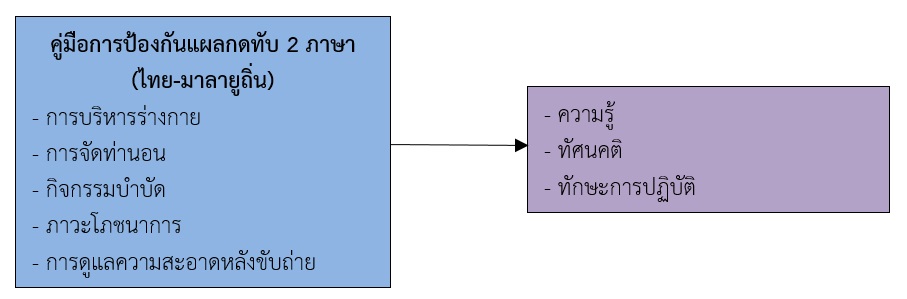
The purposes of this one-group pretest-posttest design quasi-experimental research conducted in Narathiwat Province were to: 1) study the levels of knowledge, attitude, and skills of caregivers of stroke patients about pressure injuries before and after using a bilingual (Thai-Melayu) manual for prevention, 2) to compare the knowledge, attitude, and skill before and after using a bilingual (Thai-Melayu) manual for prevention. The sample was 30 caregivers who took care of stroke patients and met the inclusion criteria. Demographic data were analyzed using descriptive statistics, and pair t-test was used to compare mean regarding research hypotheses. The instruments were an assessment form on knowledge, skills, and attitudes of caregivers about stroke, as well as a bilingual (Thai-Melayu) manual for the prevention of pressure injuries with stroke patients. The research results were as follows.
The mean score of stroke patients’ caregivers for knowledge, attitudes, and skills were significantly higher than before using the bilingual manual for prevention of pressure injuries (t=15.12, p <.001, t=7.65, p<.001, t=22.47, p<.001).
The results indicated that healthcare providers should create and develop the information sources that are convenient and accessible to the users by using a local language when appropriate. By using the local language, the caregivers become able to improving their knowledge, understanding, and providing the proper care for patients and having good attitudes in taking care of patients.
References
Artico, M., Dante, A., D’Angelo, D., Lamarca, L., Mastroianni, C., Petitti, T., et al. (2018). Prevalence, Incidence and Associated Factors of Pressure Ulcers in Homepalliative Care Patients: A Retrospective Chart Review. Palliative Medicine, 32(1), 299-307.
Chaiwongnakkapun, C., Jinawin, S., & Yottavee, W. (2017). Impact of Supportive-Educative Nursing Systemon Stress and Caring Abilities in Neuro Patients Caregivers. The Southern College Network Journal of Nursing and Public Health, 4(3), 203-217. (in Thai).
Chantra, C. (2016). Problems and Requirements of Primary Caregivers in Involving Nutrition and Bed sore Prevention of Bedridden Elderlies. Princess of Naradhiwas University Journal, 8(3), 41-50. (in Thai).
Chiaprasert, S., Sakunhongsophon, S., & Terathongkum, S. (2014). Effects of Pressure Sore Prevention Program on Knowledge and Self-Efficacy of Family Caregivers in Decreasing Pressure Sore Risk of Persons with Cerebrovascular Disease. The Bangkok Medical Journal, 15(1), 51-56. (in Thai).
Jumpapong, P. (2018). Development of Bed Bound Elder Care Process by Family Nurses, and Participation of Family and Community Party Network at Bangpakong Districts, Bangpakong, Chachoengsao. Mahasarakham Hospital Journal, 15(3), 85-92. (in Thai).
Kultipat, A., Tohthong, W., & Sukmueang, J. (2017). The Development of Comprehensive Care Stroke Patients in Phetchabun Hospital Network. Region 11 Medical Journal, 31(4), 619-630.
Lavallée, J. F., Gray, T. A., Dumville, J. C., & Cullum, N. (2019). Preventing Pressure Injury in Nursing Homes: Developing a Care Bundle Using the Behaviour Change Wheel. British Medical Journal, 9(6), 1-10.
Ministry of Public Health. (2020). Public Health Statistics A.D. 2019. Retrieved on 30 June 2021 Retrived from https://bps.moph.go.th/new_bps/sites/default/files/statistic62.pdf (in Thai).
Moonthee, W., Monkong, S., Sirapo-Ngam, Y., & Leelacharas, S. (2016). Impact of Transitional Care Programme and Family Caregivers on Stroke Patients’ Routine Activity Performance, Complications, and Satisfaction. Thai Journal of Nursing Council, 31(1), 95-110. (in Thai).
Nation Pressure Ulcer Advisor Panel (NPUAP). (2019). Prevention and Treatment of Pressure Ulcers/Injuries: Clinical Practice Guideline. Retrieved on 30 June 2020. Retrived from https://npiap.com/page/2019Guideline.
Ngaesinchai, S. S., Seerasaporn, P., Santhaweesuk, S., & Srichom, K. (2017). The Result of Rehabilitation Program for Self-Help, Prevention of Pressure Ulcers and Quality of Life in Patients with Spinal Cord Lesions. Srinagarind Medical Journal, 32(4), 74-74. (in Thai).
Paksee, N., Sirapo-Ngam, Y., Monkong, S., & Leelacharas, S. (2016). Effects of a Transitional Care Program for Stroke Patients and Family Caregivers on Caregiver’s Preparedness, Stress, Adaptation, and Satisfaction. Rama Nursing Journal, 22(1), 65-80. (in Thai).
Pitthayapong, S. (2018). Situations, Problems, and Barriers of Post-Stroke Care in the Transitional Period from Hospital to Home. Thai Red Cross Nursing Journal, 11(2), 26-39. (in Thai).
Polit, D., F., & Beck, C., T. (2012). Essentials of Nursing Research, Appraising Evidence for Nursing Practice (8th Edition). Philadelphia, PA., Lippincott Williams & Wilkins.
Prombut, P., Piaseu, M., & Sakulhongsopon, S. (2014). Factors Related to Stress of Family Caregiver of Patients with Stroke at Home. Rama Nursing Journal, 20(1), 82-96. (in Thai).
Pucciarelli, G., Vellone, E., Savini, S., Simeone, S., Ausili, D., Alvaro, R., et al. (2019). Roles of Changing Physical Function and Caregiver Burden on Quality of Life in Stroke A Longitudinal Dyadic Analysis. AHA/ASA Journals, 48(3), 733-739.
Raetong, P., Matchim, Y., & Poosamang, T. (2020). Experiences of Stroke Patients Receiving Palliative Care in Community: A Phenomenological Study. Songklanagarind Journal of Nursing, 40(1), 129-139. (in Thai).
Sangmanee, R., & Phibal, A. (2017). Experience of Using Local Wisdom for Self-Care among Patient with Hypertension in the Three Southern Border Provinces. The Southern College Network Journal of Nursing and Public Health, 4(3), 76-86. (in Thai).
Statistical Yearbook Thailand. (2017). Mortality Rate in Narathiwat Province. Retrieved on 30 June 2019. Retrived from http://service.nso.go.th/nso/nsopublish/pubs/e-book/esyb60/files/assets/basic-html/index.html#1. (in Thai).
Sukwatjanee, A., & Amatayakul, A. (2019). The Development of Competencies of Caregivers in Caring Stroke Patients. Journal of Nursing Science Chulalongkorn University, 31(2), 112-125. (in Thai).
Suttipong, C., & Sinduh, S. (2011). Factors Predicting Developmant of Pressure ulcer in Non Diabetic Elderly Stroke Patients. Journal of Nursing Science, 29(3), 113-123. (in Thai).
Thongthawee, B., Matchim, Y., & Kaewsriwong, S. (2018). Family Members’ Experience in Providing Care for Persons with Stroke: A Phenomenological Study. Songklanagarind Journal of Nursing, 38(3), 179-191. (in Thai).
Totong, K., Wongsangiem, T. N., & Wongsangiem, M. (2018). Problems and Needs of Thai Muslim for Health Service Based on Islamic Ways. The Public Health Journal of Burapha University, 13(2), 103-116.
Wagner, E. H. (1999). A Survey of Leading Chronic Disease Management Programs: are They Consistent with the Literature?. Manage Care Q 1999, 756-766.
World Health Organization. (2013). Cerebrovascular Accident. Retrieved on 30 June 2021 Retrived from https://www.who.int/health-topics/cerebrovascular_accident/en
Downloads
Published
Issue
Section
License
Copyright (c) 2021 The Southern College Network Journal of Nursing and Public Health

This work is licensed under a Creative Commons Attribution-NonCommercial-NoDerivatives 4.0 International License.
1. บทความหรือข้อคิดเห็นใด ๆ ที่ปรากฏในวารสารเครือข่าย วิทยาลัยพยาบาลและการสาธารณสุขภาคใต้ ที่เป็นวรรณกรรมของผู้เขียน บรรณาธิการหรือเครือข่ายวิทยาลัยพยาบาลและวิทยาลัยการสาธารณสุขภาคใต้ ไม่จำเป็นต้องเห็นด้วย
2. บทความที่ได้รับการตีพิมพ์ถือเป็นลิขสิทธิ์ของ วารสารเครือข่ายวิทยาลัยพยาบาลและการสาธารณสุขภาคใต้