การพัฒนานวัตกรรมการป้องกันและการเสริมสร้างสุขภาพของพระสงฆ์เกี่ยวกับ โรคไม่ติดต่อเรื้อรังแบบมีส่วนร่วมของภาคีเครือข่ายในภาคเหนือ
คำสำคัญ:
นวัตกรรม, การป้องกันโรคและการเสริมสร้างสุขภาพ, โรคไม่ติดต่อเรื้อรัง, พระสงฆ์บทคัดย่อ
การวิจัยและพัฒนานี้มีวัตถุประสงค์เพื่อศึกษาวิเคราะห์สถานการณ์ พัฒนานวัตกรรม และประเมินประสิทธิผลนวัตกรรมการป้องกันโรคและการเสริมสร้างสุขภาพของพระสงฆ์เกี่ยวกับโรคไม่ติดต่อเรื้อรังแบบมีส่วนร่วมของภาคีเครือข่ายในภาคเหนือ การดำเนินการวิจัยแบ่งเป็น 3 ขั้นตอน ได้แก่ ขั้นตอนที่ 1 วิเคราะห์สถานการณ์สุขภาพพระสงฆ์เกี่ยวกับโรคไม่ติดต่อเรื้อรัง จากพระสงฆ์จำนวน 15 รูป เก็บข้อมูลโดยการสัมภาษณ์เชิงลึก วิเคราะห์ข้อมูลด้วยการวิเคราะห์เชิงเนื้อหา ขั้นตอนที่ 2 พัฒนานวัตกรรม โดยผู้วิจัยนำผลการวิจัยจากขั้นตอนที่ 1 และทบทวนวรรณกรรม มายกร่างนวัตกรรม จากนั้นผ่านตรวจสอบคุณภาพนวัตกรรมจากผู้ทรงคุณวุฒิ 5 ท่าน ได้ค่า IOC .80-1.00 จึงนำไปทดลองใช้ ขั้นตอนที่ 3 ประเมินประสิทธิผลของนวัตกรรม กลุ่มตัวอย่างเป็นพระสงฆ์จำนวน 29 รูป เครื่องมือที่ใช้ในการวิจัยเป็นแบบทดสอบความรู้ และแบบสอบถามความพึงพอใจได้ค่า IOCระหว่าง .80-1.00 แบบทดสอบความรู้และแบบสอบถามความพึงพอใจ ได้ค่าสัมประสิทธิ์ความเชื่อมั่นครอนบาค .75 และ .84 วิเคราะห์ข้อมูลด้วยสถิติเชิงพรรณนาและค่าทดสอบที ผลการวิจัยพบว่า
1. สถานการณ์สุขภาพพระสงฆ์เกี่ยวกับโรคไม่ติดต่อเรื้อรัง ได้แก่ 1) พระสงฆ์มีความรู้และพฤติกรรมการป้องกันและเสริมสร้างสุขภาพยังไม่เหมาะสม 2) ขาดความตระหนักเกี่ยวกับปัจจัยที่ทำให้เกิดโรคไม่ติดต่อเรื้อรัง 3) ญาติโยมขาดความรู้เกี่ยวกับการถวายอาหาร และ 4) พระสงฆ์มีกิจกรรมทางกายน้อย รวมทั้งพระสงฆ์ต้องการสร้างภาคีเครือข่ายการดูแลสุขภาพ
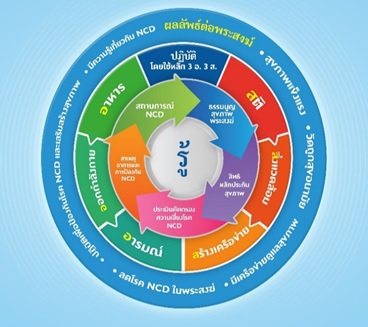
2. นวัตกรรม ประกอบด้วย 2 ส่วน คือ 1) ชุดความรู้การป้องกันและการเสริมสร้างสุขภาพของพระสงฆ์เกี่ยวกับโรคไม่ติดต่อเรื้อรัง โดยใช้หลัก 3 อ 3 ส และ 2) วีดิทัศน์การบริหารร่างกายสำหรับพระสงฆ์ ได้ค่าความเหมาะสมของรูปแบบ (CVI) 0.97 และความเป็นไปได้ในการนำไปใช้ (CVI) 0.93 ได้ค่าสัมประสิทธิ์ความเชื่อมั่นครอนบาค .84
3. หลังการใช้นวัตกรรมฯ พระสงฆ์มีคะแนนความรู้การป้องกันและเสริมสร้างสุขภาพเกี่ยวกับโรคไม่ติดต่อเรื้อรัง (M=22.00, SD=1.87) สูงกว่าก่อนใช้ (M=19.69, SD=2.35) อย่างมีนัยสำคัญทางสถิติที่ระดับ .01 (p <.001) และพระสงฆ์มีความพึงพอใจต่อการใช้นวัตกรรม อยู่ในระดับมาก
สรุปได้ว่า นวัตกรรมที่พัฒนาขึ้น ทำให้พระสงฆ์มีความรู้เรื่องการป้องกันโรคและการเสริมสร้างสุขภาพเกี่ยวกับโรคไม่ติดต่อเรื้อรังมากขึ้น จึงควรนำนวัตกรรมไปใช้เพื่อลดการเกิดโรคไม่ติดต่อเรื้อรัง
เอกสารอ้างอิง
Angkatavanich, J. (2019). Handbook of Healthy Food for Thai Monks 4.0. Bangkok: Punyamitr Publishing. (in Thai)
Boonranarak, S., Kunlaka, S., Yeujaiyen, M., & Kansri, J. (2020). Development of Self-Learning Package: Knowledge of Mental Health and Psychiatric Nursing for Nursing Student. Nursing Journal of the Ministry of Public Health, 30(1), 94-106.
Bureau of Information Office of The Permanent Secretary, MOPH. (2019). Choosing Menu of Heathy Food for Offering Monks. Retrieved Feb 13, 2022 from https://www.thaihealth.or.th/Content/47572-a.html (in Thai)
Department of Medical Service. (2021). Department of Medical Service Show Increasingly a Number of Data of Buddhist Monks with Diabetes Mellitus and Suggest People for Offering Healthy Food to Decrease NCD for Buddhist Monks. Retrieved June 21, 2021 from https://www.dms.go.th ›Content › News › Attachservice (in Thai)
Division of Non Communicable Diseases, Department of Disease Control. (2020). Report of Situation NCDs: DM, HT, and related risk factors. Retrieved Feb 13, 2022 from https://ddc.moph.go.th/uploads/publish/1035820201005073556.pdf (in Thai)
Hennink, M. & Kaiser, B. N. (2021). Sample Size for Saturation in Qualitative Research: A Systematic Review of Empirical Test. Social Science & Medicine, 1-10. Retrieved Jan 4, 2022 from https://doi.org/10.1016/j.socscimed.2021.114523
Hfocus team. (Sep 18, 2019). Crisis of Hundred Thousand Monks Regarding NCD: Causing Health Risk Behaviors. Retrieved Jan 8, 2022 from https://www.hfocus.org/content/2019/09/17751 (in Thai)
Information Center, Phrae Hospital. (2019). Data Regarding Illness of Buddhist Monks at OPD Department, Phrae Hospital. Phrae: Phrae hospital. (in Thai)
Jongsuksomsakul, P. (2021). Innovative Development for Promoting Buddhist Monk’s Health with Participation of Kilanupatthak Monk. Journal of Human Sciences, 22(2), 161-177. (in Thai)
Kamkokgruad, T., Chatthongpisut, R., & Intajarurnsan, S. (2019). Nutritional Value of Populae Food Offered to Monks by Thai Buddhist. Naresuan University Journal: Science and Technology, 27(1), 32-43. (in Thai)
Latham, J. (2020). Qualitative Sample Size-How Many Participant is Enough? Retrieved May 2, 2020 from www.drjohnlathan.com/many- participant- enough/
Miles, M. B., & Huberman, A. M. (1994). Qualitative data Analysis: An Expanded Sourcebook (2nd ed.). London: SAGE Publication.
Naebood, S. (2019). Effect of Practicing Control Lipid Level among Dyslipidemia Persons. Thai Red Cross Nursing Journal, 12(1), 96-104. (in Thai)
Nimtrakul, U., & Phra Wisit Thitawisittho. (2020). Health Behaviors of Monks and Health Literacy From Phra Kilanuphatthak to Communicators in Health Region1. Journal of Buddhist Studies, 11(1), 33-51. (in Thai)
Nokdee, C. (2020). Training Regarding Knowledge for Buddhist Monks Taking Care Together. Retrieved February 5, 2022 from https://www.thaihealth.or.th/Content/52560 (in Thai)
Norasigha, P., Navaphongpaveen, K. & Piyaaramwong, P. (2018). Prevalence and Associated Factors of Metabolic Syndrome in Buddhist Monks at Phra Nakhon Si Ayutthaya Province, Thailand. Journal of Medicine and Health Science, 25(2), 21-29. (in Thai)
Palungrit, S. (2019.) Health Status and Health Promoting for Buddhist Monk in Muang District, Pathumthani Province. Journal of Nursing and Health Care, 37(2), 134-142. (in Thai)
Panyachotikun, A., Satkong, S., & Sriwisit. S. (2018). Effects of SKT Meditation Therapy for Lowering Blood Pressure Level of Patients with Hypertension in Sikao Hospital, Trang Province. The Southern College Network Journal of Nursing and Public Health, 4(2), 245-255. (in Thai)
Pataraanuntanop, N. (2022). Policy Implementation for Developing Well-Being of Buddhist Monks at 1st Public Health Region. Retrieved February 5, 2022 from shorturl.at/oqtRS (in Thai)
Phachan, S., & Muktabhant, B. (2015). Nutritional Status and Food Consumption of Buddhist Monks in Muang District, Khon Kaen Province. Srinagarind, 30(6), 552-561. (in Thai)
Phra Kittiyanamedhi, S. R., Subruangthong, W., Sooksamran, S. (2018). Promoting Holistic Health Care of the Monks in Lopburi. Rajapark Journal, 12(25), 94-107. (in Thai)
Phra Kru Suvithanpatthanabandit, Daengharn, T., & Vapuchavitee, S. (2015). Model Development of Monk’s Holistic Health Care in Province Through the Network Participation. Journal of the Office of DPC 7 Khon Kaen, 22(2), 117-130. (in Thai)
Phra Rajvoramuni, P. A., Phra Mongkonvachirakorn, S. Y., Phra Mongkonthamvithan, S. P., & Putthasri, W. (Eds.). (2018). National Health Constitution for Buddhist monks B.E. 2560. Retrieved October 8, 2021 from https://www.nationalhealth.or.th/en/node/2005 (in Thai)
Phramaha Yottana, P. (2019). An Analysis of the Practical Breathing Meditation Teaching by Buddhadasa Bhikkhu. Journal of MCU Nakhondhat, 6(5), 2194-2212. (in Thai)
Poungkaew, A., Panitrat, R., Sanaha, C., Na Ayuthdaya, S.K., & Sangkapong, T. (2018). Model Development for Promoting Food Consumption Behaviors of Monks: Monks’ Perspectives. Journal of Health Science Research, 12(1), 81-91. (in Thai)
Priest Hospital, Department of Medical Service. (n.d.). Guidelines for the Movement and Practice Exercise for Monks. Retrieved October 8, 2021 from https://www.priest- hospital.go.th /handBook/exercise/ (in Thai)
Singmanee, C., Samerchua, W., & Satchasakulrat, S. (2017). Health Behaviors among Buddhist Monks in Phayoa Province. Journal of MCU Nan Review, 1(1), 44-55. (in Thai)
Suphunnakul, P., & Srithong, W. (2015). Causal Relationship Model of Factors Influencing Glycemic Control Behavior among Monks with Type 2 Diabetes in the Upper Northern Region of Thailand. Journal of Behavioral Science, 21(1), 95-105.
Triumchaisri, S.K. (2013). Practicing Meditation Therapy Toward Heal Health. Nonthaburi: Jaihoa.
Yingyoungmatee, N., Yucharoen, D., Sawangchai, J., Wonglamthong, S., & Nimitpornchai, P. (2020). The Effectiveness of SKT’s Meditation Therapy on Glucose Level in Diabetic Patients with Poor Glycemic Control. Region 4-5 Medical Journal, 39(2), 75-85. (in Thai)
ดาวน์โหลด
เผยแพร่แล้ว
ฉบับ
ประเภทบทความ
สัญญาอนุญาต
ลิขสิทธิ์ (c) 2022 วารสารเครือข่ายวิทยาลัยพยาบาลและการสาธารณสุขภาคใต้

อนุญาตภายใต้เงื่อนไข Creative Commons Attribution-NonCommercial-NoDerivatives 4.0 International License.
1. บทความหรือข้อคิดเห็นใด ๆ ที่ปรากฏในวารสารเครือข่าย วิทยาลัยพยาบาลและการสาธารณสุขภาคใต้ ที่เป็นวรรณกรรมของผู้เขียน บรรณาธิการหรือเครือข่ายวิทยาลัยพยาบาลและวิทยาลัยการสาธารณสุขภาคใต้ ไม่จำเป็นต้องเห็นด้วย
2. บทความที่ได้รับการตีพิมพ์ถือเป็นลิขสิทธิ์ของ วารสารเครือข่ายวิทยาลัยพยาบาลและการสาธารณสุขภาคใต้