New E-learning Lessons for Teaching the Mental Health and Psychiatric Nursing Course to the 4th-Year Students at the Songkhla College of Nursing
Keywords:
e-Learning, Mental Health and Psychiatric Nursing CourseAbstract
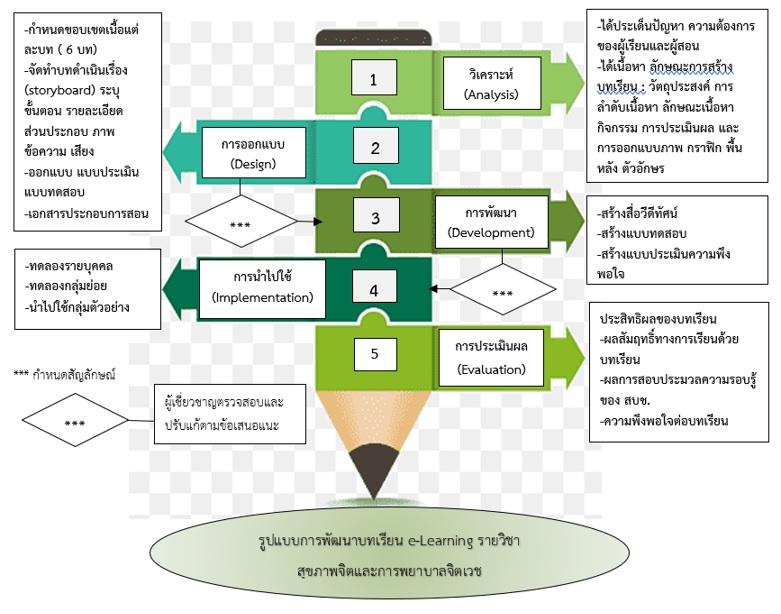
This research and development study, realized at the Songkhla Boromarajonani College of Nursing, aimed to: 1) document the current use of e-learning lessons, 2) develop new e-learning lessons and, 3) examine effectiveness of those e-Learning lessons for mental health and psychiatric nursing subject. It was divided in 3 phases. First one was to study situation and problems, using a sample of 5 instructors of psychiatric nursing department as well as 16 nursing students. Instrument was an interview form, which had content validity index of 1.00. Phase 2 was the proper development of e-learning lessons, using conceptual framework of ADDIE model, as well as the results from phase 1 along with a literature review for drafting. The draft was validated by a panel of 5 experts for suitability and feasibility. Phase 3 consisted of an assessment of e-learning lesson, using a sample of 156 nursing students. Instrument included an evaluation form, which was tested for reliability using KR-20 with a value of 0.73. A satisfaction questionnaire, which had Cronbach alpha coefficient of 0.93, was also used. Data were analyzed using frequency, percentage, mean, standard deviation and dependent t–test. Results were as follows.
1. Situation of e-learning lessons revealed a range of benefits including availability of study, selection of lesson, and a way to communicate in case of misunderstanding. However, the problems were instability of internet, lack of discipline in study attendance, and lack of study concentration. Suggestions were that construction of lessons should have objectives, content organization, understandable content summary, evaluation, and interesting graphic design.
2. E-learning lessons development for mental health and psychiatric nursing course consisted of 6 chapters with a quiz at the end of each chapter. The media is a video clip and teaching documents.
3. Effectiveness of e-Learning lessons showed that mean score after study (M=32.32, SD=2.72) was significantly higher than that of before (M=21.51, SD=3.71) (p<.001). 82.69% of sample passed the first comprehensive examination of Praboromarajchanok institute for mental health and psychiatric nursing subject, and satisfaction towards e-learning lessons was at the highest level (M=4.82, SD=0.21).
Results suggest that e-Learning lessons can be used effectively for examination preparation of fourth year nursing students in the comprehensive examination of Praboromarajchanok institute.
References
Barame, J. (2008). Statistics for Health Research and Data Analysis with SPSS. Chonburi: Sri Silpa Printing.
Binhosen, V., & Namjuntra, R. (2015). A Development of E-Learning Course Ware Media of BNS 405: Elderly Nursing on Student’s Readiness for Nursing Licensing Examination School of Nursing Rangsit University. Journal of Nursing and Education, 8(4), 114-125. (in Thai)
Chamnian, M., & Chamnian, K. (2018). Benefit, Problems and Solutions of Using Online Media in Studies with Efficiency in Schools, Nakhon Si Thammarat Province. Ratchaphruek Journal, 16(3), 113-121. (in Thai)
Chen, W., & Jia, J. (2016). Comparison of Online and Onsite Students’ Learning Outcomes and Experiences in a Massively Open Online Course in China. Journal of Educational Technology Development and Exchange, 9(1), 67-88.
E-learning Association of Thailand. (2014). E-learning for Education. Retrieved Dec 19, 2021, from http://www.e-lat.or.th/joomla/index.php/Th/ home-th/80-e-learning-reports
Hair, F. J., Black, C. W., Babin, J. B., & Anderson, E. R. (2010). Multivariate Data Analysis. (7th ed). New Jersey: Pearson Education.
Intarapoo, A., & Srifa, P. (2015). Evelopment of Web-B Ased Knowledge Construction System for Undergraduate Students Bachelor Degree in SuanSunandha Rajabhat University. Research and Development Journal Suan Sunandha Rajabhat University, 7(3), 161-174. (in Thai)
Kunaviktikul, W. (2015). Teaching and Learning in the Discipline of Nursing in the 21st Century. Nursing Journal, 42(2), 152-156. (in Thai)
Mc Griff, Steven J. (2000). Instructional System Design (ISD): Using the ADDIE Model. Instructional Design Models, 226(14), 1-2.
Office of the Education Council Ministry of Education. (2002). National Education Act B.E.1999 and Amendments (Second National Education Act B.E.2002). Retrieved Dec 19, 2021, from https://www.sl.ac.th/addons/qa/9.pdf
Patarasajjatham, P. (2016). Instructional System Design (ISD) by ADDIE Model: The Development of Metacognition of Nursing Students. Journal of Education Silpakorn University, 13(2), 6-17. (in Thai)
Puengchompoo, W., & Panuthai, S. (2014). Developing of the Learning and Teaching with E-Learning Model for Undergraduate Nursing Students in a Gerontological Nursing Course. Nursing Journal, 41(Supplement), 11-25. (in Thai)
Rouhollah, S., Maryam, B., Sayed, A. H., Elaheh, A., & Nasrin, E. (2018). Improving Nursing Students' Learning Outcomes in Fundamentals of Nursing Course Through Combination of Traditional and e-Learning Methods. Iranian Journal of Nursing and Midwifery Research, 23(3), 217-222.
Salem, A. (2017). Apply of E-learning in the Teaching Process Minburi Bangkok Business Administration Technological College. A Minor Thesis Submitted in Partial Fulfillment of the Requirements for the Master of Science Degree in Information Technology, Mahanakorn University of Technology. (in Thai)
Subtanadol, T. (2011). Factors Affecting the Teaching and Learning Management of Online Lessons at Nakhon Ratchasima Rajabhat University. Veridian E-Journal SU, 4(1), 652-666. (in Thai)
Thammetar, T. (2014). e-Learning: from Theory to Practice. Bangkok: Sahamitr printing & Publishing Company. (in Thai)
Thanormchayathawat, B., Vanitsuppavong, P., & Niemted, W. (2016). 21st Century Skills: A Challenge for Student Development. The Southern College Network Journal of Nursing and Public Health, 3(2), 208-222. (in Thai)
Valentina, A., & Nelly, A. (2014). The Role of e-Learning, the Advantages and Disadvantages of its Adoption in Higher Education. International Journal of Education and Research, 2(12), 397-410.
Downloads
Published
Issue
Section
License
Copyright (c) 2021 The Southern College Network Journal of Nursing and Public Health

This work is licensed under a Creative Commons Attribution-NonCommercial-NoDerivatives 4.0 International License.
1. บทความหรือข้อคิดเห็นใด ๆ ที่ปรากฏในวารสารเครือข่าย วิทยาลัยพยาบาลและการสาธารณสุขภาคใต้ ที่เป็นวรรณกรรมของผู้เขียน บรรณาธิการหรือเครือข่ายวิทยาลัยพยาบาลและวิทยาลัยการสาธารณสุขภาคใต้ ไม่จำเป็นต้องเห็นด้วย
2. บทความที่ได้รับการตีพิมพ์ถือเป็นลิขสิทธิ์ของ วารสารเครือข่ายวิทยาลัยพยาบาลและการสาธารณสุขภาคใต้