New Continuing Care Model for Dependent Elderly Patients
Keywords:
Model Development, Continuing Care, Dependent Older PeopleAbstract
This participatory action research aimed to develop a continuing care model for dependent elderly patients, and assess its outcomes. The research process was divided into three phases: 1) analysis of incidences, 2) development of the model, 3) outcomes. The participants were 50 public health officials and caregivers as well as 60 pairs of dependent elderly patients and their caregivers. The continuing development model, designed for the PDCA nursing teams, in collaboration with Khok Pho networks, included continuing treatments, discharge planning, appointments for follow-up, and referral. The research instruments were 1) a semi-structured questionnaire, 2) a team’s satisfaction evaluation form, 3) an evaluation form of active living activities, and 4) an evaluation form of home health care behavior. Cronbach’s alpha coefficient for content validity were ranged between 0.80 - 0.98. Data were statistically analyzed by descriptive statistics and paired t-test. And results were as follows.
1. As for the incidences of continuous caregiving for dependent elderly patients, it was found that they had more and more complications each year since there was no continuous caregiving system connecting to inside and outside medical centers, as well as a lack of confidence and knowledge from the relatives to take care of those patients.
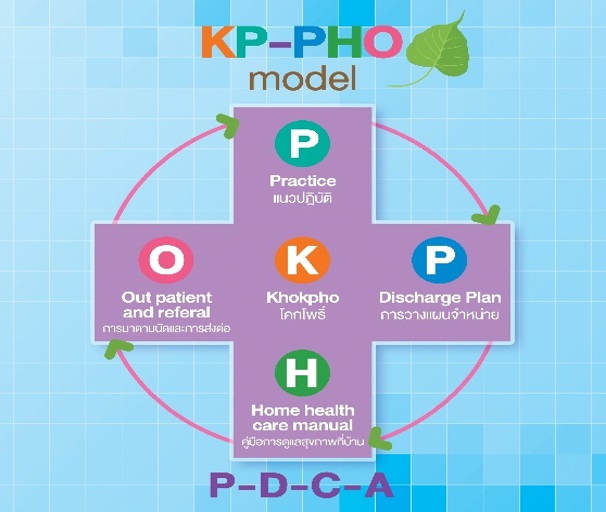
2. The KP-PHO model was divided in 4 sections: 1) a guideline of integrated continuing care, 2) a form for discharge planning, 3) a form for appointments and referral, and 4) a home health care manual.
3. After using the model, the team’s mean score was satisfactory (M=3.56, SD=0.76), while the mean score of home health care behavior was at a good level (M=2.56, SD=0.52). The comparison between before and after the evaluation of active living activities were statistically significantly different (t=-5.12, p<.05).
It can be concluded that the new continuing care model for dependent elderly patients could well affect the patients and their caregivers. The medical officials could use the forms easily, and they were satisfied with the outcomes.
References
Arttaros, T., & Apai, J. (2011). Continuing Model Communicable disease in Child. Journal Thailand Nursing and Midwifery Council, 26(Special), 112-125. (In Thai).
Boonleart, P., Promarak, T., &Taewpea, S. (2016). Continuous Care Model Development for Disability Elders in Bandongmone Health Promotion Hospital Tumbon Singkok Aumphur Kasetwisai Roi-Et Province. Journal of the office of DPC 7 Khonkaen, 23(2), 79-87. (In Thai).
Ciccone, A., Celani, M. G., Chiaramonte, R., Rossi, C., & Righetti, E. (2013). Continuous Versus. Intermittent Physiological Monitoring for Acute Stroke 2013: Intervention Review.
Department of Medical Service Ministry of Public Health. (2014). Screening Guide/Assess the Elderly. Edition 1. Bangkok: Tahan Pansuak Printing House. (In Thai)
Goncalve-Bradley, D. C., Iliff, S., Doll, H. D., Broad, J., Gladman, J., Langhorne, P., Richards, S. H., & Shepperd, S. (2017). Early Discharge Hospital at Home: Cochrane Systematic Reviview.
Khokpho District. (2017). Population Elder Year 2017. Khokpho District, Pattani Province.
Khokpho Hospital (2017). Key Performance Indicator. Khokpho Hospital.
Nakgul, N. (2018). The Development of a Care Model for Home-Bound and Bed-Bound Chronically ill Patients in Suratthani Municipality. Nursing Journal of the Ministry of Public Health, 1(7), 36-50. (In Thai).
National Health Security Office (NHSO). (2016). Guide Support National Health Longterm Care Edition 1. (In Thai).
National Statistical Office. (2017). Survey Economicand Social. Bangkok: National Statistical Office. (In Thai).
Nursing Division. (2014). Criteria Home Health Care. Edition 1. Bangkok: Choomnoomshakornkankaset Print House. (In Thai).
Office of the National Economic and Social Development Council (2016). Estimate Thai Population Year 2543-2573. (In Thai)
Pischalad K., & Mulpanun K. (2016). Improvement of a Continuing Care Model in Child. Nursing Journal, 40(3), 96-108. (In Thai).
Srisaad, B. (2013). Basic Research New Update. Edition 9. Bangkok: Suviriya Print. (In Thai).
Tapasi, W., Danpradit, P., & Ratnawijit, S. (2017). Health Care Service Model for Elderly by Community Participation, Wangtagoo Subdistrict, Nakhon Pathom Province. Kuakarun Journal of Nursing, 24(1), 42-54. (In Thai).
Wicha, S. (2017). Development a Health Service Network for Elderly People in Home-Bound and Home-Bed in Hongha. Health Promotion Hospital. (In Thai).
Downloads
Published
Issue
Section
License
Copyright (c) 2021 The Southern College Network Journal of Nursing and Public Health

This work is licensed under a Creative Commons Attribution-NonCommercial-NoDerivatives 4.0 International License.
1. บทความหรือข้อคิดเห็นใด ๆ ที่ปรากฏในวารสารเครือข่าย วิทยาลัยพยาบาลและการสาธารณสุขภาคใต้ ที่เป็นวรรณกรรมของผู้เขียน บรรณาธิการหรือเครือข่ายวิทยาลัยพยาบาลและวิทยาลัยการสาธารณสุขภาคใต้ ไม่จำเป็นต้องเห็นด้วย
2. บทความที่ได้รับการตีพิมพ์ถือเป็นลิขสิทธิ์ของ วารสารเครือข่ายวิทยาลัยพยาบาลและการสาธารณสุขภาคใต้