A Recreation Program for Increasing the Adversity Quotient (AQ) Score among Student Teachers in Bangkok
Keywords:
Recreation Program, Adversity Quotient Score, AQ, Student TeachersAbstract
This developmental research aimed to create a recreation program, and to study the effects of it, with the aim of increasing the adversity quotient (AQ) score among student teachers in Bangkok. The research was divided in two steps. Step 1 was to study the need for recreational activities among 260 student teachers, and to use the results for developing a recreation program so to enhance the adversity quotient (AQ) score among student teachers. Step 2 was to study the effects of using such a program, with a sample from purposive sampling of 60 participants. The tools used for data collection were a questionnaire regarding the need for recreational activities, as well as an adversity quotient (AQ) evaluation form. Reliability of the tools was tested using Cronbach’s alpha coefficient, yielding values of .90 and .85, respectively. Data were analyzed using percentage, means, standard deviation, and dependent t-test.
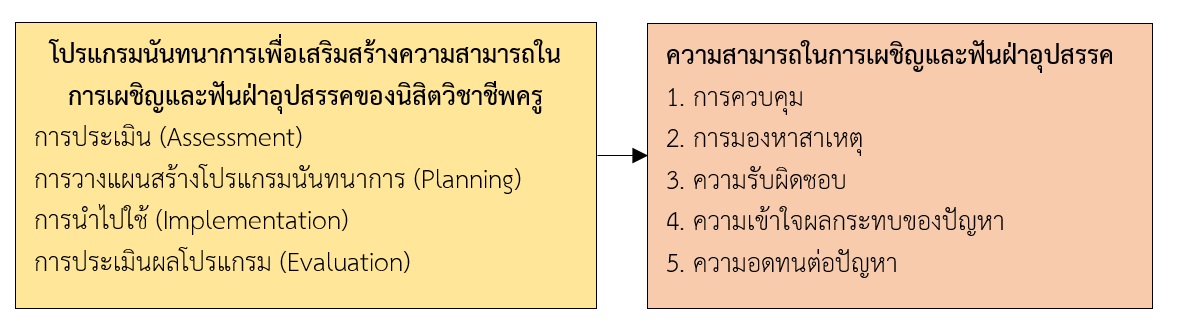
1. The top 3 needs of recreation activities among student teachers were: 1) music and singing, 2) games and sports, as well as 3) drama and movies. The recreation program was developed based on 5 domains, namely control, origin, ownership, reach, and endurance. The program activity pattern consisted of individual activities, couples’ activities, and group activities of 2 hours each, for 8 consecutive weeks.
2. In terms of AQ, after having participated in the recreation program, students had a better score than before participating into the program with the statistical significance (t=0.77, P<.05), particularly in the domains of reach and endurance (M=3.45, SD=0.20; M=3.39, SD=0.25, respectively).
The recreation program can increase the AQ score among student teachers. Therefore, it should be applied.
References
Austin, D. R. (2013). Therapeutic Recreation Processes & Techniques: Evidenced-Based Recreational Therapy (7th ed). Illinois: Sagamore Publishing.
Bhatti, A. M., Majit, M., Anwar, S. M., & Khan, B. (2016). Human Emotion Recoqnition and Analysis in Response to Audio Music Using Brain Signal. Computers in Human Behavior, 65, 267-275.
Delaney, H. (2019). Education for the 21st Century. Retrieved June 12, 2019 from https://www.unicef.org/thailand/th/stories/
Edginton, C. R., Hudsun, S. D., & Scholl, K. G. (1995). Leisure and Life Satisfaction. Lowa: Brown and Benchmark.
Edginton, C. R., Hudsun, S. D., & Scholl, K. G. (2002). Leisure and Life Satisfaction: Foundational Perspectives Dubuque. Iowa: McGraw-Hill.
Hurd, A. P., & Anderson, D. M. (2011). The Park and Recreation Professional Handbook. Illinois: Human Kinetic.
Khamplew, J. (2018). Relationships Between Attitude and Behavior Towards Recreation Among Student at Rajamangala University of Technology Krungthep. Presented in Partial Fulfillment of Requirements for the Master of Arts Degree in Sport and Leisure Management at Srinakharinwirot University. (in Thai).
Modthond, K., Tanpichai, P., & Sajjasoporn, R. (2019) Factors Affecting Adversity Quotient of Undergraduate Students in Kasetsart University Kampheang Saen Campus, Nakhonpathom Province. Journal for Social Sciences Research, 10(2), 18-33. (in Thai).
Office of the Education Council. (2009). A Cognitive Study on Desirable Characteristics of Thai People: The Ability to Face and Overcome Obstacles (Adversity Quotient: AQ). Bangkok: (in Thai)
Polsorn, K. (2018). Effects of a Recreation Program for Improvement of Adversity Quotient of Hearing Impaired Students, Liberal Arts Journal Prince of Songkla University, 10(2), 333-359. (in Thai).
Rossman, J. R., & Schlatter, B. E. (2008). Recreation Programming: Designing Leisure Experiences. Illinois: Sagamore.
Shinawatra, T. (2019). IQ EQ is Not Enough, Must have AQ. Retrieved June 12, 2019 from https://www.thaksinofficial.com/good-monday/iq-eq-aq/
Stoltz, P. G. (2000). Adversity Quotient @ Work: Make Everyday Challenges the Key to Your Success. New York: Harper Collins.
Sungthong, M., Tangon, K., & Kluanuan, P. (2013). The Factors Related to Adversity Quotient of Students in Rajamangala University of Technology Suvarnabhumi, Journal of Association of Research, 18(1), 97-108. (in Thai)
Tangsujjapoj, S. (2021). Organization of Physical Activities for Recreation in Educational
Institutions. Retrieved July 05, 2021 from http://ped.edu.ku.ac.th/home/research
/data/29_08_2015_21_16_24.pdf
Downloads
Published
Issue
Section
License
Copyright (c) 2021 The Southern College Network Journal of Nursing and Public Health

This work is licensed under a Creative Commons Attribution-NonCommercial-NoDerivatives 4.0 International License.
1. บทความหรือข้อคิดเห็นใด ๆ ที่ปรากฏในวารสารเครือข่าย วิทยาลัยพยาบาลและการสาธารณสุขภาคใต้ ที่เป็นวรรณกรรมของผู้เขียน บรรณาธิการหรือเครือข่ายวิทยาลัยพยาบาลและวิทยาลัยการสาธารณสุขภาคใต้ ไม่จำเป็นต้องเห็นด้วย
2. บทความที่ได้รับการตีพิมพ์ถือเป็นลิขสิทธิ์ของ วารสารเครือข่ายวิทยาลัยพยาบาลและการสาธารณสุขภาคใต้