Development of an Integrated Reminiscence Group Program on Depression, Self-esteem, and Quality of Life for Older Adults in Nakhon Si Thammarat
Keywords:
Reminiscence, Depression, Self-Esteem, Quality of Life, Older AdultAbstract
This research and development study aimed to conduct situation analysis, then to develop an integrated reminiscence group program, and compare levels of depression, self-esteem and quality of life among older adults before and after participating the program. The method consisted of 3 phases. The first phase was to study of situation of self–esteem, depression and quality of life. Sample was 517 older adults, selected using multi-stage random sampling. The research questionnaires consisted of Thai Geriatric Depression Scale (TGDS), self-esteem scale as well as quality of life. Data analyzed by descriptive statistic and Pearson correlation coefficients. Second phase was to develop an integrated reminiscence group program. The third phase was a pre–posttest one-group research design study in order to compare levels of depression, self - esteem, and quality of life among the 15 older adults, who were found having lower than the 25-percentile of quality of life, and had mild to moderate depression. Data were tested using Wilcoxon Signed Rank Test. The results of this study showed as follows.
1. Most of the older adults were not depressed (75.05%); only 20.70% of them had mild depression. Most of them (73.89%) had a high level of self-esteem. Overall quality of life was at a good level (82.79%) and depression was significantly correlated with quality of life (r=.148, p<.01). While self - esteem had moderately and positively correlated with quality of life (r=.549, p<.001)
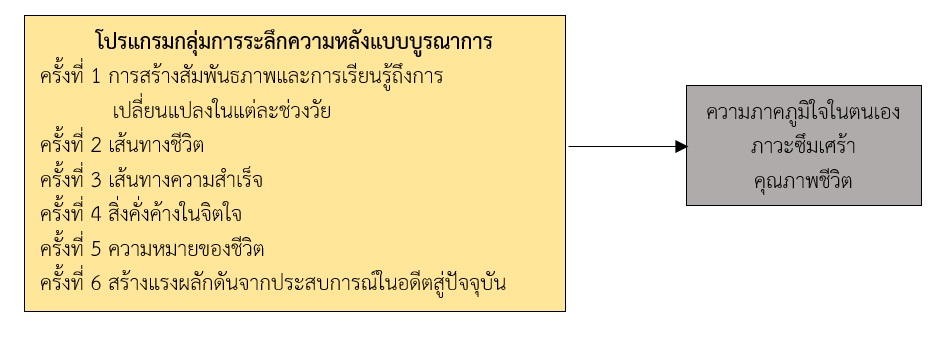
2. The integrated reminiscence group program consists of 6 activities, namely relationship building, life path, successful life path, unfinished business in the mind, meaning of life, and creation of an impulsion from the past to the present.
3. After participating the program, the mean score of depression was significantly lower than before participating in the program (p<.001). The mean score of self-esteem and quality of life were significantly higher than before participating the program (p< .05 and .001, respectively).
Per findings, the integrated reminiscence group program could increase self-esteem, decrease depression, and promote quality of life among older adults.
References
Atchley, R. C. (1989). A Continuity Theory of Normal Aging. Gerontologist, 29(2), 183-190.
Barakovi´c, S., Husi´c, J. B., van Hoof, J., Krejcar, O., Maresova, P., Akhtar, Z. & Melero, F. J. (2020). Quality of Life Framework for Personalised Ageing: A Systematic Review of ICT Solutions. International Journal of Environmental Research and Public Health, 17, 2940. https://doi:10.3390/ijerph17082940
Bazooband, A., Baghbanian, A., & Torkfar, G. (2016). A study of Group Reminiscence Therapy and Emotional Intelligence among Elderly Members. Geriatric Care, 2, 5927. https://doi: 10.4081/gc.2016.5927
Bodner, E., & Bergman, Y. S. (2016). Loneliness and Depressive Symptoms among Older Adults: The Moderating Role of Subjective Life Expectancy. Psychiatry Research, 237, 78–82.
Bohlmeijer, E., Smit, F., & Cuijpers, P. (2003). Effects of Reminiscence and Life Review on Late-Life Depression: A Meta Analysis. International Journal of Geriatric Psychiatry, 18(12), 1088-1094.
Bulechek, G., Butcher, H., & Dochterman, J. (2008). Nursing Interventions Classification (NIC) (5th ed.). St. Louis: Mosby-Elsevier
Chen, T-J., Li, H-J., & Li, J. (2012). The Effects of Reminiscence Therapy on Depressive Symptoms of Chinese Elderly: Study Protocol of a Randomized Controlled Trial. BMC Psychiatry, 12, 189. http://www.biomedcentral.com/1471-244X/12/189 (Open Access)
Chiang, K-J., Chu, H., Chang, H-J., Chung, M-H., Chen, C-H., Chiou, H-Y., & Chou, K-R. (2010). The Effects of Reminiscence Therapy on Psychological Well - Being, Depression, and Loneliness among the Institutionalized Aged. International Journal of Geriatric Psychiatry, 25(4), 380–388
Hinkle, D. E. (1998). Applied Statistics for the Behavior Sciences. (4th ed.). New York: Houghton Mifflin.
Khalil, A. A., & Abed, M. A. (2014). Perceived Social Support is a Partial Mediator of the Relationship Between Depressive Symptoms and Quality of Life in Patients Receiving Hemodialysis. Archives of Psychiatric Nursing, 28(2), 114–118. http://dx.doi.org/10. 1016/j.apnu.2013.11.007.
Korte, L., Cappeliez, P., Bohlmeijer, E. T., & Westerhof, G. J. (2012). Meaning in Life and Mastery Mediate the Relationship of Negative Reminiscence with Psychological Distress among Older Adults with Mild to Moderate Depressive Symptoms. European Journal of Ageing, http://doi: 10.1007/s10433-012-0239-3
Lei, P., Xu, L., Nwaru, B. I., Long, Q., & Wu, Z. (2016). Social Networks and Health-Related Quality of Life among Chinese Old Adults in Urban Areas: Results from 4th National Household Health Survey. Public Health, 131, 27-39.
Mahatnirunkul, S., Tantipiwattanaskul, W., Wongsuwan, K., & Prommanajirangkul, W. (1998). Comparison of the WHOQOL-100 and the WHOQOL-BREF (26items). Journal of Mental Health Thailand, 5, 4-15. (In Thai)
Meléndez-Moral, J. C., Charco-Ruiz, L., Mayordomo-Rodríguez, T., & Sales-Galán, A. (2013). Effects of a Reminiscence Program among Institutionalized ElderlyAadults. Psicothema, 25(3), 319-323. https://doi: 10.7334/psicothema2012.253
Meléndez-Morala, J. C., Fortuna-Terrerob, F. B., Sales-Galána, A., & Mayordomo, T. (2015). Effect of Integrative Reminiscence Therapy on Depression, Well-being, Integrity, Self-Esteem, and Life Satisfaction in Older Adults. The Journal of Positive Psychology, https://doi: 10.1080/17439760.2014.936968 Rodríguez
O'Rourke, N., Bachner, Y. G., Cappeliez, P., Chaudhury, H., & Carmel, S. (2015). Reminiscence Functions and the Health of Israeli Holocaust Survivors as Compared to other Older Israelis and Older Canadians. Aging & Mental Health, 19(4), 335-346.
Orth, U., & Robins, R. W. (2013). Understanding the Link Between Low Self-Esteem and Depression. Current Directions in Psychological Science, 22, 455-460. https://doi.org/10.1177/0963721413492763
Pinquart, M., & Forstmeier, S. (2012). Effects of Reminiscence Intervention on Psychosocial Outcomes: A Meta - Analysis. Aging Mental Health, 16, 541-558. https://doi: 10.1080/13607863.2011.651434. (PubMed)
Sharath, S., & Nuthan, R. (2020). A Study to Assess the Effect of Reminiscence Therapy on Psychological Well-Being, Depression, and Loneliness among Elderly in Selected Old Age Homes of Mysore. IP Journal of Paediatrics and Nursing Science, 3(1), 19-23. http://doi.org/10.18231/j.ijpns.2020.003
Sinchaiwanichakul, C., & Kespichayawattana, J. (2018). Factors Related to Healthy Aging among the Older Persons in Community-Dwelling of Bangkok Metropolitan. Journal of The Royal Thai Army Nurses, 19(Supplement), 100-109. (in Thai)
Srikuankaew, A., Jiawiwatkul, A., & Thayansin, S. (2018). The Relationship Between Happiness, Health Literacy and Quality of Life of Elderly: A Case Study in Wiang Elderly School, Fang District, Chiang Mai Province. MFU Connexion, 7(2), 76-95. (in Thai)
Train the Brain Forum Committee (Thailand). (1993). Thai Mental State Examination. Siriraj Hospital Gazette, 45, 359-374.
Unalan, D., Gocer, S., Basturk, M., Baydur, H., & Ozturk, A. (2015). Coincidence of Low Social Support and High Depressive Score on Quality of Life in Elderly. European Geriatric Medicine, 6(4), 319–324. https://doi: 10.1016/j.eurger.2015.02.009.
WORLD HEALTH ORGANIZATION. (WHO). (2006). The WHOQOL-OLD Module – Manual. https://www.who.int/mental_health/evidence/WHOQOL_OLD_Manual.pdf
Zhou, W., He, G., Gao, J., Yuan, K., Feng, H., & Zhang, C. K. (2012) The Effects of Group Reminiscence Therapy on Depression, Self - Esteem, and Affect Balance of Chinese Community - Dwelling Elderly. Archives of Gerontology and Geriatrics, 54, 440–447.
Published
Issue
Section
License
1. บทความหรือข้อคิดเห็นใด ๆ ที่ปรากฏในวารสารเครือข่าย วิทยาลัยพยาบาลและการสาธารณสุขภาคใต้ ที่เป็นวรรณกรรมของผู้เขียน บรรณาธิการหรือเครือข่ายวิทยาลัยพยาบาลและวิทยาลัยการสาธารณสุขภาคใต้ ไม่จำเป็นต้องเห็นด้วย
2. บทความที่ได้รับการตีพิมพ์ถือเป็นลิขสิทธิ์ของ วารสารเครือข่ายวิทยาลัยพยาบาลและการสาธารณสุขภาคใต้