Factors Predicting Smoking Behavior of Vocational Students and Undergraduate Students: A Study from Mahasarakham Province
Keywords:
Smoking Behavior, Student, Higher Education, Predicting FactorsAbstract
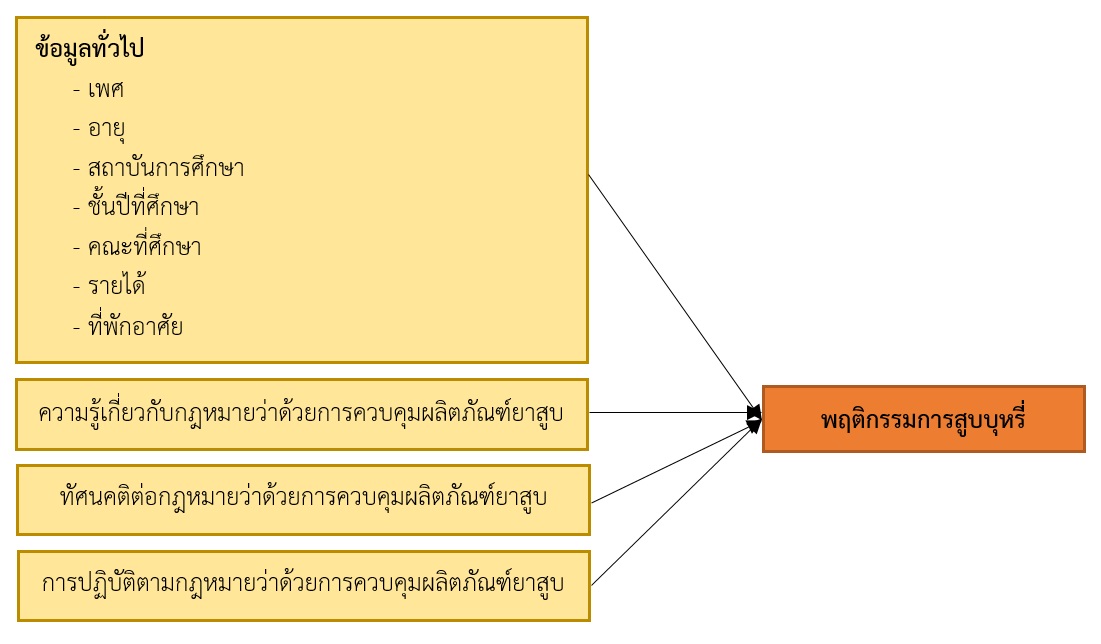
The purposes of this cross-sectional survey study were: 1) to study the knowledge, attitude, and practice toward the law of tobacco control and smoking behavior, and 2) to study the factors affecting smoking behavior in vocational and undergraduate students in Mahasarakham province. The 806 vocational and undergraduate students were collected from five different educational institutions. Data were analyzed using descriptive statistics, as well as the binary logistic regression analysis by the Enter method.
The majority of the samples (76.8%) were female. The average age was 20.89 years (SD=0.92). Most of the students did not smoke (92.06%). In the case of smoking, the average age for first-time smoking was 13.42 years, with an average of 3.85 cigarettes per day. About half of the students (50.87%) had knowledge about tobacco control laws at a high level. Most (66.75%) of them had an attitude about tobacco control law at a very good level. However, more than two-thirds of the students (69.23%) complied with the tobacco control laws at a very low level. Four factors affected the smoking behavior of the students at the significant level of 0.05: sex, age, history of having a friend who smoked, and compliance with tobacco control law. The equation could explain the percentage of 35.80 of variance in smoking behavior.
Despite the fact that smoking behavior was at a low level, local governments and stakeholders should encourage and improve students’ knowledge in order to change their attitudes toward the tobacco control laws resulting in their smoking behavior change.
References
Allport, G. (1975). Attitude and Phychology. Sanfrancisco: Jossey Bass.
Bandura, A. (1997). Self-Efficacy: The Exercise of Control. New York: W.H. Freeman and Company.
Best, J. W. (1977). Research in Education. (3rd ed.) Englewood Cliffs, New Jersey: Prentice Hall.
Bloom, B. S. (1971). Handbook on Formative and Summative Evaluation of Student Learning. New York: McGraw–Hill.
Cobb, S. (1976). Social Support as a Moderator of Life Stress. Psychosomatic Medicine, 38(5), 300-314.
Comrey, A., & Lee, H. (1992). A first Course in Factor Analysis. NewYork: Plenum.
Health Education Division, Ministry of Public Health. (2015). Smoking Behavior Modification for Working People. Nonthaburi: Ministry of Public Health. (in Thai)
Inchaithep, S., Kuangchai, S., Punsawat, M. & Yotthamsenee, W. (2020). Factors Predicting the First Smoking Behavior among Young Women. Journal of Nursing, Public Health, and Education, 21(3), 16-29. (in Thai)
Ingkapakorn, A. (2015). Knowledge, Attitude, and Practice to Smoking of Undergraduate Student, Kasetsart University. Independent Study of Bachelor Degree of Health Education. Kasetsart University. (in Thai)
Jarujit, S., Srisuriyawet, R., Homsin, P. (2015). Factors Associated with Regular Smoking among Male Vocational Students in Chanthaburi Province. Journal of Nursing and Education, 8(1), 59-71. (in Thai)
Kispredarborisuthi, B. (2010). Techniques for Creating Data Collection Tools for Research. Bangkok; Chulalongkorn University Press.
Krejcie, R., & Morgan, D. (1970). Determining Sample Size for Research Activi- ties. Educational and Psychological Mea- Surement, 30, 607-610. https://home.kku.ac.th/sompong/guest_speaker/KrejcieandMorgan_article.pdf
Kaewwichit, H. (2016). Human Behavior and Self Development. UdonThani; UdonThani Rajabhat University. (in Thai)
Leewiroj, P., & Kunsanong, O. (2016). Factors Affecting Smoking Behavior in Adolescent and The Effective Development Program of Cognitive Behavior Therapy for Reducing Smoking Behavior in Out of School Adolescent. Tobacco Control Research and Knowledge Management Center (TRC). (in Thai)
Luksanavimon, L., Petsirasan, R., Aekwarangkoon, S., & Noonil, N. (2020). Factors Related to Smoking Behavior among Youths in Thasala District, Nakhon Si Thammarat Province. Thai Journal of Nursing, 69(1), 1-9. (in Thai)
National Satatistical Office Thailand. (2014). The Smoking and Drinking Behavioral Survey 2014. Bangkok: National Satatistical Office Thailand. (in Thai)
National Satatistical Office Thailand. (2018). The Smoking and Drinking Behavioral Survey 2017. Bangkok: Pimdeekarpim Co.,Ltd. (in Thai)
Nevid, J. S. (2012). An Introduction to Psychology. (4th ed.). Connecticus; WADSWORTH CENGAGE Learning.
Nawsuwan, K., Singhasem, P., & Kienprasert B. (2017). Smoking Prevention Skills of Secondary School Students in Songkhla Province. Journal of Preventive Medicine Association of Thailand, 7(1), 87-94. (in Thai)
Pitayarangsarit, S., & Seetabut, D. (2016). Report of Evaluation of Action to WHO Framework Convention on Tobacco Control 2016. Bangkok; Tobacco Control Research and Knowledge Management Center (TRC). (in Thai)
Pongpit, K., Chankamkum, S., Kraiwisej, R., & Chaikoolvatana, A. (2011). A Survey of General Knowledge, Attitude and Beliefs Related to Cigarette Smoking by Ubon Ratchathani University Students. Isan Journal of Pharmaceutical Sciences, 7(2), 40–50. (in Thai)
Royal Thai Government Gazette. (2017). Tobacco Products Control Act B.E. 2560 (2017). Vol 134, Part 39A. (in Thai)
Schwartz, N. E. (1976). Nutrition Knowledge, Attitudes and Practices of Canadian Public Health Nurses. Journal of Nutrition Education, 8(1), 28–31. https://doi.org/https://doi.org/10.1016/S0022-3182(76)80113-6
Siriwanarangsun, S., & Siriwanarangsun, P. (2018). Tobacco Products Control and Non-Smokes Health Protection: A Case Study in Bangkok Area, B.E. 2560. Journal of Preventive Medicine Association of Thailand, 8(2), 173–181. (in Thai)
World Health Organization. (2003). WHO Framework Convention on Tobacco Control (WHO FCTC). WHO Document Production Services.
Downloads
Published
Issue
Section
License
Copyright (c) 2022 The Southern College Network Journal of Nursing and Public Health

This work is licensed under a Creative Commons Attribution-NonCommercial-NoDerivatives 4.0 International License.
1. บทความหรือข้อคิดเห็นใด ๆ ที่ปรากฏในวารสารเครือข่าย วิทยาลัยพยาบาลและการสาธารณสุขภาคใต้ ที่เป็นวรรณกรรมของผู้เขียน บรรณาธิการหรือเครือข่ายวิทยาลัยพยาบาลและวิทยาลัยการสาธารณสุขภาคใต้ ไม่จำเป็นต้องเห็นด้วย
2. บทความที่ได้รับการตีพิมพ์ถือเป็นลิขสิทธิ์ของ วารสารเครือข่ายวิทยาลัยพยาบาลและการสาธารณสุขภาคใต้