Relationship among Knowledge, Attitudes, Subjective Norms, Perceived Behavioral Control, and Mother’s Intention to Donate Breast Milk
Keywords:
Knowledge, Attitude, Subjective Norm, Perceived Behavioral Control, Intention to Donate Breast Milk, Human Milk BankAbstract
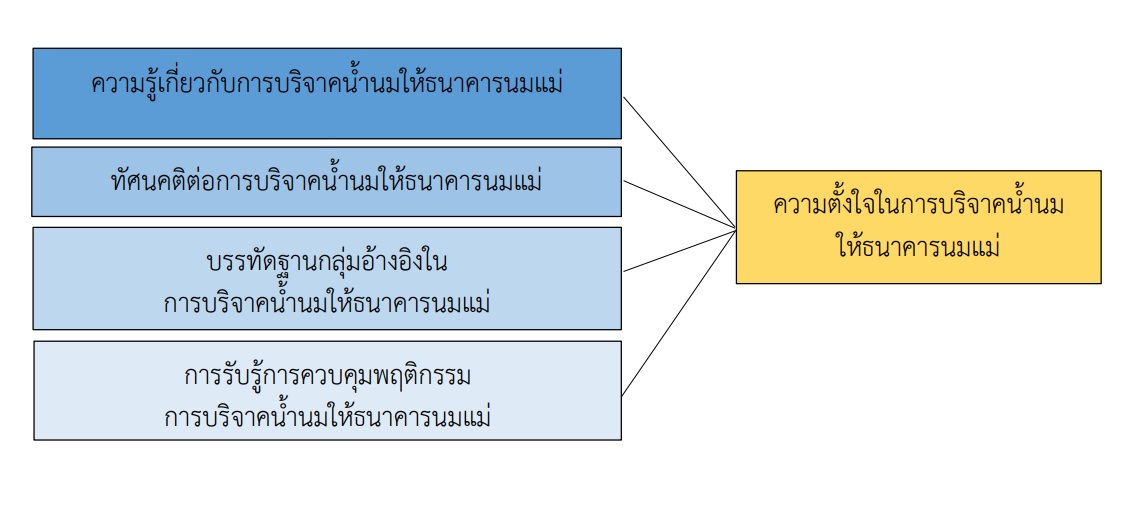
This descriptive study aimed to examine the relationships among knowledge, attitude, subjective norms, perceived behavioral control, and intention to donate breast milk to the human milk bank. A purposive sample of 255 postpartum women were recruited at a hospital in Southern Thailand between August and November 2020. Data were collected using a questionnaire including: 1) knowledge regarding breast milk donation, 2) attitude towards breast milk donation, 3) subjective norms, 4) perceived behavioral control, and 5) intention to donate breast milk to the Human Milk Bank in Southern Thailand. Content validity of the questionnaire was examined by experts, obtaining a value of 1.0. In terms of knowledge regarding breast milk donation, the reliability of the questionnaire was tested using Kuder Richardson (KR-20), yielding a value of .71. The attitudes, subjective norms, perceived behavioral control, and intention to donate breast milk to the Human Milk Bank questionnaire were tested with Cronbach’s alpha coefficient, yielding a value of .95, knowledge regarding breast milk donation, attitude towards breast milk donation, subjective norms and perceived behavioral control yielding a value of .80, .94 and .90 respectively. Data were analysed using descriptive statistics, and Spearman's rank correlation.
The results showed that 54% of subjects had a moderate level of knowledge regarding breast milk donation. Subjects had a positive attitude towards breast milk donation to the human milk bank (M=32.50, SD=5.40). The mean score for subjective norm was a high level (M=33.16, SD=9.01). The mean score for perceived behavioral control to donate breast milk to the human milk bank was at a moderate level (M=35.27, SD=8.16). Seventy-two percent of subjects had a high level of intention to donate breast milk to the human milk bank. Knowledge regarding breast milk donation had no significant correlation with the intention to donate breast milk to the Human Milk Bank (rs=.08, p=.22). Attitudes, subjective norms, and perceived behavioral control had a moderate significant positive correlation with the intention to donate breast milk to the human milk bank (rs=.47; rs=.49 and rs=.42, p<.01 respectively).
The results of this study can be used to enhance the intention to donate breast milk to the human milk bank among postpartum women who have excess milk supply by promoting a positive attitude, increasing subjective norm, and perceived behavioral control.
References
Ajzen, I. (1991). The Theory of Planned Behavior. Organizational Behavior and Human Decision Processes, 50, 179-211. doi:10.1016/0749-5978(91)90020-T
Bhasin, M., Nangia, S., & Goel, S. (2020). Role of Human Milk Banks Amid COVID 19: Perspective from a Milk bank in India. International Breastfeeding Journal, 15, 104, 1-6. https://doi.org/10.1186/s13006-020-00346-0
Bloom, B. S. (1971). Handbook on Formative and Summative Evaluation of Student Learning. New York: McGraw–Hill.
Candelaria, L. M., Spatz, D. L. & Giordano, N. (2018). Experience of Women Who Donated Human Milk. Journal of Obstetric, Gynecologic & Neonatal Nursing, 47(4), 556-563. doi:10.1016/j.jogn.2017.12.007
Canizo Vazquez, D., Salas Garcia, S., Izquierdo Renau, M., & Iglesias-Platas, I. (2019). Availability of Donor Milk for Very Preterm Infants Decreased the Risk of Necrotizing Enterocolitis Without Adversely Impacting Growth or Rates of Breastfeeding. Nutrients, 11(8), 1895. https://doi.org/10.3390/nu11081895
Cortez, J., Makker, K., Kraemer, D. F., Neu, J., Sharma, R. & Hudak, M. L. (2018). Maternal Milk Feedings Reduce Sepsis, Necrotizing Enterocolitis and Improve Outcomes of Premature Infants. Journal of Perinatology, 38(1), 71-74. doi:10.1038/jp.2017.149
De Meneses, T. M. X., de Oliveira, M. I. C., & Boccolini, C. S. (2017). Prevalence and Factors Associated with Breast Milk Donation in Banks That Receive Human Milk in Primary Health Care Units. Journal de Pediatric, 93(4), 382-388. doi:10.1016/j.jped.2016.09.004
Dos Santos, J. A. B., Serva, V. M. S. B., & Caminha, M. F. C. (2017). Reasons for Human Milk Donation According to Different Per Capita Income. Revista Brasileira de Saúde Materno Infantil, 17(2), 307-315. doi:10.1590/1806-93042017000200006
Doshmangir, L., Naghshi, M. & Khabiri, R. (2019). Factors Influencing Donations to Human Milk Bank: A Systematic Review of Facilitators and Barriers. Breastfeeding Medicine, 14, 298-306. doi:10.1089/bfm.2019.0002
Eksioglu, A., Yesil, Y. & Turfan, E. C. (2015). Mothers’Views of Milk Banking: Sample of İzmir. Turkish. Archives of Pediatrics, 50(2), 83-89. doi:10.5152/tpa.2015.2406
Ergin, A. & Uzun, S. U. (2018). Turkish Women’s Knowledge, Attitudes, and Behaviors on Wet-Nursing, Milk Sharing and Human Milk Banking. Journal of Maternal and Child Health, 22(4), 454–460. doi:10.1007/s10995-018-2433-1
Grunert, D. (2018). Decision Making Surrounding Human Milk Donation: Attitudes, Subjective Norms and Barriers. Master of Science in Nursing, Vancouver, Canada. Retrieved January 15, 2020 from https://open.library.ubc.ca/media/stream/pdf/24/1.0365593/4
Haiden, N. & Ziegler, E. E. (2016). Human Milk Banking. Annals of Nutrition and Metabolism, 69(2), 7-15. doi:10.1159/000452821
Huang, C., Han, W. & Fan, Y. (2021). Knowledge and Attitude on Donation of Breast Milk in Hospitalized Mothers. Gac Sanit, 35(3), 213-215. https://doi.org/10.1016/j.gaceta.2019.09.013
Kadioglu, M., Avcialpar, D. & Sahin, N. H. (2019). Turkish Women’s Attitudes and Views Regarding Human Milk Banking. Clinical Practice, 16(2), 1069-1076. doi:10.4172/clinical-practice.1000449
Karadag, A., Ozdemir, R., Karatas, M., Ozer, A. & Dogan, D. G. (2015). Human Milk Banking and Milk Kinship: Perspectives of Religious Officers in a Muslim Country. Journal of Perinatology, 35(2), 137-141. doi:10.1038/jp.2014.177
Khaonark, R., Kala, S. & Chatchawet, W. (2020). Perception in Breastfeeding of Postpartum Mothers with Newborns Hospitalized in Neonatal Intensive Care Unit. Songklanagarind Journal of Nursing, 40(1), 30-44.
Kim, H. Y. (2013). Statistical Notes for Clinical Researchers: Assessing Normal Distribution (2) Using Skewness and Kurtosis. Restorative Dentistry & Endodontics, 38(1), 52-54. doi:10.5395/rde.2013.38.1.52
Kimani-Murage, E. W., Wanjohi, M. N., Kamande, E. W., Macharia, T. N., Mwaniki, E., Zerfu, T., et al. (2019). Perceptions and Acceptability of Donating and Use of Donated Human Milk and Human Milk Banking in Nairobi, Kenya. Maternal & Child Nutrition, 15(4), 1-11. doi:10.1111/mcn.12842
Liu, X. H., Han, S. P., Wei, Q. F., Zheng, F. Y., Zhang, T. Chen, H.-M., et al. (2019). The Data and Characteristics of the Human Milk Banks in Mainland China. World Journal of Pediatrics, 15(2), 190-197.
Mahidol University. Faculty of Medicine Ramathibodi Hospital. (2014). Ramathibodi Human Milk Bank. Retrieved January 10, 2020 from https://www.medmahidol.ac.th/th/news/announcements/09122014-1734-th. (in Thai)
Mahidol University. Faculty of Medicine Siriraj Hospital. (2019). Siriraj Human Milk Bank. Retrieved January 10, 2020 from https://www.si.mahidol.ac.th/th/division/sirirajmilkbank/ (in Thai)
Mankar, A. & Mourya, A. (2018). Knowledge and Attitude Regarding Human Milk Banking among Postnatal Mothers in Selected Hospitals. International Journal of Science and Research, 7(10), 352-356. doi:1021275/ART20191766
Mayae, H., Wiroonpanich, W. & Wattanasit, P. (2020). Relationship Between Knowledge and Attitude, and Pain Management of Nurses in Pediatric Intensive Care Units, Southern Part of Thailand. The Southern College Network Journal of Nursing and Public Health, 7(3), 47-57. (in Thai)
Meier, P., Patel, A. & Esquerra-Zwiers, A. (2017). Donor Human Milk Update: Evidence, Mechanisms, and Priorities for Research and Practice. Journal of Pediatrics, 180, 15-21. http://dx.doi.org10.1016/j.jpeds.2016.09.027.
National Statistical Office, & United Nation Children’s Fund. (2020). Thailand Multiple Indicator Cluster Survey 2019 survey findings report August 2020. Retrieved January 10, 2020 from https://www.unicef.org/thailand/media/5146/file/Multiple%20Indicator%20Cluster%20Survey%202019.pdf (in Thai)
Pal, A., Soontarapornchai, K., Noble, L. & Hand, I. (2019). Attitudes Towards Donor Breast Milk in an Inner City Population. International Journal of Pediatrics, 2019(2), 1-4, doi:10.1155/2019/3847283
Perrin, M. T., Goodell, L. S., Fogleman, A., Pettus, H., Bodenheimer, A. L. & Palmquist, A. E. (2016). Expanding the Supply of Pasteurized Donor Milk: Understanding why Peer-to-Peer Milk Sharers in the United States do Not Donate to Milk Banks. Journal of Human Lactation, 32(2), 229-237. doi:10.1177/0890334415627024
Prince of Songkla University. Faculty of Medicine. (2018). History of Department of Pediatrics. Retrieved January 10, 2020 from https://peddepartpsu.wixsite.com/pediatricpsu/blank-1 (in Thai)
Quigley, M. & Mcguire, W. (2018). Formula Versus Donor Breast Milk for Feeding Preterm or Low Birth Weight Infants. Cochrane Database Systematic Review, 6, 1-2. doi:10.1002/14651858.CD002971.pub4
Senol, D. K. & Aslan, E. (2017). Women’s Opinions about Human Milk Donation and Human Milk Banking. Biomedical Research, 28(15), 6866-6871.
Songklanagarind Hospital. Neonatal Intensive Care Unit. (2018). Patient Registration: Breastfeeding Data. Songkhla: Neonatal Intensive Care Unit Songklanakarind Hospital. (in Thai)
Tato, R. (2018). Nursing Research: Concepts to Application. Bangkok: Chulalongkorn University Printing House. (in Thai)
Virano, R., Coscia, A., Tonetto, P., Perathoner, C., Bertino, E., Gardois, P. & Moro, G. E. (2017). Human Milk Donation in Northern Italy: Barriers, Facilitators and Information Sources. World Journal of Research and Review, 4(5), 64-70.
Wambach, K., Bateson, T., Matheny, P. & Easter-Brown, K. (2019). A Descriptive Study of the Attitudes, Perceptions, and Experiences of Human Milk Donation. Advances in Neonatal Care, 19(6), 441–451. doi:10.1097/ANC.0000000000000659
Wattanasit, P. & Kautrakool, A. (2017). The Relationship Between Anthropometric Indices and Hypertension in Thai Adolescents. Songklanagarind Journal Nursing, 37(3), 1-10. from file:///C:/Users/ASUS/Downloads/100456-Article%20Text-252534-1-10-20170930.pdf (in Thai)
World Health Organization. (2011). Guidelines on Optimal Feeding of Low Birthweight Infants in Low-and Middle-Income Countries. WHO Document Production Services. Geneva: Switzerland. Retrieved May 1, 2021 from https://apps.who.int/iris/bitstream/handle /10665/85670/9789241548366_eng.pdf?sequence=1&isAllowed=y&ua=1
World Health Organization. (2020). Infant and Young Child Feeding. Retrieved May 1, 2021 from https://www.who.int/news-room/fact-sheets/detail/infant-and-young-child-feeding.
Yilmaz, M., Aykut, M., Sahin, H., Ongan, D., Balci, E., Gun, I., et al. (2018). Knowledge, Attitude, and Practices about Wet-Nursing and Human Milk Bank in Kayseri, Turkey. Erciyes Medical Journal, 40(4), 204–209. doi:10.5152/etd.2018.18080
Zhang, N., Jun-Yan, L., Xin-Wen, L., Yu-Lei, J., Sharon, R., & Yan-Qiong, O. (2020). Factors Associated with Postpartum Women's Knowledge, Attitude and Practice Regarding Human Milk Banks and Milk Donation: A Cross-Sectional Survey. Midwifery, 91, 102837. doi:10.1016/j.midw.2020.102837
Downloads
Published
Issue
Section
License
Copyright (c) 2022 The Southern College Network Journal of Nursing and Public Health

This work is licensed under a Creative Commons Attribution-NonCommercial-NoDerivatives 4.0 International License.
1. บทความหรือข้อคิดเห็นใด ๆ ที่ปรากฏในวารสารเครือข่าย วิทยาลัยพยาบาลและการสาธารณสุขภาคใต้ ที่เป็นวรรณกรรมของผู้เขียน บรรณาธิการหรือเครือข่ายวิทยาลัยพยาบาลและวิทยาลัยการสาธารณสุขภาคใต้ ไม่จำเป็นต้องเห็นด้วย
2. บทความที่ได้รับการตีพิมพ์ถือเป็นลิขสิทธิ์ของ วารสารเครือข่ายวิทยาลัยพยาบาลและการสาธารณสุขภาคใต้