The Effectiveness of a Self-efficacy Building Program on Stroke Prevention Behaviors among Elderly Patients with Chronic illness in Khlong Khlung District, Kampaengphet Province
Keywords:
Elderly with Chronic Illness, Stroke, Prevention Behavior, Self-Applied ProgramAbstract
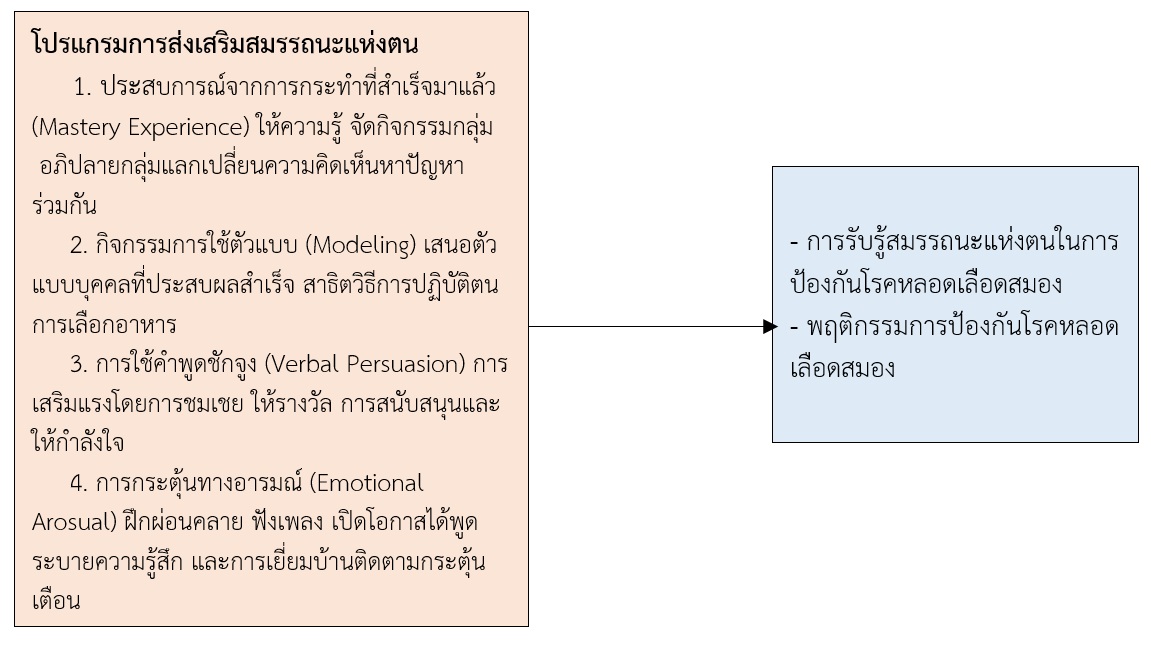
This research aimed to study the effectiveness of a new program to promote self-efficacy in stroke prevention behaviors among elderly patients with chronic illness. The participants were 98 elderly patients aged above 60 years from the NCD service clinic of Khlong Khlung Hospital in Kamphaengphet province. They were randomly assigned into either the experimental group or control group, with 49 patients per group. The control group received the usual advice, whereas the experimental group also participated in the self-applied stroke prevention behavior program. This was continued for 12 weeks with a 16-week follow-up period. Data collection instruments used were the Program to Promote Self-Applied Stroke Prevention Behavior and its Self-Evaluation Questionnaire. The content validity of the questionnaire was 0.80-0.91 and its reliability was 0.80-0.90. Statistical analysis was performed by using descriptive statistics, independent samples t-test, and one-way repeated ANOVA with the Bonferroni method.
The results showed that the mean score for self-applied stroke prevention behavior, in the experimental group, after 12 weeks of intervention and 16 weeks of the follow-up period, had a significantly higher mean score than the control group (p<.001).
Per the findings, group-based development processes and home health care visitation promote the development of self-applied stroke preventive behavior in elderly patients. Public health workers should utilize these group-based development processes and home visitation to facilitate activities that promote knowledge and behavior that will prevent stroke in elderly patients with chronic diseases.
References
Assantachai, P. (2000). Common health problems in the elderly and their prevention. Bangkok: Union Creation printing. (in Thai).
Bandura, A. (1986). The explanatory and predictive scope of self-efficacy theory. Journal of Clinical and Social phychology, 4, 359-373.
Bandura A. (1997). Self-efficacy: The exercise of control. New York: W.H. Freeman and Company.
Bunhu B, Toskulkao T, & Changmai S. (2020. The effects of transition promotion program on confidence and coping with health transition in first ever ischemic stroke patients. Thai Journal of Cardio-Thoracic Nursing, 31(2), 187-204.
Chulalongkorn Stroke Center of Excellence. (2015). Stroke. Bangkok: Amarin printing Group. (in Thai)
Department of Health. (2019). Age group knowing healty life. Retrieved September 12, 2019 from https://multimedia.anamai.moph.go.th/wp-.
Division of non communicable disease. (2015). Guidelines for Assessment of Cardiovascular Risk. Bangkok: Office of Printing Works, Veterans Affairs Organization.
HDC dashboard. (2021). HDCservice. Retrieved April 15, 2021 from:https://hdcservice.moph.go.th/hdc/main/index.php#.
Jamkrajang T, Boonchan N, & Mala J. (2017). The Effectiveness of the Self-efficacy and Social support Enhancement Program on Medication adherence and Blood pressure among Hypertensive Elderly in Community. Journal of The Royal Thai Army Nurses, 18(1), 270-279. (in Thai)
Kanokthet, T. (2016). Sociology of public health. Phitsanulok: Naresuan University Publishing House. (in Thai)
Kitreerawutiwong, N. (2017). Public Health Research: From Principle to Practice. Phitsanulok: Naresuan University Publishing House. (in Thai).
Muangpaisan, W. (2017). Gerontology and geriatrics for primary care practice. Bangkok: Association of Thai Probiology and Geriatric Medicine. (in Thai)
Nantsupawat, W. (2008). Elderly Nursing Challenges with the aging population. (2nd.). Khon Kaen: Khon Kaen printing. (in Thai).
Ouysakul, K., & Jitpanya, C. (2012). Factors Related to Stroke Awareness in Hypertensive Patients in Southern Region, Thailand. Journal of The Police Nurse, 40(1), 15-26. (in Thai)
Painupong, I., Sae-Sia, W., & Kupantawee, N. (2015). Pain Management Programme and Self-Empowerment Exercise Activity: Their Impact on Elderly Total Knee Arthroplasty Patients' Recovery. Thai Journal of Nursing Council, 30, 99-110. (in Thai)
Polit, D.F., & Beck, C.T. (2008). Nursing Research: Generating and Assessing Evidence For Nursing Practice. Philadelphia: Lippincott Williams & Wilkins.
Promyu, R., Naewbood, S., & Wannapornsiri, C. (2015). Effects of a health behaviors developing program for the elderly with hypertension. Journal of Hursing and Health, 10(3), 108-120.
Purakom, A. (2018). Promoting Physical Activity for Health in the Elderly. Nakhon Pathom: Phetkasam Printing Group. (in Thai).
Sanghuachang, W. (2013).effects of education program using group process and telephone follow up on stroke prevention knowledge and practice in elderly with chronic illness. J Prapokklao Hosp Clin Med Educat Center 30, 260-273. (In Thai)
Strategy and Planning division office of Health district at 1-13 about ministry of Public Health. (2020). Report thaihealth district level. Bangkok: Chinakson Printing House. (in Thai)
Suankratay, C. (2015). Medicine book 1. Bangkok: Chulalongkorn University Printing House. (in Thai).
Singtha, N. (2015). Effects of The Enhancing Self-Efficacy Program on Prevention Behavior Among Risk Group of Pre-Hypertension in Bankhok District, Uttaradit Province. Faculty of Nursing Science, Naresuan University. (in Thai).
Suphunnakul, P. (2018). Sathiti prayuk samrap: Applied Statistics For public health research. Phitsanulok: Naresuan University Publishing House. (in Thai)
Thongcharoen, V. (2015). Science and Arts of Nursing Patients. Bangkok: NP PRESS LTD. (in Thai)
Watcharanurak, P., & Klubklay, A. (2017). Factors Influencing Preventive Behavior among Stroke-Risk Patients in Songkhla Province. The Southern College Network Journal of Nursing and Public Health, 4(1), 217-233. (in Thai)
Wongsawat, P. (2018). Experimental research design : application for research to improve health behaviors. Bangkok: CDMK printing. (in Thai)
Yotpanya, A. (2015). Effectiveness of a health behavior change program applying self-efficacy theory on a diabetes mellitus type 2 risk group in than district, Utai Thani Provine. Master of Public Health Program, Naresuan University. (in Thai).
Kittiboonthawal, P., Yingrengreung, S., & Srithanya, S. (2014). Perceptions of Stroke Warning Signs among Risk Patients. Nursing Journal of the Ministry of Public Health, 23(3), 132-141. (in Thai)
Moonthee, W., Monkong, S., Sirapo-ngam, Y., & Leelacharas, S. (2016). Impact of Transitional Care Programme and Family Caregivers on Stroke Patients’ Routine Activity Performance, Complications, and Satisfaction. Thai Journal of Nursing Council, 31(1), 95-110. (in Thai)
Downloads
Published
Issue
Section
License
Copyright (c) 2022 The Southern College Network Journal of Nursing and Public Health

This work is licensed under a Creative Commons Attribution-NonCommercial-NoDerivatives 4.0 International License.
1. บทความหรือข้อคิดเห็นใด ๆ ที่ปรากฏในวารสารเครือข่าย วิทยาลัยพยาบาลและการสาธารณสุขภาคใต้ ที่เป็นวรรณกรรมของผู้เขียน บรรณาธิการหรือเครือข่ายวิทยาลัยพยาบาลและวิทยาลัยการสาธารณสุขภาคใต้ ไม่จำเป็นต้องเห็นด้วย
2. บทความที่ได้รับการตีพิมพ์ถือเป็นลิขสิทธิ์ของ วารสารเครือข่ายวิทยาลัยพยาบาลและการสาธารณสุขภาคใต้