Leadership and Organizational Performance Indicators in Private Sector: A Systematic Review
Keywords:
Private Sector, Organizational Performance Indicators, Systematic ReviewAbstract
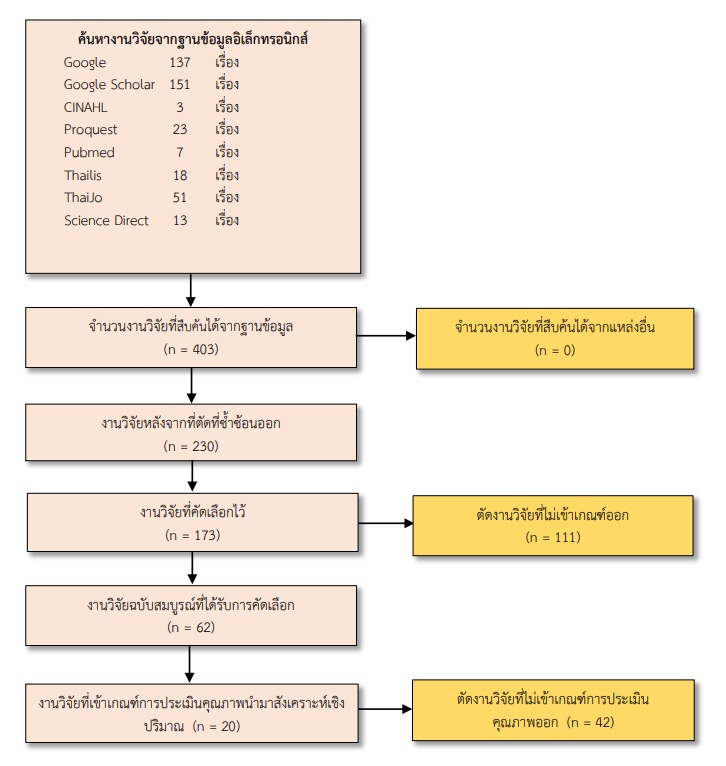
The purposes of the present systematic review were to synthesize and summarize the existing evidences and theory–based studies on leadership and organizational performance indicators currently used in the private health sector by searching research reports from national and international research databases, published between 2010 and 2020. Eleven (11) databases were systematically searched: Medline/Pubmed, CINAHL, ResearchGate, Google, Google scholar, Thai LIS, Thai JO, Proquest, Science Direct, Scopus, Psyinfo.
The quality appraisal for the study was evaluated using Kmet, Lee and Cook’s standard quality assessment criteria for evaluating primary research papers were used to assess theresearch reports, the inter-rater reliability was 89.5%. Data were analyzed using descriptive statistics. Kappa statistic was uses to test consistency among the two reviewer, obtaining Cohen’s Kappa coefficient = 0.115, (p=.305).
As a result, 20 studies were eligible for this systematic review, among which 17 were conducted among managers or among managers and employees. Most studies were on leadership and organizational performance. Bass & Avolio’s transformational leadership theory was the most applied leadership theory. Organizational performance indicators were financial performance and operational performance. Most studies were measuring profitability, followed by growth, and market shares. For operational performance, most studies were measuring customer satisfaction, followed by employee satisfaction.
This review indicates that the transformational leadership is an important factor to increasing organizational performance in private sector.
References
Ahmad, M., & Ejaz, T. (2019). Transactional and Transformational Leadership Impact on Organizational Performance: Evidence from Textile Sector of Pakistan. European Online Journal of Natural and Social Sciences, 8(2), 97-103.
Asrar-ul-Haq, M., & Kuchinke, K. P. (2016). Impact of Leadership Styles on Employees’ Attitude Towards Their Leader and Performance: Empirical Evidence from Pakistani Banks. Future Business Journal, 2(1), 54-64.
AL-Abrrow, H. (2014). Transformational Leadership and Organizational Performance in the Public Healthcare Sector: The Role of Organizational Learning and Intellectual Capital. Irish Journal of Management, 33, 27-48.
Al Khajeh, E. H. (2018). Impact of Leadership Styles on Organizational Performance. Journal of Human Resource Management Research, 2018, 1-10.
Arif, S., & Akram, A. (2018).Transformational Leadership and Organizational Performance: The Mediating Role of Organizational Innovation. SEISENSE Journal of Management, 1(3), 59-75.
Anantharaman, K., Shivakumar, V., & Saha, D. (2008) Utilisation of Thorium in Reactors. Journal of Nuclear Materials, 383, 119-121.
Bass, B. M. (1985). Leadership and Performance Beyond Expectations. Collier Macmillan.
Bass, B. M. & Avolio, B. J. (1990), Developing Transformational Leadership: 1992 and Beyond, Journal of European Industrial Training, 14(5).
Bass, B. M., & Avolio, B. J. (1994). Improve Organizational Effectiveness Through Leadership. London: Sage Publication Inc.
Bass, B. M., & Riggio, R. E. (2006). Transformational Leadership. Mahwah, NJ: L. I Lawrence Erlbaum.
Berson, Y., Shamair, B., Avolio, Bruce J., & Popper, M. (2001). The Relationship Between Vision Strength, Leadership Style, and Context. The Leadership Quarterly, 12, 55-73.
Chutiwong, N., & Kertsri, N. (2011). Analysis of Factors Supporting an Innovative Organization in Thailand. Thammasat Business Journal, 34(130), 47-58.
Choudhary, A. I., Akhtar, S. A., & Zaheer, A. (2013). Impact of Transformational and Servant Leadership on Organizational Performance: A Comparative Analysis. Journal of Business Ethics, 116(2), 433- 440.
Cho, J. J., Ozment, J., & Sink, H. L. (2008). Logistics Capability, Logistics Outsourcing and Firm Performance in an E-Commerce Market. International Journal of Physical Distribution & Logistics Management, 38, 336-359.
Cohen, J. (1960). A Coefficient of Agreement for Nominal Scales. Educational and Psychological Measurement, 20(1), 37-46.
Daft, R. L. (2000). Organization Theory and Design. (7th ed.) South-Western College Publishing, Thomson Learning. U.S.A.
Day, D., Fleenor, J., Atwater, L., Sturm, R., & Mckee, R. (2014). Advances in Leader and Leadership Development: A Review of 25 Years of Research and Theory. The Leadership Quarterly, 25, 63-82.
De Jong, S., & Bruch, H. (2013). The Importance of a Homogeneous Transformational Leadership Climate for Organizational Performance. International Journal of Leadership Studies, 8(1), 61-78.
Ebrahim Hasan Al Khajeh. (2018). Impact of Leadership Styles on Organizational Performance. Journal of Human Resources Management Research, 2018, 1-10.
Garcia-Morales, V., Jimenez-Barrionuevo, M., & Gutierrez, L. (2012). Transformational Leadership Impact on Organizational Performance through Organizational Learning and Innovation. Journal of Business Research, 65(7), 1040-1050.
Gavrea, C., Ilies, L., & Stegerean, R. (2011) Determinants of Organizational Performance: The Case of Romania. Management & Marketing Challenges for the Knowledge Society, 6, 285-300.
Ghosh, D., & Wu, A. (2007). Intellectual Capital and Capital Markets: Additional Evidence. Journal of Intellectual Capital, 8(2), 216-235.
Golla, E., & Johnson, R. (2013). The Relationship Between Transformational and Transactional Leadership Styles and Innovation Commitment and Output at Commercial Software Companies. The Business Review Cambridge, 21(1), 337-343.
Heldi, V. A., Marjan, M., Ivalaina, A., Puspa, D., & Warnadie. (2019). Servant Leadership: Its Impact and Relationship on Organizational Performance & Organizational Learning in Physicians, International Journal of Innovation, Creativity and Change, 9(5), 338-363.
Ibrahim, A. U., & Daniel, C. O. (2019). Impact of Leadership on Organizational Performance. International Journal of Business Management and Social Research, 6(02), 367-374.
Kaplan, R. S., & Norton, D. P. (1992). The Balanced Scorecard-Measures that Drive Performance. Harvard Business Review, (January-February), 71-79.
Khan, Raza, & Bukhari, Adeel. (2016). Effects of Leadership Style on Health Care Organizational Performance: A Survey of Selected Tertiary Care Hospital in Karachi, Pakistan. International Journal of Economics & Management Sciences, 5(3), 1-8.
Kmet, L. M., Lee, R. C., & Cook, L. S. (2004). Standard Quality Assessment Criteria for Evaluating Research Papers from a Variety of Fields. Canada: Interpret Design Inc.
Khandwalla, P. N. (1977). Some Top Management Styles, Their Context and Performance. Organization & Administrative Sciences, 7, 21-45.
Klaywong, C. (2020). The Impacts of Transformational Leadership, Organizational Innovation and Change Management on Private Hospital Performance in Thailand. Journal of Social Science and Buddhistic Anthropology, 5(4), 127-144.
Lashari, R. H., & Rana, A. H. (2018). The Impact of Transformational Leadership and Social Interaction on Organizational Performance in the Viewpoint of Knowledge Management: An Empirical Study in Banking Sector of Pakistan. International Journal of Organizational Leadership, 7(2018), 383-396.
Lin, H.-F., & Lee, G.-G. (2004). Perceptions of Senior Managers Toward Knowledge-Sharing Behavior. Management Decision, 42(1/2), 108-125.
McColl-Kennedy, J. R., & Anderson, R. D. (2002). Impact of Leadership Style and Emotions on Subordinate Performance. The Leadership Quarterly, 13(5), 545-559.
Moher, M., Liberati, A., Tetzlaff, J., Altman, D. G., & The PRISMA Group. (2009). Preferred Reporting Items for Systematic Reviews and Meta-Analysis: The PRISMA Statement. Journal of Clinical Epidemiology, 62, 1006-1012.
Morales, V., Montes, F., & Jover, A. (2008). The Effects of Transformational Leadership on Organizational Performance Through Knowledge and Innovation. British Journal of Management, 19, 299-319.
Murray, J. Y., & Kotabe, M. (1999) ‘Sourcing Strategies of US Service Companies: a Modified Transaction-Cost Analysis’. Strategic Management Journal 20(9), 791-809.
Muniz, B., Peon, J., & Ordas, C. (2009). Relationship Between Occupation Safety Management and Firm Performance. Safeth Science, 47(7), 980-991.
Noruzy, A., Dalfard, M. V., Behnaz Azhdari, Nazari-Shirkouhi, S., & Rezazadeh, A. (2013). Relations Between Transformational Leadership, Organizational Learning, Knowledge Management, Organizational Innovation, and Organizational Performance: An Empirical Investigation of Manufacturing Firms. The International Journal of Advanced Manufacturing Technology, 64(5-8), 1073-1085.
Ogolla, A., & Senaji, T. A. (2018). Transformational Leadership and Organizational Performance of State Corporation in Kenya. International Journal of Multidisciplinary Research, 2(3), 12-21.
Overstreet, R. E., Hanna, J. B., Byrd, T. A., Cegielski, C. G. & Hazen, B. T. (2013). Leadership Style and Organizational Innovativeness Drive Motor Carriers Toward Sustained Performance. The International Journal of Logistics Management, 24(2), 247-270.
Ozsahin, M., Zehir, C. & Acar, A. Z. (2011). Linking Leadership Style to Firm Performance: The Mediating Effect of the Learning Orientation. Procedia-Social and Behavioral Sciences, 24(2011), 1546-1559.
Pelham, A. M., & Wilson, D. T. (1996) A Longitudinal Study of the Impact of Market Structure, Organization Structure, Strategy and Market Orientation Culture on Dimensions of Small-Organization Performance. Journal of the Academy of Marketing Science, 24, 27.
Phromket, C. (2016). Building Strategic Leadership, Technology and Market-Based Radical Innovations Capability on Performance of Motor Vehicles and Parts Business in Thailand. Sakon Nakhon Graduate Studies Journal, 61(13), 173-185.
Rosenzweig, E. D., Roth, A., & Dean, J. (2003). The Influence of an Integration Strategy on Competitive Capabilities and Business Performance: An Exploratory Study of Consumer Products Manufacturers. Journal of Operations Management, 21, 437-456.
Saleh, R. M. M., Nusari, M., Habtoor, N., & Isaac, O. (2018). The Effect of Leadership Style on Organizational Performance: Organizational Commitment as a Mediator Variable in the Manufacturing Sector of Yemen. International Journal of Management and Human Resource (IJMHS), 2(4), 13- 24.
Samad, S. (2012). The Impact of Innovation and Transformational Leadership on Organizational Performance. Procedia - Social and Behavioral Sciences, 57(2015), 486-493.
Senge, P. M., Kleiner, A., Roberts, C., Ross, R. B. & Smith, B. J. (1994). The Fifth Discipline Fieldbook. Doubleday, New York, 5.
Thudam, P., & Salaebing, M. (2017). The Causal Model of Innovativeness of Halal Food Business in Southern Border Provinces of Thailand. MFU Connexion: Journal of Humanities and Social Sciences, 6(2), 189-211.
Tushman, M. L., & Nadler, D. A. (1986). Organizing for innovation. California Management Review, 28(3), 74-92.
Venkatraman, N., & Ramanujam, V. (1986). Measurement of Business Performance in Strategy Research: A Comparison of Approaches. Academy of Management Review, 11, 801-814.
Wang, H., Sui, Y., Luthans, F., Wang, D., & Wu, Y. (2014). Impact of Authentic Leadership on Performance: Role of Followers' Positive Psychological Capital and Relational Processes. Journal of Organizational Behavior, 35(1), 5-21.
Widiartanto, S. (2013). The Effect of Transformational Leadership on Market Orientation, Learning Orientation, Organization Innovation and Organization Performance (Study on Star-Rated Hotels in Central Java Province, Indonesia. IOSR Journal of Business and Management, 12(6), 8-18.
Yang, S., & Kang, H. (2008). Is Synergy Always Good? Clarifying the Effect of Innovation Capital and Customer Capital on Firm Performance in Two Contexts. Technovation, 28, 667-678.
Yeung, A. (2008). Strategic Supply Management, Quality Initiatives, and Organizational Performance. Journal of Operations Management, 26, 490-502.
Yildiz, S., & Karaka, A. (2012). Defining Methods and Criteria for Measuring Business Performance: a Comparative Research Between the Literature in Turkey and Foreign. Procedia-Social and Behavioral Sciences, 58, 1091-1102.
Yıldız, Sebahattin, Basturk, Faruk, & Boz, İlknur. (2014). The Effect of Leadership and Innovativeness on Business Performance. Procedia - Social and Behavioral Sciences, 150, 785-793.
Yukl, G. (2002). Leadership in Organizations (5th ed.). Upper Saddle River, NJ: Prentice Hall.
Zacharatos, A., Barling, J., & Kelloway, E. K. (2000). Development and Effects of Transformational Leadership in Adolescents. The Leadership Quarterly, 11(2), 211–226.
Zelbst, P., Green, K. Jr, Sower, V. & Abshire, R. (2010), “Relationships among Market Orientation, JIT, TQM, and Agility”, Industrial Management & Data Systems, 110(5), 637-658.
Downloads
Published
Issue
Section
License
1. บทความหรือข้อคิดเห็นใด ๆ ที่ปรากฏในวารสารเครือข่าย วิทยาลัยพยาบาลและการสาธารณสุขภาคใต้ ที่เป็นวรรณกรรมของผู้เขียน บรรณาธิการหรือเครือข่ายวิทยาลัยพยาบาลและวิทยาลัยการสาธารณสุขภาคใต้ ไม่จำเป็นต้องเห็นด้วย
2. บทความที่ได้รับการตีพิมพ์ถือเป็นลิขสิทธิ์ของ วารสารเครือข่ายวิทยาลัยพยาบาลและการสาธารณสุขภาคใต้