Intravenous Venipuncture: New Development in Training on Arm Manikin
Keywords:
Training Model, Intravenous Venipuncture, Arm Manikin, Nursing Students, PracticumAbstract
The purposes of this research and development were 1) to create and develop an intravenous venipuncture training model on arm manikin, and 2) to evaluate the effectiveness of the training model. Study was divided into three parts: 1) perform need assessment for use of intravenous venipuncture training model on arm manikin, 2) develop arm manikin training model by a) literature review, b) creating the arm manikin, c) running a try-out, and d) improving the arm manikin. Evaluation of arm manikin training model for its effectiveness was done with 78 nursing students in year 2, during academic year 2019. Research tool was a questionnaire with an IOC range between .67 and 1.00, and a Cronbach’s alpha coefficient equal to .935. Data were analyzed using Wilcoxon signed ranks test. Results of this study are as follows.
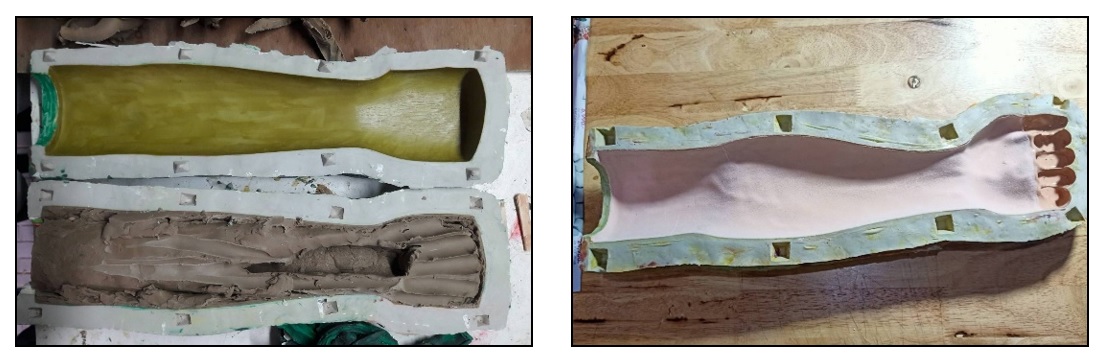
1. The intravenous venipuncture training consists of an arm manikin and artificial blood supply system. It is made from natural rubber and synthetic rubber like a sleeve from the fingertips to the elbow. The sleeve has two layers; the inner part with the installed artificial vein, and the outer part that can be worn on a man’s arm for practicing. The artificial blood vessels can be connected with the artificial blood system that can be replaced when it is damaged.
2. In terms of effectiveness, the nursing students’ satisfaction and confidence who used the arm manikin were higher after training than before at a statistically significant level (p<.001).
Therefore, Boromarajonani college of nursing should provide nursing students the intravenous venipuncture training model on arm manikin in nursing laboratory, and let students bring the arm manikin to their dormitory a certain time before going for practicum at hospital wards. The more they practice, the more confident and accurate in intravenous venipuncture for patients they become.
References
Bannaasan, B. (2017). Portable Adult Arm Model for Nursing Students’ Venipuncture and Peripheral Intravenous Cannulation Practice. Thai Journal of Nursing Council, 32(3), 38-49. (In Thai)
Choeychom, S., & Rujiwatthanakorn, D. (2015). The Use of Manikin Innovation in the Training of Aqueous Solution in the Veins of Nursing Students. Ramathibodi nursing journal, 21(3), 395-407. (In Thai)
Hair, J. F., Black, W. C., Babin, B. J. & Anderson, R. E., (2010). Multivariate Data Analysis (7th ed.). NJ: Prentice Hall.
Kunavikikul, W. (2015). Teaching and Learning in the Discipline of Nursing in the 21st Century. Nursing Journal, 42(2), 152-156. (In Thai)
Lertlum, L., Tanasansutee, Ch., Panawatthanapisuit, S., & Bumrungsri, Ch. (2019). Development of a Simulation-Based Learning Model. The Southern College Network Journal of Nursing and Public Health, 6(Special), 43-58. (In Thai)
Wadyim, N., Wangchom, S., & Mano, A. (2017). Teaching And Learning Management In Nursing Using Electronic Learning. Journal of Boromarajonani College of Nursing, Bangkok, 33(3), 146-157. (In Thai)
Downloads
Published
Issue
Section
License
1. บทความหรือข้อคิดเห็นใด ๆ ที่ปรากฏในวารสารเครือข่าย วิทยาลัยพยาบาลและการสาธารณสุขภาคใต้ ที่เป็นวรรณกรรมของผู้เขียน บรรณาธิการหรือเครือข่ายวิทยาลัยพยาบาลและวิทยาลัยการสาธารณสุขภาคใต้ ไม่จำเป็นต้องเห็นด้วย
2. บทความที่ได้รับการตีพิมพ์ถือเป็นลิขสิทธิ์ของ วารสารเครือข่ายวิทยาลัยพยาบาลและการสาธารณสุขภาคใต้