Infants’ Nutritional Status: The Effects of a Health Education Program on Perceived Self-Efficacy among Caregivers about Complementary Feeding
Keywords:
Infant, Nutritional Status, Caregiver, Health Education, Complementary FeedingAbstract
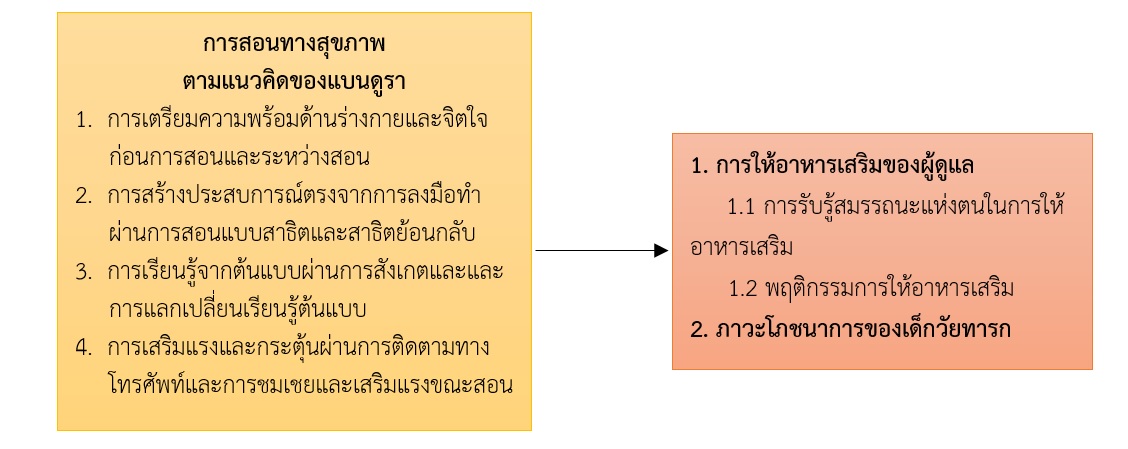
This study aimed to measure the effects of giving a health education program on complementary feeding self-efficacy (CFS-E), and both behaviorห of caregivers and nutritional status of infants. Program was based on Bandura's concept. Participants were 120 caregivers (60 pairs) and their infant aged 6- month-old, who attended the well-baby clinic at the Paliean Health Promoting Hospital of Trang province. Those were matched into the experimental and control group (30 pairs per group). The experimental group received the health education program based on Bandura’s concept, home visit, and telehealth, whereas the control group only received the advice from the handbook of maternal and child health. Research instruments were caregivers’ personal demographic, CFS-E, CFB, and infants’ nutritional status. The content validity of the questionnaire was .72, and .78. Its reliability was .80, and .86. Data were analyzed using descriptive statistics, independence t-test, and Chi-Square.
The findings showed that 1) there was no difference of CFS-E between the experimental group and the control group 2) the mean CFB of the experimental group was significantly higher than in the control group (p<0.05), and 3) infants of the experimental group were more likely to have body weight and height in the normal range, compared to those of the control group (p<0.05).
Thus, giving health education program based on Bandura’s concept should be applied for providing maternal and childcare in communities. Community nurses should play a health educator role, while health volunteers should monitor infants’ nutritional status until one-year of age.
References
Bandura, A. (1971). Social Learning Theory. Retrieved from http://www.asecib.ase.ro/mps/ Bandura_SocialLearningTheory.pdf.
Chan, M. Y., Ip, W. Y., & Choi, K. C. (2016). The Effect of a Self-Efficacy-Based Educational Program on Maternal Breastfeeding Self-Efficacy, Breast Feeding Duration and Exclusive Breast-Feeding Rates: A Longitudinal Study. Midwifery, 36, 92-98.
Dodt, R. C. M., Joventino, E. S., Aquino, P. S., Almeida, P. C., & Ximenes, L. B. (2015). An Experimental Study of an Educational Intervention to Promote Maternal Self-Efficacy in Breastfeeding. Revista Latino-Americana De Enfermagem, 23(4), 725-732.
Hendriyani, H., Sudargo T., Lusmilasari, L., Helmyati, S., Susetyowati, S., & Nindrea, R. D. (2020). Complementary Feeding Self-Efficacy: A Concept Analysis. Macedonian Journal of Medical Sciences, 15(8), 11-22.
Jintrawet, U., Sukkasem, N., Tongswas, T., & Somboon, L. (2015). Effects of Breastfeeding Promotion and Social Support Program on Breastfeeding Self-Efficacy and Exclusive Breastfeeding Rate among Postpartum Mothers. Journal of Nursing Science Chulalongkorn University, 27(2), 34-47. (In Thai).
Johnson, K. E., McMorris, B. J., Raynor, L. A., & Monsen, K. A. (2013). What Big Size You Have! Using Effect Sizes to Determine the Impact of Public Health Nursing Interventions. Applied Clinical Informatics, 4(3), 434–444. https://doi.org/10.4338/ACI-2013-07-RA-0044.
Kalid, M., Osman, F., Sulaiman, M., Dykes, F., & Erlandsson, K. (2019). Infant and Young Child Nutritional Status and Their Caregivers' Feeding Knowledge and Hygiene Practices in Internally Displaced Person Camps, Somalia. BMC Nutrition, 5, 59.
Khakhong, S., & Nirattharadorm, M. (2017). The effects of Promoting Self-Efficacy Program on Breast Feeding Behavior among Adolescent Mothers in Community. Journal of Public Health, 47(1), 31-43. (In Thai).
Krisame, K. (2020). Effects of Child Caregivers’ Self-Efficacy Enhancement Program for Promoting Child. Academic Journal of Mahasarakham Provincial Public Health Office, 4(8), 72-84. (In Thai).
Laving, A. R., Hussain, S. R., & Atieno, D. O. (2018). Overnutrition: Does Complementary Feeding Play a Role? Annuals of Nutrition & metabolism, 73(Suppl 1), 15-18.
Montigny, F., & Lacharité, C. (2005). Perceived Parental Efficacy: Concept Analysis. Journal of Advanced Nursing, 49(4), 387-396.
Munirul, I. M., Arafat, Y., Connell, N., Mothabbir, G., McGrath, M., Berkley, J. A., et al. (2019). Severe Malnutrition in Infants Aged < 6 Months-Outcomes and Risk Factors in Bangladesh: A Prospective Cohort Study. Maternal and Child Nutrition, 15(1), e12642.
Prell, C., & Koletzko, B. (2016). Breastfeeding and Complementary Feeding: Recommendations on Infant Nutrition. Deutsches Ärzteblatt International, 113(25), 435-444.
Qu, P., Mi, B., Wang, D., Zhang, R., Yang, J., Liu, D. et al. (2017). Association Between the Infant and Child Feeding Index (ICFI) and Nutritional Status of 6- to 35-Month-Old Children in Rural Western China. PloS One, 12(2), e0171984-e0171984.
Rafieyan-Kopaei, Z., Fathian-Dastgerdi, Z., Tarrahi, M. J., & Zamani-Alavijeh, F. (2019). Effectiveness of Message-Framing Intervention on Complementary Feeding Related Behaviors among Mothers with Infants Aged 4-8 Months: A 3-Arm Randomized Controlled Trial. Italian Journal of Pediatrics, 45(1), 158-158.
Saleem, A. F., Mahmud, S., Baig-Ansari, N., & Zaidi, A. K. M. (2014). Impact of Maternal Education about Complementary Feeding on Their Infants' Nutritional Outcomes in Low-and Middle-Income Households: A Community-Based Randomized Interventional Study in Karachi, Pakistan. Journal of Health, Population and Nutrition, 32(4), 623-633.
Trang Provincial Public Health Office. (2019). Population Report. Retrieved from https://trg. hdc.moph.go.th/hdc/reports/.
Vazir, S., Engle, P., Balakrishna, N., Griffiths, P. L., Johnson, S. L., Creed-Kanashiro, H. et al. (2013). Cluster-Randomized Trial on Complementary and Responsive Feeding Education to Caregivers Found Improved Dietary Intake, Growth and Development among Rural Indian Toddlers. Maternal and Child Nutrition, 9(1), 99-117.
Wells, J. C. K. (2018). The Capacity-Load Model of Non-Communicable Disease Risk: Understanding the Effects of Child Malnutrition, Ethnicity and the Social Determinants of Health. European Journal of Clinical Nutrition, 72(5), 688-697.
Winichagoon, P., & Damrongwongsir, O. (2020). Breastfeeding Situation, Facilitators and Obstacles, Policy and Program to Promote Breastfeeding in Thailand. Journal of Nutrition Association of Thailand, 55(1), 66-81.
World Health Organization. (2017). Guidance on Ending the Inappropriate Promotion of Foods for Infants and Young Children: Implementation Manual. Retrieved from http: //apps.who.int/iris/bitstream/handle/10665.
Downloads
Published
Issue
Section
License
1. บทความหรือข้อคิดเห็นใด ๆ ที่ปรากฏในวารสารเครือข่าย วิทยาลัยพยาบาลและการสาธารณสุขภาคใต้ ที่เป็นวรรณกรรมของผู้เขียน บรรณาธิการหรือเครือข่ายวิทยาลัยพยาบาลและวิทยาลัยการสาธารณสุขภาคใต้ ไม่จำเป็นต้องเห็นด้วย
2. บทความที่ได้รับการตีพิมพ์ถือเป็นลิขสิทธิ์ของ วารสารเครือข่ายวิทยาลัยพยาบาลและการสาธารณสุขภาคใต้