ผลโปรแกรมการจัดการอบรมของกลุ่มงอกงามต่อการส่งเสริมคุณค่าในตนเองสำหรับนักเรียนระดับชั้น มัธยมศึกษาปีที่ 3 โรงเรียนราชประชานุเคราะห์ ในสามจังหวัดชายแดนภาคใต้
คำสำคัญ:
กลุ่มงอกงามประเภทกลุ่มอบรม, การเห็นคุณค่าในตนเอง, โรงเรียนราชประชานุเคราะห์ จังหวัดชายแดนภาคใต้บทคัดย่อ
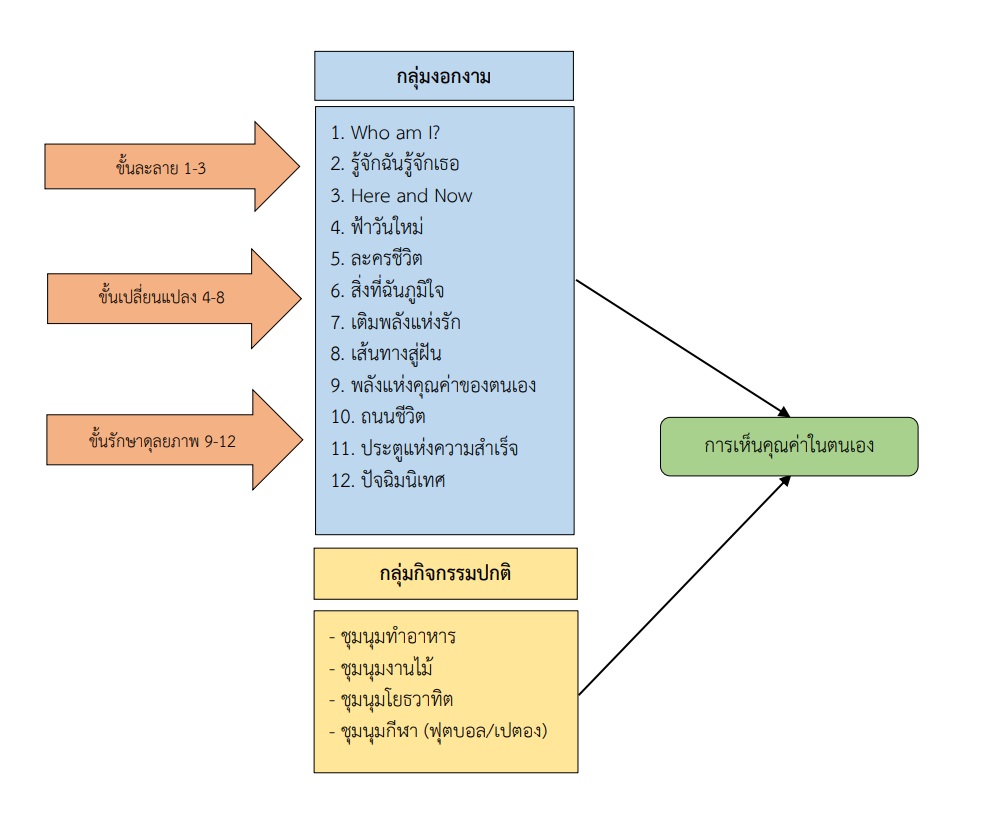
งานวิจัยกึ่งทดลองแบบ 2 กลุ่มวัดซ้ำนี้มีวัตถุประสงค์เพื่อ 1) เปรียบเทียบการเห็นคุณค่าในตนเองของนักเรียนระดับชั้นมัธยมศึกษาปีที่ 3 ก่อนและหลังของกลุ่มงอกงาม 2) เปรียบเทียบการเห็นคุณค่าในตนเองของนักเรียนที่เข้าร่วมกลุ่มงอกงามกับกลุ่มที่เข้าร่วมกิจกรรมปกติของโรงเรียน 3) เปรียบเทียบการเห็นคุณค่าในตนเองของนักเรียนใน 3 ช่วงเวลา ได้แก่ ระยะก่อนทดลอง ระยะหลังทดลอง และระยะติดตามผล กลุ่มตัวอย่าง คือ นักเรียนระดับชั้น มัธยมศึกษาปีที่ 3 โรงเรียนราชประชานุเคราะห์ในสามจังหวัดชายแดนภาคใต้ จำนวน 48 คนโดยใช้วิธีการสุ่มอย่างง่าย จากเปอร์เซ็นไทล์ที่ 25 ลงมาโดยทำการแบ่งกลุ่มตัวอย่างออกเป็น 2 กลุ่ม คือ กลุ่มทดลองและกลุ่มควบคุม เครื่องมือที่ใช้ในการวิจัย คือ แบบวัดการเห็นคุณค่าในตนเองที่ผู้วิจัยพัฒนามาจากแบบวัดการเห็นคุณค่าในตนเองฉบับนักเรียนของ Coopersmith Self-Esteem Inventory-School Form มีค่าสัมประสิทธิ์ แอลฟ่าครอนบาค เท่ากับ 0.96 และโปรแกรมกลุ่มงอกงาม สถิติที่ใช้ในการวิเคราะห์ข้อมูล ได้แก่ ค่าร้อยละ ค่าเฉลี่ย และค่าส่วนเบี่ยงเบนมาตรฐาน สถิติ Dependent t-test, Independent t-test และวิเคราะห์ความแปรปรวนแบบวัดซ้ำ 2 มิติ ผลการวิจัย พบว่า
1. ค่าเฉลี่ยการเห็นคุณค่าในตนเองระยะก่อนทดลองและหลังทดลองของนักเรียนที่เข้าร่วมกลุ่มงอกงาม พบว่า ค่าเฉลี่ยในระยะหลังทดลองสูงกว่าระยะก่อนทดลองอย่างมีนัยสำคัญทางสถิติที่ระดับ .001
2. ค่าเฉลี่ยการเห็นคุณค่าในตนเองในระยะก่อนทดลองระหว่างนักเรียนที่เข้าร่วมกลุ่มงอกงามและนักเรียนเข้าร่วมกิจกรรมปกติของโรงเรียนไม่แตกต่างกัน และค่าเฉลี่ยการเห็นคุณค่าในตนเองระยะหลังทดลอง พบว่า นักเรียนที่เข้าร่วมกลุ่มงอกงามมีค่าเฉลี่ยสูงกว่านักเรียนเข้าร่วมกิจกรรมปกติของโรงเรียนอย่างมีนัยสำคัญทางสถิติที่ระดับ .001
3. ปฏิสัมพันธ์ระหว่างกลุ่มตัวอย่างกับช่วงเวลา 3 ระยะ ได้แก่ ระยะก่อนทดลอง ระยะหลังทดลอง และระยะติดตามผลมีอิทธิพลต่อการเห็นคุณค่าในตนเองอย่างมีนัยสำคัญทางสถิติ ที่ระดับ .001
ควรนำโปรแกรมกลุ่มงอกงามไปใช้ในการศึกษาเชิงจิตวิทยาเกี่ยวกับการพัฒนามนุษย์ในมิติต่าง ๆ เช่น การมองโลกบวก การเสริมสร้างภาวะผู้นำ เป็นต้น
เอกสารอ้างอิง
Amornsingh, S. (2019). Effects of Recreation Program on Self - esteem of Grade 5 - 6 Broken-Family Students. Journal of Health, Physical Education and Recreation, 45(2), 182-196. (in Thai)
Andresen, R. M. (2018). Personal Growth Group-Evaluation for Victories of the Heart (VOTH)- Men’s Group. Psy.D. Thesis, The Chicago School of Professional Psychology.
Anusic, I. & Schimmack, U. (2016). Stability and Change of Personality Traits, Self-Esteem, and Well-Being: Introducing the Meta - Analytic Stability and Change Model of Retest Correlations. Journal of Personality and Social Psychology, 110(5), 766-781.
Barron, A. (2016). An Art Therapy Approach to Increase The Self-Esteem of Latina Pre-Adolescent Girls Using Narrative Therapy. A Thesis Submitted in Partial Fulfillment of the Requirements for the Degree of Master of Arts in Marriage and Family Therapy Notre Dame de Namur University.
Boran, S. (2016). The Effects of Supportive Group Psychotherapy on Perceived Self-Efficacy and Intention to Drug Abstinence among Adolescents with Amphetamine Addiction. A Thesis Submitted in Partial Fulfillment of the Requirement for the Master of Nursing Science Program in Psychiatric and Mental Health Nursing, Burapha University. (in Thai)
Bussabokkaew, N. (2018). Project–Based Learning and Life Skills of High School Students: A Case Study of a Welfare Education School. Kasem Bundit Journal, 19, 1-13. (in Thai)
Clinebell, H. (1977). Growth Groups. Religion Online. Retrieved October 25, 2019 from https://www.religion-online.org/book/growth-groups/.
Colakkadioglu, O., & Celik, B. (2016). The Effect of Decision-Making Skill Training Programs on Self-Esteem and Decision-Making Styles. Eurasian Journal of Educational Research, 65, 259-276.
Dinh, C. (2020). A Person-Centered Expressive Arts and Relational-Cultural Therapy Group to Increase Self- Esteem. A Thesis Submitted in Partial Fulfillment of the Requirement for the Master of Arts Degree in Education, Saint Mary’s College of California.
Ekathikhomkit, N. (2022). Factors Predicting Anxiety in Thai Disadvantaged Adolescents in A Province in The North Region. The Journal of Psychiatric Nursing and Mental Health, 36(2), 77-96. (in Thai)
Haertel, R. (2016). The Relationship Between Fragile Self-Esteem, Mindfulness, and Hostile Attribution style. A Dissertation submitted to the Graduate Faculty in Educational Psychology in Partial Fulfillment of the Requirements for the Degree of Doctor of Philosophy, The City University of New York.
Komanee, S. (2018). The Development of Discipline of Senior High School Students of Srinakharinwirot University, Prasarnmit Demonstration School (Secondary) through Group Dynamics. Journal of Education Research, Faculty of Education, Srina Kharinwirot University, 13(1), 152-168. (in Thai)
Kunakornviroon, V. (2013). Optimism and Self-Esteem in Predicting Adversity Quotient of Personnel in Autonomous Universities. A Thesis Submitted in Partial Fulfillment of the Requirement for the Master of Industrial and Organizational Psychology, King Mongkut’s University of Technology North Bangkok. (in Thai)
Lewin, K. (1947). Lewin's 3-Stage Model of Change: Unfreezing, Changing & Refreezing. Retrieved November 11, 2019 from https://study.com/academy/lesson/lewins-3-stage-model-of- changeunfreezing-changing-refreezing.html.
Ligkachai, S. (2012). The Effect of Developing Program on Self-Esteem of Matthayomsuksa 1-3 Students of Loysaianusorn School in Lat phrao District Bangkok. A Thesis Submitted in Partial Fulfillment of The Requirement for the Master of Education Degree in Guidance and Counseling Psychology, Srinakharinwirot University. (in Thai)
Pongpumma, L. (2017). Problems of adolescents in Thai society. Knowledge Boromarajonani Chon Buri. Retrieved September 20, 2022 from http:// 164.115.41.60. (in Thai)
Rajaprajanugroh Foundation Under Royal Patronage. (2022). Annual Report 2020. Retrieved October 25, 2019 from https://www.rajk.org/news-all/annual-report.html.
Rosidi, R., Sutoyo, A. & Purwanto, E. (2018). Effectiveness of Reality Therapy Group Counseling to Increase The Self-Esteem of Students. Jurnal BimbinganKonseling, 7(1). Retrieved October 25, 2019 from https://journal.unnes.ac.id/sju/index.php/jubk/article/view/21582.
Rungsaung, P. (2017). The Effect of Group Counseling on Self-Esteem of Middle-School Victims of Cyberbullying. A Thesis Submitted in Partial Fulfillment of the Requirement for the Master of Arts Program in Psychology, Chulalongkorn University. (in Thai)
Saijun, K. (2013). Innovation Model of Enhancing Developmental Capabilities in Underprivileged Children. A Dissertation Submitted in Partial Fulfillment of the Requirement for the Doctor of Philosophy in Administration of Innovation Development, Nakhon Si Thammarat Rajabhat University. (in Thai)
Saisuwan, W. (2020). Relationships Between Family Functioning, Sense of Belonging, Perceived Stress and Resilience in Thai Disadvantaged Adolescents in A Province in The Northern Region. The Journal of Psychiatric Nursing and Mental Health, 34(1), 61-85. (in Thai)
Tancharoen, A. & Sanjamsai, S. (2020). The Effect of the Family Participation Group Process on Self Esteem of Children with Learning Disabilities. Thai Journal of Clinical Psychology, 51(2), 13-27. (in Thai)
Tonpaibool, C. (2019). Effects of the Buddhist Personal Growth and Counseling Group on Psychological Well-Being of Sisaket Rajabhat University Students. Sisaket Rajabhat University Journal, 13(1), 126-135. (in Thai)
Wiangnak, P. & Taephant, N. (2020). Psychological Experience of Junior High School Students with Increased Self-Esteem After Participating in Personal Growth Group with Gardening. Journal of MCU Humanities Review, 6(1), 1-17. (in Thai)
ดาวน์โหลด
เผยแพร่แล้ว
ฉบับ
ประเภทบทความ
สัญญาอนุญาต
ลิขสิทธิ์ (c) 2022 วารสารเครือข่ายวิทยาลัยพยาบาลและการสาธารณสุขภาคใต้

อนุญาตภายใต้เงื่อนไข Creative Commons Attribution-NonCommercial-NoDerivatives 4.0 International License.
1. บทความหรือข้อคิดเห็นใด ๆ ที่ปรากฏในวารสารเครือข่าย วิทยาลัยพยาบาลและการสาธารณสุขภาคใต้ ที่เป็นวรรณกรรมของผู้เขียน บรรณาธิการหรือเครือข่ายวิทยาลัยพยาบาลและวิทยาลัยการสาธารณสุขภาคใต้ ไม่จำเป็นต้องเห็นด้วย
2. บทความที่ได้รับการตีพิมพ์ถือเป็นลิขสิทธิ์ของ วารสารเครือข่ายวิทยาลัยพยาบาลและการสาธารณสุขภาคใต้