Disaster Management Competency among Nursing Administrators in Public Hospitals: A Factor Analysis
Keywords:
Disaster Management Competency, Nursing AdministratorsAbstract
This study proposed a factor analysis to identify the indicators of nursing administrators' disaster management competencies, and to examine the structural validity of nursing administrators' disaster management competency components, in hospitals under the Thai Ministry of Public Health of Health Region 11. Sample was 280 participants, recruited by simple random. Disaster management components, and competency indicators of nursing administrators were determined using the international nursing council's conceptual framework. Instrument was a questionnaire validated by 5 experts for content. Its reliability was examined, yielding a Cronbach's alpha coefficient of 0.98. Data were collected and analyzed using percentage, standard deviation, as well as tested construct validity, using first-order confirmatory factor analysis. Results of study were as follows.
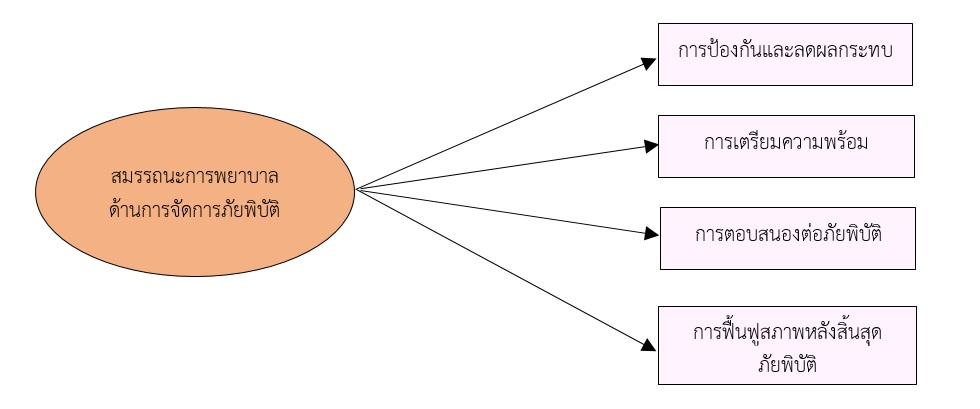
1. Disaster management competencies of nursing administrators were divided into four components: 1) disaster protection and reduction of severity, 2) disaster preparedness, 3) disaster response, and 4) disaster recovery and rehabilitation.
2. The disaster management competency of nursing administrators in hospitals under the Ministry of Public Health was consistent with the empirical evidence. All components had an acceptable level. Chi-square value was at 1.69 degrees, freedom was at the 1 level, probability was 0.681, goodness of fit index (GFI) was at 1.00, root mean square residual (RMR) was at 0.00. Root mean square error of approximation (RMSEA) was at 0.00, comparative fit index (CFI) was at 1.00, and the normed fit index (NFI) was at 1.00.
Per findings, construct validity of disaster management competency should be conducted, so that it can be used to evaluate nursing administrators in a public hospital context.
References
Beach, M. (2010). Disaster Preparedness & Management. Philadelphia: F.A. Davis.
Best, John W. (1981). Research in Education. 3rd ed. Englewood Cliffs, New Jersey: Prentice. Hall Inc.
Comrey, A. L., & Lee, H. B. (1992). A First Course in Factor Analysis (2nd ed.). New Jersey: Lawrence Erlbaum Associates. Retrived October 15, 2009, from http:// www. ingentaconnect.com/content/apl/lcbi
DeVellis, R. F. (2012). Scale Development: Theory and Applications. London: SAGE Publication Ltd.
Fablgren, T., & Drenkard, K. N. (2002). Healthcare System Disaster Preparedness, Part 2: Nursing Executive Role in Leadership. The Journal of Nursing, 32(10), 531-537.
Gebbie, K. M., & Qureshi, K. (2002). Emergency and Disaster Preparedness: Core Competenciesfor Nurses: What Every Nurse Should But May Not Know. American Journal of Nursing, 102(1), 46-51.
Goodwin Veenema, T., Deruggiero, K., Losinski, S., & Barnett, D. (2017). Hospital Administration and Nursing Leadership in Disasters. Nursing Administration Quarterly, 41(2), 151-163. doi:10.1097/NAQ.0000000000000224
Hammad, K. S., Arbon, P., & Gebbie, K. M. (2011). Emergency Nurses and Disaster Response: An Exploration of South Australian Emergency Nurses’ Knowledge and Perceptions of Their Roles in Disaster Response. Australasian Emergency Nursing Journal, 14(May), 81-94.
Ishii, M. (2012). Disaster Nursing 2. Paper Presented at the Disaster Nursing Training Course, May 7 and 8: Chulalongkorn University-Global Development Learning Network (CU-GDLN). Faculty of Nursing, Chulalongkorn University and Word Bank Tokyo Development Learning center (WBTDLC).
Jennings-Sanders, A., Frisch, N., & Wing, S. (2005). Nursing Students’ Perceptions about Disaster. Disaster Management & Response, 3(3), 80-85.
Lin, C. J., & Chen, C. M. (2008). Important Issues and Challenges: Disaster Nursing. In C.-M.Chen, Y. M. Chao, & Y. H. Lai (Eds.), Nursing Care in Taiwan. Taipai: Department of Health.
Livomese, K., & Vedder, J. (2017). The Emotional Well-Being of Nurses and Nurse Leaders in Crisis. Nursing Administration Quarterly, 41(2), 144-150. doi:10.1097/NAQ.0000000000000221
National Disaster Preparedness Committee. (2015). Prevention and Mitigation National Fire and Rescue Department. Bangkok: Department of Disaster Prevention and Mitigation. Ministry of the Interior
Newton, E. E. (2017). Preparing for the Big One: Emergency Preparedness for Nursing Leaders. Nursing Administration Quarterly. Apr/Jun, 41(2), 101-111. doi: 10.1097/NAQ.0000000000000215.
Office of The National Economic and Social Development Council. (2011). Disaster Management and Rehabilitation After Disaster Report. Phenchrung Publishing, Bangkok.
Shih, F., Turale, S., Lin, Y., Gau, M., Kao, C., Yang, C., & Liao, Y. (2009). Surviving a Life-Threatening Crisis: Taiwan's Nurse Leaders' Reflections and Difficulties Fighting the SARS Epidemic. Journal of Clinical Nursing, 18(24), 3391-3400. doi:10.1111/j.1365-2702.2008.02521.x
Siripukdeekan, A. & Wiserith, (2014). W. A Study of Disaster Nursing Management. Journal of The Royal Thai Army Nurses, 15(2), 348-359.
Siripul, P., Sakdisthanont, S (2012). Disaster Nursing: Essential Competencies for Thai Nurses) Thai Journal of Nursing Council. 27. Special Issue, 1-30.
Slepski, L. (2007). Emergency Preparedness and Professional Competency among Health Care Providers during Hurricanes Katrina and Rita: Pilot Study Results. Disaster Management & Response, 54(4), 99-110.
Thanaroj, S., Sadhittwithayanan, S., & Chantra, R. (2014). Nurse Competencies in Disaster Management. Journal of Boromarajonani College of Nursing, Bangkok, 30(3), 35-44.
Tipwareeom, W. (2012). Public Health Nursing Role a Natural Disaster Management. Journal of Public Health Nursing, 26(3), 119-131.
Ummunt, U., Kongkom, S., Nontapate, O., & Srekate, P. (2011). Natural Disaster Management: Nurse Experience in Southern Province. Journal of Nursing Devision, 38(1), 67-74.
Willis, J., & Philp, L. (2017). Orlando Health Nurse Leaders Reflect on the Pulse Tragedy. Nurse Leader, 15(5), 319-322. doi:10.1016/j.mnl.2017.07.007
Witoonsasiwimol, P., & Kanjanarat, P. (2017). Medication Preparedness for Emergency Flooding Situations of Public Hospitals in Central Thailand: A Case Study of Flooding Crisis in 2011 IJPS, 13(3), 25-37
Wynd, C. A. (2006). A Proposed Model for Military Disaster Nursing. Online Journal of Issues in Nursing, 11(3), 17.
Downloads
Published
Issue
Section
License
1. บทความหรือข้อคิดเห็นใด ๆ ที่ปรากฏในวารสารเครือข่าย วิทยาลัยพยาบาลและการสาธารณสุขภาคใต้ ที่เป็นวรรณกรรมของผู้เขียน บรรณาธิการหรือเครือข่ายวิทยาลัยพยาบาลและวิทยาลัยการสาธารณสุขภาคใต้ ไม่จำเป็นต้องเห็นด้วย
2. บทความที่ได้รับการตีพิมพ์ถือเป็นลิขสิทธิ์ของ วารสารเครือข่ายวิทยาลัยพยาบาลและการสาธารณสุขภาคใต้