Relationships Between Knowledge, Perception, and the "New Normal Behaviors" for Preventing Coronavirus Disease (COVID-19) Infection among People in Narathiwat Province
Keywords:
COVID-19, Knowledge, Perception, New Normal BehaviorsAbstract
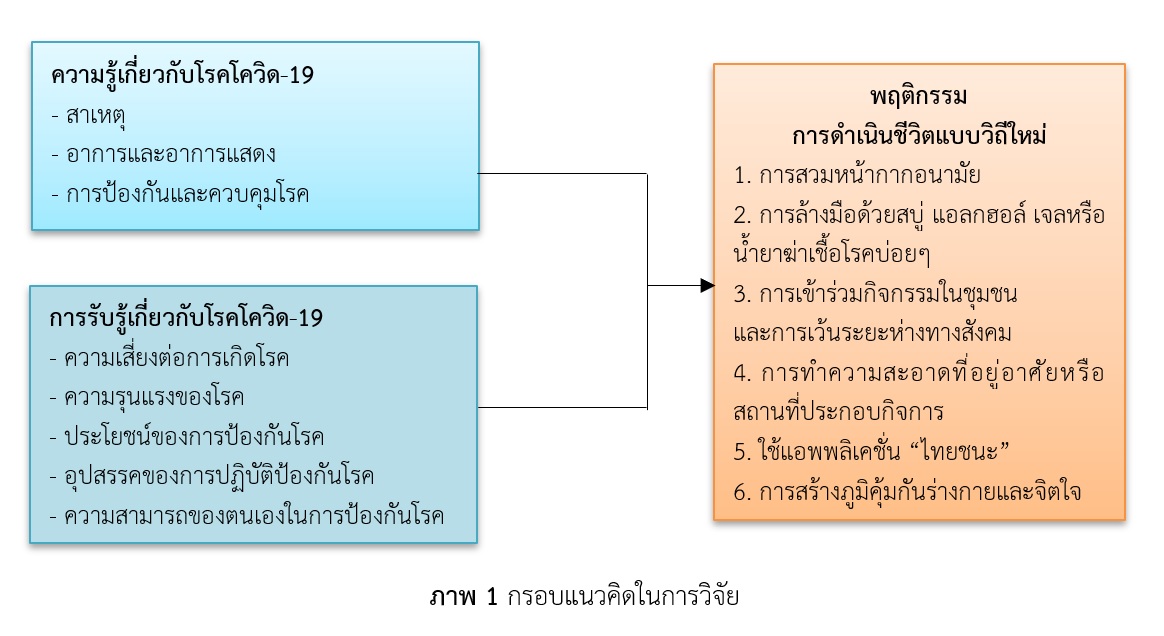
This descriptive and cross-sectional research aimed to study the level of knowledge, perception, and the "new normal behaviors" for COVID-19 prevention, and then to examine the relationships between knowledge, perception, and those behaviors for COVID-19 prevention in Narathiwat province.Sample was 5,444 people aged 15 and over. Research tool was a questionnaire consisting of 4 parts: 1) general information, 2) knowledge about COVID-19, 3) awareness of COVID-19, and 4) new normal behaviors for the prevention of COVID-19. Content validity of the questionnaire was examined by experts, and obtained IOC values between 0.67–1. Reliability of questionnaire regarding knowledge was tested using KR-20, and obtained a value of 0.80. Reliability of perception, and "new normal behaviors" part was tested using Cronbach’s alpha coefficient, yielding values of 0.92 and 0.90, respectively. Data were analyzed using frequency, percentage, mean, standard deviation, and Pearson's correlation. Results were as follows.
Most of people (79.50 %) had knowledge about COVID-19 at a high level (M=17.29, SD=3.94). Their perception about COVID-19 was at a high level (M=3.97, SD=0.40) as well. While the "new normal behaviors" for the prevention of COVID-19 was at a moderate level (M=1.28, SD=0.27). Knowledge and perception about the COVID-19 were positively correlated with the new normal behaviors for the prevention of COVID-19 (r=0.211, p<.01 and r= .101, p<.01).
From the research results, relevant agencies should communicate, understand and campaign for "new normal behaviors" in order to prevent COVID-19, in particular, the use of the Thai Chana application, the registration of the public access in public areas. The data can be used in surveillance and control disease, and develop New normal behaviors for continual and sustainable COVID-19 prevention.
References
Bangkok Poll. (2020). Don’t Let Your Guard Down. Retrieved February 2, 2021 from http://bangkokpoll.bu.ac.th/
Best, W. J. (1978). Research in Education. (3rd ed.). New Jersey: Prentice Hall.
Boonmee, P., Mahamit, S., & Kawila, T. (2018) Knowledge, Perception, and Awareness of RiskManagement and Patient Safety towards Nursing Students at Boromarajonani College of Nursing, Phayao. Journal of Nursing and Education, 11(3), 112-124.
Department of Disease Control Ministry of Public Health. (2021). COVID-19 Report. Retrieved April 20, 2021 from https://ddc.moph.go.th/viralpneumonia/file/situation/situation-no437-150364.pdf
Glomjai, T., Kaewjiboon, J., & Chachvarat, T. (2020). Knowledge and Behavior of People Regarding Self-Care Prevention from Novel Coronavirus 2019 (COVID-19). Journal of Nursing, Public Health, and Education, 21(2), 29-39.
Health Data Center (HDC) Narathiwat. (2020). Narathiwat Population. Retrieved May 14, 2020 fromhttp://hdc.ntwo.moph.go.th/hdc/reports/page.php?cat_id=ac4eed1bddb23d6130746d62d2538fd0
Malathum, K., & Malathum, P. (2020). The COVID-19 Pandemic: What We Have Learned from Thai Experiences. Pacific Rim Int J Nurs Res, 24(4), 431-435.
Narathiwat Province. (2021). COVID-19 Report. Retrieved April 20, 2021 from http://www2. narathiwat.go.th/nara2016/covid
National Broadcasting and Telecommunication Commission. (2020). Press Conference on the COVID-19 Outbreak. Retrieved February 2, 2021 from https://www.bangkokbiznews. com/news/detail/914136
National Statistical Office of Thailand. (2021). TV Viewing Devices in Thai Households. Retrieved February 2, 2021 from http://www.nso.go.th/sites/2014/Pages/News/2561/N25-01-61-2.aspx
Nawsuwan, K., Singweratham, N., & Thepaksorn, P. (2020). Compositions and Indicators for Successful Implementation of Novel Coronavirus (COVID-19) in the Community of Village Health Volunteers (VHVs) in Thailand. The Southern College Network Journal and Public Health, 7(2), ก-จ.
Nawsuwan, K., Singweratham, N., Waichompu, N., & Chayakul, K. (2020). The Successful Implementation of Novel Coronavirus (COVID-19) in the Community of Village Health Volunteers (VHVs) in Thailand. Princess of Naradhiwas University Journal, 12(3), 195-212.
Pannarunothai, S. (2020). Surviving COVID-19 Pandemic with Knowledge and Action. Journal of Health Systems Research, 14(1), 1-6.
Powwattana, A., Kalampakorn, S., Lagampan S., & Rawiworrakul. (2018). Health Promotion and Disease Prevention in Community: An Application of Concepts and Theories to Practice (Revised Edition). Chachoengsao: M N COMPUTE OFFSET CO., LTD. (in Thai)
Singweratham, N., Thaopan, W. W., Nawsuwan, K., Pohboon, C., & Surirak, S. (2020). Perception and Preventive Behaviors on the Coronavirus Disease-2019 (COVID-19) among Dental Nurses under the Ministry of Public Health. J Bamrasnaradura Infect Dis Inst, 14(2), 104-115.
Thai Health Promotion Foundation. (2020). New Way of Life Guide Life Begins with Us. Retrieved July 15, 2020 from https://www.thaihealth.or.th/Books/643/คู่มือ%20ชีวิตวิถีใหม่.html
Thato, R. (2018). Nursing Research: Concepts to Application.(3 rd ed.). Bangkok: Chulalongkorn University. (in Thai)
Downloads
Published
Issue
Section
License
1. บทความหรือข้อคิดเห็นใด ๆ ที่ปรากฏในวารสารเครือข่าย วิทยาลัยพยาบาลและการสาธารณสุขภาคใต้ ที่เป็นวรรณกรรมของผู้เขียน บรรณาธิการหรือเครือข่ายวิทยาลัยพยาบาลและวิทยาลัยการสาธารณสุขภาคใต้ ไม่จำเป็นต้องเห็นด้วย
2. บทความที่ได้รับการตีพิมพ์ถือเป็นลิขสิทธิ์ของ วารสารเครือข่ายวิทยาลัยพยาบาลและการสาธารณสุขภาคใต้