The Effects of a New Blended Learning Program on Health Behaviors among Women at Risk for Gestational Diabetes Mellitus
Keywords:
Blended Learning Program, Health Behaviors, Women at Risk for Gestational Diabetes MellitusAbstract
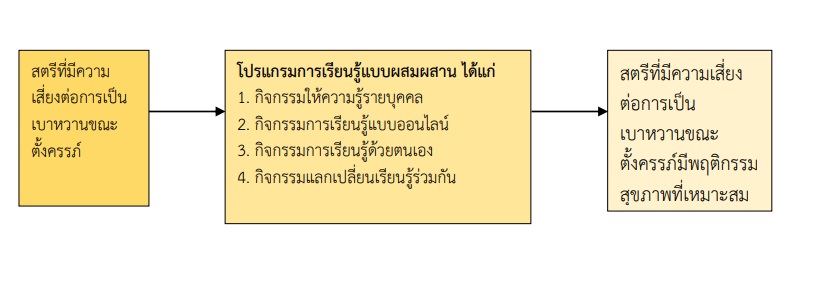
This two-group pretest-posttest pseudo-randomized controlled trial research aimed to examine the effects of a new blended (or hybrid) learning program on health behaviors among women at risk for gestational diabetes mellitus. The experimental group received the blended learning program, while the control group did not. The participants were 52 pregnant women at risk for gestational diabetes mellitus at the stage of 20 to 24 gestational weeks, receiving antenatal care at Udonthani Hospital, from August to November 2020. The 52 participants were randomly assigned into the control and experimental groups (26 per each) by tossing a coin. The experimental group received the blended learning program combined with the usual care, the control group received the usual care. The research instruments were: 1) the blended learning program and 2) the self-care handbook for women at risk for gestational diabetes mellitus. The collecting data instruments included a personal data record form, as well as a questionnaire on health behavior for women at risk for gestational diabetes mellitus developed by the researcher with a content validity index (CVI) of 1, and a reliability of .87. Data were analyzed using descriptive statistics, Fisher’s exact test, independent t-test, and paired t-test. The results were as follows.
1.The experimental group, after receiving the blended learning program, had statistically significantly higher health behavior mean scores than before (p<.001).
2.The experimental group, after receiving the blended learning program, had a statistically significantly higher health behavior mean scores than the control group (p<.001)
The findings from this study suggest that nurse midwives can use this blended learning program, so to improve health behaviors among women at risk for gestational diabetes mellitus.
References
American College of Obstetricians and Gynecologists. (2018). ACOG Practice Bulletin No. 190: Gestational Diabetes Mellitus. Obstetrics & Gynecology, 131(2), e49–e64. doi:10.1097/aog.0000000000002501
Chuchue, A., Pakdevon, N., & Binhosen, V. (2014). Effects of Self Management Enhancing Program on Health Behaviors and Blood Sugar in Women with Gestational Diabetes Mellitus. Journal of Nursing and Health Care, 32(4), 60-67.
Bellamy, L., Casas, J. P., Hingorani, A. D., & Williams, D. (2009). Type 2 Diabetes Mellitus After Gestational Diabetes: A Systematic Review and Meta-Analysis. The Lancet, 373(9677), 1773–1779.
Burn, N., & Grove, S. K. (2009). The Practice of Nursing Research: Conduct, Critique and Utilization (6thed.). St. Louis: Elsevier Saunders.
Bunthalarath, S., Sunsaneevithayakul, P., & Boriboohirunsarn, D. (2004). Risk Factors for Early Diagnosis of Gestational Diabetes Mellitus. Journal-Medical Association of Thailand, 87, S50–S53.
Carolan-Olah, M., Steele, C., & Krenzin, G. (2015). Development and Initial Testing of a GDM Information Website for Multi-Ethnic Women with GDM. BMC Pregnancy and Childbirth, 15(145). 1-9. doi.org/10.1186/s12884-015-0578-0
HAPO Study Cooperative Research Group. (2002). The hyperglycemia and Adverse Pregnancy Outcome (HAPO) Study. International Journal of Gynecology & Obstetrics, 78(1), 69-77.
HAPO Study Cooperative Research Group. (2008). Hyperglycemia and Adverse Pregnancy Outcomes. New England Journal of Medicine, 358(19), 1991-2002.
International Diabetes Federation [IDF]. (2017). Care & Prevention Gestational Diabetes. Retrieved form https://www.idf.org/our-activities/care-prevention/gdm.html
Kamana, K. C., Shakya, S., & Zhang, H. (2015). Gestational Diabetes Mellitus and Macrosomia: a Literature Review. Annals of Nutrition and Metabolism, 66(Suppl. 2), 14-20.
Kasl, S. V., & Cobb, S. (1966). Health Behavior, Illness Behavior, and Sick-Role Behavior. Archives of Environmental Health: An International Journal, 12(4), 531-541. doi:10.1080/00039896.1966.10664421
Kramer, C. K., Campbell, S., & Retnakaran, R. (2019). Gestational Diabetes and the Risk of Cardiovascular Disease in Women: a Systematic Review and Meta-Analysis. Diabetologia, 62(6), 905-914.
Limruangrong, P., Boriboonhirunsarn, D., Puangsricharern, A. & Pinitlertsakun, O. (2016). Factors Influencing the Occurrence of Gestational Diabetes Mellitus in Pregnant Women with Abnormal Glucose Challenge test. Journal of Nursing Science, 34(2), 59-69.
Qui, J., Liu, Y., Zhu, W., & Zhang, C. (2020). Comparison of Effectiveness of Routine Antenatal Care with a Midwife-Managed Clinic Service in Prevention of Gestational Diabetes Mellitus in Early Pregnancy at a Hospital in China. Medical Science Monitor: International Medical Journal of Experimental and Clinical Research, 26, e925991-18. doi: 10.12659/MSM.925991
Pholyiam, R. & Wattananukulkiat, S. (2016). Effect of Health Belief Based Education Program on Health Behavior among Pregnant Women at Risk for Gestational Diabetes Mellitus. The Journal of Baromarajonani College of Nursing Nakhonratchasima, 22(1), 77-92.
Rojnawaseree, D. (2018). The Effect of Health Promotion and Spouse Support to the Blood Glucose Level and Health-Promoting Behaviors in Women at Risk of Gestational Diabetes Mellitus. Nursing Public Health and Education Journal, 19(3), 47-58.
Singwongsa, A., & Borriboonhiransan, D. (2016). Incidence and Associated Factors of Gestational Diabetes Mellitus Diagnosed During 24-28 Weeks of Gestation. Thai Journal of Obstetrics and Gynaecology, 24(3), 184-192.
Sitkulanan, P. & Kumtip, P. (2020). Impact of a Self-Management Programme Monitored Through the Application LINE on Eating Behaviour, Arm-Swing Exercise Behaviour, and Blood Glucose Levels in Women with Gestational Diabetes Mellitus. Journal of Thailand Nursing and Midwifery Council, 35(2), 52-69.
Society of Obstetricians and Gynaecologists of Canada. (2016). Diabetes in Pregnancy. J Obstet Gynaecol Can, 38(7), 67-79.
Uwes, A. C., Wibawa, B., & Syahrial, Z. (2018). Determining the Appropriate Blend of Blended Learning: A Formative Research in the Context of Spada-Indonesia. American Journal of Educational Research, 6(3), 188-195. doi:10.12691/education-6-3-5
Wang, C., Wei, Y., Zhang, X., Zhang, Y., Xu, Q., Sun, Y., et al. (2017). A Randomized Clinical Trial of Exercise During Pregnancy to Prevent Gestational Diabetes Mellitus and Improve Pregnancy Outcome in Overweight and Obese Pregnant Women. American Journal of Obstetrics and Gynecology, 216(4), 340-351. doi:10.1016/j.ajog.2017.01.037
Zhu, Y., & Zhang, C. (2016). Prevalence of Gestational Diabetes and Risk of Progression to Type 2 Diabetes: a Global Perspective. Current Diabetes Reports, 16(7). doi:10.1007/s11892-015-0699-x
Downloads
Published
Issue
Section
License
Copyright (c) 2022 The Southern College Network Journal of Nursing and Public Health

This work is licensed under a Creative Commons Attribution-NonCommercial-NoDerivatives 4.0 International License.
1. บทความหรือข้อคิดเห็นใด ๆ ที่ปรากฏในวารสารเครือข่าย วิทยาลัยพยาบาลและการสาธารณสุขภาคใต้ ที่เป็นวรรณกรรมของผู้เขียน บรรณาธิการหรือเครือข่ายวิทยาลัยพยาบาลและวิทยาลัยการสาธารณสุขภาคใต้ ไม่จำเป็นต้องเห็นด้วย
2. บทความที่ได้รับการตีพิมพ์ถือเป็นลิขสิทธิ์ของ วารสารเครือข่ายวิทยาลัยพยาบาลและการสาธารณสุขภาคใต้