Development of a Web Application for Reporting Laboratory Results to Patients with Diabetes in Health Promoting Hospitals of Suphanburi
Keywords:
Web Application, Laboratory Result Report, Diabetes PatientsAbstract
This research and development study aimed to: 1) identify reporting laboratory problems process with diabetic patients, 2) develop a web application for reporting laboratory results, and 3) study the effectiveness of the laboratory report process in Health promoting hospital of Muang Suphanburi. Study consisted of 3 steps. First step was the situation analysis regarding problems in reporting laboratory results. Problems were reported through interviewing patients and staff members. Second step was the development of a web application for reporting laboratory results, which was based on the previous step and literature review. Third step was the quality assessment of web application. The laboratory reporting process was evaluated among patients with diabetes and incidents were reported. Reliability was examined using Cronbach’s alpha coefficient, yielding a value of .88. Content validity presented higher than 0.5. Descriptive statistic and inferential statistic paired t-test were uses to analyze data. Results of this study revealed as follows.
1. Investigating and reporting blood test results firstly acknowledged that the diabetic patients had to go to the hospital for blood tests. Then, they had to wait for the test result at the hospital. After that, the patients had to bring their laboratory results back to their Health promoting hospital staff in order to be used for treatment.
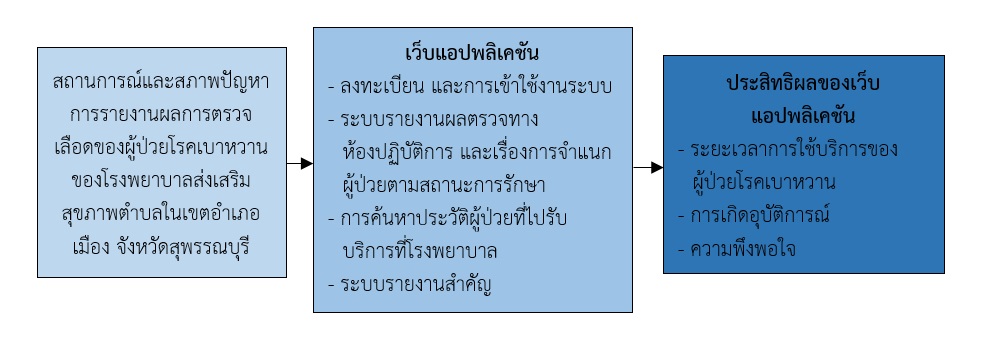
2. Use of the web application consists of 3 parts: 1) reporting blood test results, 2) finding the history of patients who went to the hospital, and 3) reporting system.
3. After using the web application, duration of service was statistically significant less than before using the web application (M=99.81, SD=38.17, and M=156.74, SD=22.32, respectively, p<.01). In addition, after using the web application, there were no reported problems about laboratory result reporting such as lost, damaged, and forgotten document.
References
Cohen, J. (1988). Statistical Power Analysis for the Behavioral Sciences. (2nd). Hillsdale, NJ: Lawrence Erlbaum Associates, Publishers.
Faul, F., Erdfelder, E., Lang, A. G., & Buchner, A. (2007). G*Power 3: A Flexible Statistical Power Analysis Program for the Social, Behavioral, and Biomedical Sciences. Behavior Research Methods, 39(2), 175-191.
Health Systems Research Institute. (2010). Knowledge Management and Synthesis of Practice Guidelines for Tambon Health Promoting Hospitals. Management of Chronic Disease Care System In Case of Diabetes and Hypertension. (in Thai)
Khakom, A. (2003). The Study Factors Which Related to Credit Service of Government Hosing Bank. Kasetsart University. Bangkok. (in Thai)
Phromwong, C. (2013). Developmental Testing of Media and Instructional Package. Silpakorn Journal of Research Sciences, 5(1), 5-20. (in Thai)
Sinsawad, P., Chuawong, P. & Muangpool, T. (2019). Application to Calculate the High Alert Drugs. Journal of Project in Computer Science and Information Technology, 5(1), (in Thai)
Thipprapai, N. (2016). The Satisfaction and Behavior among Company Workers to use Application Affecting Rebooking Hotel by Application on Smartphone. M.B.A., Graduate School, Bangkok University. (in Thai)
Wasutada, K. (2017). The Relationship Between Perception Toward Non-Communicable Diseases and Health Promotion Behaviors for Non-Communicable Diseases Prevention among People in Muang District, Chanthaburi Province. The journal of Pharapokklao nursing College, 29(2), (in Thai).
Downloads
Published
Issue
Section
License
1. บทความหรือข้อคิดเห็นใด ๆ ที่ปรากฏในวารสารเครือข่าย วิทยาลัยพยาบาลและการสาธารณสุขภาคใต้ ที่เป็นวรรณกรรมของผู้เขียน บรรณาธิการหรือเครือข่ายวิทยาลัยพยาบาลและวิทยาลัยการสาธารณสุขภาคใต้ ไม่จำเป็นต้องเห็นด้วย
2. บทความที่ได้รับการตีพิมพ์ถือเป็นลิขสิทธิ์ของ วารสารเครือข่ายวิทยาลัยพยาบาลและการสาธารณสุขภาคใต้