การพัฒนารูปแบบการจัดการมูลฝอยติดเชื้อในชุมชน เขตสุขภาพที่ 4
คำสำคัญ:
การพัฒนารูปแบบ, การจัดการมูลฝอยติดเชื้อในชุมชน, เขตสุขภาพที่ 4บทคัดย่อ
การวิจัยเชิงผสมผสานนี้ ประยุกต์ใช้ CIPP-I Model ในการประเมินผลสัมฤทธิ์ของการจัดการมูลฝอยติดเชื้อในชุมชน เพื่อพัฒนารูปแบบการจัดการมูลฝอยติดเชื้อในชุมชน เขตสุขภาพที่ 4 โดยแบ่งเป็น 5 ระยะ ได้แก่ 1) ทบทวน กฎหมาย มาตรการ การจัดการมูลฝอยติดเชื้อในชุมชน 2) ศึกษาศักยภาพการจัดการมูลฝอยติดเชื้อในชุมชน เขตสุขภาพที่ 4 ด้วยแบบสอบถาม จากผู้รับผิดชอบการจัดการมูลฝอยติดเชื้อในระดับตำบล จำนวน 260 คน สุ่มตัวอย่างแบบโค้วต้าและสุ่มแบบง่าย 3) ศึกษาปัจจัยความสำเร็จในการจัดการมูลฝอยติดเชื้อ พื้นที่ต้นแบบ 4 จังหวัด ด้วยการสัมภาษณ์ จากผู้รับผิดชอบการจัดการมูลฝอยติดเชื้อ ใน สสจ, รพ.แม่ข่าย, สสอ., ทต. และ รพ.สต.จำนวน 20 คน สุ่มโดยวิธีเฉพาะเจาะจง 4) การร่างรูปแบบการจัดการมูลฝอยติดเชื้อในชุมชนจากการถอดบทเรียนปัจจัยความสำเร็จและรูปแบบในการจัดการมูลฝอยติดเชื้อ พื้นที่ต้นแบบ 4 จังหวัดโดยผู้วิจัย 5) การยืนยันรูปแบบฯ ด้วยแบบสอบถามและการสนทนากลุ่ม กลุ่มตัวอย่าง คือ ผู้รับผิดชอบการจัดการมูลฝอยติดเชื้อ ใน รพ.สต., สสอ., โรงพยาบาลแม่ข่าย และ อปท. ในเขตสุขภาพที่ 4 จำนวน 100 คน โดยวิธีเฉพาะเจาะจง วิเคราะห์ข้อมูลด้วยสถิติเชิงพรรณนา และการวิเคราะห์เชิงเนื้อหา ผลการวิจัย พบว่า
1. ศักยภาพการกำจัดมูลฝอยติดเชื้อในชุมชน มีศักยภาพต่ำ (M=0.33 SD=0.470)
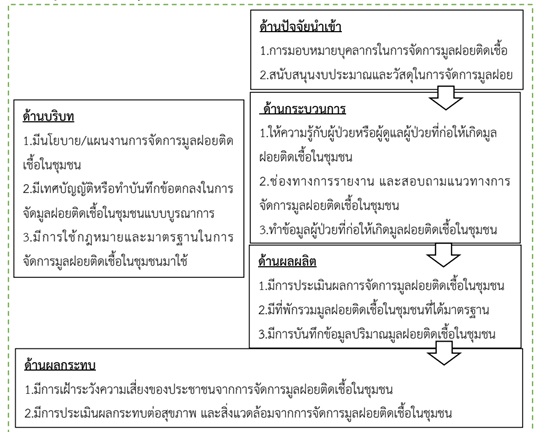
2. รูปแบบการจัดการมูลฝอยติดเชื้อในชุมชน ประกอบด้วย 1) ด้านบริบท คือ (ก) จัดทำเทศบัญญัติ,ข้อตกลงในการจัดการมูลฝอยติดเชื้อ (ข) จัดทำแผนงานร่วมกันในการจัดการมูลฝอยติดเชื้อ (ค) การใช้กฎหมายและมาตรฐานที่เกี่ยวข้อง 2)ด้านปัจจัยนำเข้า คือ (ก) สนับสนุนงบประมาณและวัสดุในการจัดการมูลฝอยติดเชื้อ (ข) มอบหมายบุคลากรที่ชัดเจน 3)ด้านกระบวนการ คือ (ก) ให้ความรู้กับผู้ป่วยและผู้ดูแลผู้ป่วย (ข) จัดทำฐานข้อมูลผู้ป่วยในชุมชน (ค) การติดตามประเมินผล 4) ด้านผลผลิต คือ (ก) ช่องทางการรายงานและสอบถาม (ข)การบันทึกปริมาณมูลฝอยติดเชื้อ (ค) มีที่พักมูลฝอยติดเชื้อที่ได้มาตรฐาน 5) ด้านผลกระทบ ได้แก่ (ก)ประเมินผลกระทบต่อสุขภาพและสิ่งแวดล้อม (ข) การเฝ้าระวังความเสี่ยงจากการจัดการมูลฝอยติดเชื้อในชุมชน โดยรูปแบบการจัดการมูลฝอยติดเชื้อในชุมชน มีความเหมาะสม (M=4.18, SD=0.629) และความเป็นได้ (M=3.86, SD=0.829) ในระดับมาก
ควรมีการนำรูปแบบการจัดการมูลฝอยติดเชื้อในชุมชนไปใช้ ในการจัดการมูลฝอยติดเชื้อในชุมชน ซึ่งการจัดการมูลฝอยติดเชื้อตั้งแต่ต้นทางที่ถูกต้องเหมาะสมจะช่วยลดผลกระทบต่อสุขภาพและสิ่งแวดล้อมได้
เอกสารอ้างอิง
Abbas, S., MBBS, T., McNair, M. D., & Bearman, G. (2018). Guide to Infection Control in The Hospital. Retrieved February 10, 2020 from https://isid.org/wpcontent/uploads/2018/02/ISID InfectionGuide Chapter56.pdf
Ali, M., Wang, W., Chaudhry, N. & Geng, Y., (2017). Hospital Waste Management in Developing Countries: A Mini Review. Waste Manage. Retrieved March 3, 2020 from https://pubmed.ncbi.nlm.nih.gov/28566033/:581-592.
Chaisri, Y., Kittitornkool, J., & SuksaroJ. T., (2015). The Development of Infectious Waste Management System in Huasai Hospital, Nakhon Si Thammarat Province. The 34th National Graduate Research Conference Retrieved February 10, 2020 from https://gsbooks.gs.kku.ac.th/58/the34th/pdf/MMP10.pdf,P981-988;
Chartier, Y., Emmanuel, J., Pieper, U., Prüss A., Rushbrook, P., & Stringer, R. (2014). Safe Management of Wastes for Health-Care Activities. Second Edition ed. Editors. Geneva: Retrieved February 10, 2020 from http://www.wpro.who.int/entity/apac_ rfhe/hcwmanagement_factsheet_rfhe.pdf
Department Disease Control. (2010). Guide for Management of Infectious Waste Center for Local Administrative Organizations. Bankok: (pp.16-18) (In Thai)
Department of Health. (2017). Documents on Infectious Waste Management. Bankok: Retrieved February 10, 2020 from www.oic.go.th/Fileweb/Cabinforcenter17/Drawer002/General/ Data0001/00001430.
Department of Health. (2019). Infectious Waste Control Program Retrieved February 10, 2019 from https://envmanifest.anamai.moph.go.th/
Jeroen, B., Liesje D., & Jonas V., (2011). Municipal Infectious Waste Collection Problems: A Literature Review. Hub Research Papers 2011/34 Economics & Management: 3. Retrieved February 10, 2020 from https://www.researchgate.net/publication/257420825__
Krejcie, R. V. & Morgan, D. W. (1970). Determining Sample Size for Research Activities. Educational and Psychological Measurement, 30(3), 607-610.
Manee-in, J. (2013). Infectious Waste Management of Local Authorities. A Dissertation Submitted in Partial Fulfilment of the Requirement of the Master of Science (Environmental Management). Graduate School of Environmental Development Administration, National Institute of Development Administration. (In Thai)
Mastorakis, N. E., Bulucea, C. A., Oprea, T. A., Bulucea, C. A., & Dondon, P. (2011). Holistic Approach of Biomedical Waste Management System with Regard to Health and Environmental Risks. Development, Energy, Environment, Economics, 5(3), 287-295. Retrieved February 10, 2020 from https://www.researchgate.net/profile/Nikos_Mastorakis2/publication/50370424_ Holistic_approach_of_biomedical_waste_management_system_with_regard_to_health_and_environmental/links/573b254408ae9ace840e9ec0/Holistic-approach-of-biomedical-waste-management-system-with-regard-to-health-and-environmental.pdf
Nwachukwu, N. C., Orji, F. A., & Ugbogu, O. C. (2013). Health Care Waste Management Public Health Benefits, and the Need for Effective Environmental Regulatory Surveillance in Federal Republic of Nigeria. Retrieved February 10, 2020 from https://www.intechopen.com/books/current-topics-in-public-health/health-care-waste-management-public-health-benefits-and-the-need-for-effective-environmental-regulation
Onchuanjit, S., & Treethong, R. (2006). Home Health Care Service. 2nded. Faculty of Nursing Prince of Songkla University. Songkla: Songkla University. (in Thai)
Phobun, J. (2017). Environmental Assessment. Bangkok: All in One Printing. (in Thai)
Phongsawalee, A. (2019). Infectious Waste Management Effectiveness of the Public Health Services Organization, Nongbualamphu Province. Thailand Journal of Health Promotion and Environment Health, 82-92. (in Thai)
Radha, R. (2012). Assessment of Existing Knowledge, Attitude and Practices Regarding Biomedical Waste Management among the Health Care Workers in a Tertiary Care Rural Hospital. International Journal of Health Services and Research, 2. 14-19. Retrieved February 10, 2020 from http://www.ijhsr.org/IJHSR_Vol.2_Issue.7_Oct2012/3.pdf
Religion Health Promotion Center 4. (2019). Infectious Waste Management in Health Region4 Saraburi. Retrieved February 10, 2020 from https://hpc4.anamai.moph.go.th/. (in Thai)
Soponpats, P. (2012). An Evaluation of Public Participation in Environmental Impact Assessment: A Study of the Khao Hin Son Coal-Fired Power Plant Project, Chachoengsao A Dissertation Submitted in Partial Fulfilment of the Requirement of the Master of Science (Environmental Management): Graduate School of Environmental Development Administration, National Institute of Development Administration. (in Thai)
Sunthorn, T. (2013). A Study of Infectious Waste Management for Overnight Hospital in Pattaya Municipality, Chonburi Province. Case Study: A Private Hospital in the North Pattaya Municipality, Chonburi Province, Dhurakij Pundit University. (in Thai)
Tabrizi, J. S., Saadati, M., Heydari, M., Rezapour, R. & Zamanpour, R. (2018). Primary Health Care Benefits, and the Need for Effective Environmental Regulatory Surveillance in Federal Republic of Nigeria. Retrieved February 10, 2020 from https://www.semanticscholar.org/paper/Health-Care-Waste-Management-%E2%80%93-Public-Health-and-in-Nwachukwu Orji/70c9a8cd11f6d3274bdc5ea5c7024e3dcadc35a7
Takoporn, R. (2015). Infectious Waste Management Behaviors With in Household. A Case Study of Chombueng, Ratchaburi Province An Independent Study Submitted in Partial Fulfillment of the Requirements for the Degree Master of Science Program in Environmental Science Department of Environmental Science Graduate School, Silpakorn University. (in Thai)
Vetrivel, C. (2014). Segregation of Biomedical Waste in an South Indian Tertiary Care Hospital. Journal of Natural Science, Biology and Medicine, 5(2), 378-382 Retrieved February 10, 2020 from https://www.ncbi.nlm.nih.gov/pubmed/25097419
WHO. (2015). Safe Health-Care Waste Management Policy Paper. Retrieved February 10, 2020 from: http://ww.who.int/water_sanitation_health/medicalwaste/hcwmpolicy/en/;31-34
ดาวน์โหลด
เผยแพร่แล้ว
ฉบับ
ประเภทบทความ
สัญญาอนุญาต
ลิขสิทธิ์ (c) 2022 วารสารเครือข่ายวิทยาลัยพยาบาลและการสาธารณสุขภาคใต้

อนุญาตภายใต้เงื่อนไข Creative Commons Attribution-NonCommercial-NoDerivatives 4.0 International License.
1. บทความหรือข้อคิดเห็นใด ๆ ที่ปรากฏในวารสารเครือข่าย วิทยาลัยพยาบาลและการสาธารณสุขภาคใต้ ที่เป็นวรรณกรรมของผู้เขียน บรรณาธิการหรือเครือข่ายวิทยาลัยพยาบาลและวิทยาลัยการสาธารณสุขภาคใต้ ไม่จำเป็นต้องเห็นด้วย
2. บทความที่ได้รับการตีพิมพ์ถือเป็นลิขสิทธิ์ของ วารสารเครือข่ายวิทยาลัยพยาบาลและการสาธารณสุขภาคใต้