Prevention of Ventilator-Associated Pneumonia (VAP): Updated Guideline and Literature Review
Keywords:
VAP, Ventilator Pneumonia, Content Analysis, Literature Review, GuidelineAbstract
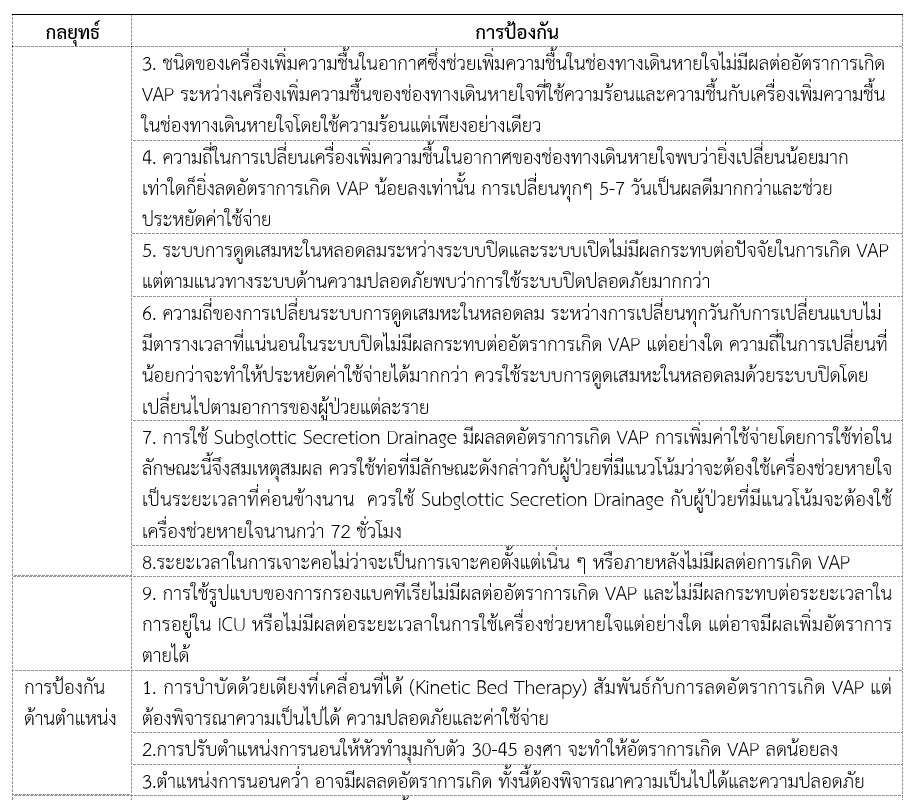
The objective of this article was to review research literature in order to create an updated guideline for the prevention of ventilator-associated pneumonia (VAP) in patients. All research results published from 2009 to 2019 were analyzed and synthesized. The evidence-based practice criteria of both Melnyk & Fineout-Overholt and Polit & Hungler were employed. The selected pieces of evidence were 7 types of research in level 1, 14 research in level 2, 1 research in level 4, and 1 research in level 5. The guideline, categorized by preventing principle, was composed of 1) reducing the risk of pneumonia, 2) minimizing micro-aspiration from endotracheal tube, 3) controlling infection, 4) preventing the increase of bacteria, and 5) management of respirator. These can be used as preventing strategies under 3 aspects: 1) the physical aspect (inserting of an endotracheal tube into the mouth, frequency of changing instruments, type of humidity increasing equipment, frequency of changing the humidity increasing equipment, secretion suction system, frequency of changing secretion suction in the pharynx, subglottic secretion drainage, duration of endotracheal tube keeping, bacteria filtration pattern), 2) the positional aspect (mobile patient bed therapy, lay position adjustment, prone position), and 3) the pharmacological aspect (using antibiotics, oral contamination, sinusitis prevention).
The content analysis from a literature review is the alternative way to create effective preventive guidelines accordingly to the health care situation. It can reduce the gap in policies, increase cooperation, and improve clinicians’ expertise, as well as patients’ preferences.
References
Bamrasnaradura Infectious Diseases Institute. (2015). Guidelines for Preventing Pneumonia from Using a Ventilator. Bangkok: Printing Office of the National Buddhism Office. (in Thai)
Bloos, F., Muller, S., Harz, A., Gugel, M., Geil, D., Egerland, K., et al. (2009). Effects of Staff Training on the Care of Mechanically Ventilated Patients: a Prospective Cohort Study. Br J Anaesth. 103, 232–237.
Chaiyawong, A., Kasettath, M., Naku, A. & Jesanti S. (2019). Development of Clinical Nursing Practice Guideline for Preventing Ventilator Associated Pneumonia in Intensive Care Unit, Lamphun Hospital. Lanna Public Health Journal, 10(3), 183-193. (in Thai)
De Smet, A. M., Kluytmans, J. A., Cooper, B. S., Mascini, E. M., Benus, R. F., van der Werf, T.S., et al. (2009). Decontamination of the Digestive Tract and Oropharynx in ICU Patients. N Engl J Med, 360, 20-31.
Dudeck, M. A., Horan, T. C., Peterson, K. D., Allen-Bridson, K., Morrell, G., Anttila, A., et al. (2011). National Healthcare Safety Network (NHSN) Report, Data Summary for 2011, Device-associated Module 2013. [updated October 31st, 2013].
Hamilton, V. A., Grap, M. J. (2012). The Role of the Endotracheal Tube Cuff in Microaspiration. Heart Lung J Crit Care, 41, 167-172.
Han, J. & Liu, Y. (2010). Effect of Ventilator Circuit Changes on Ventilator Associated Pneumonia: a Systematic Review and Meta-Analysis. Respir Care, 55, 467-474.
Hass, C. F., Eakin, R. M., Konkle, M. A. & Blank, R. (2014). Endotracheal Tubes: Old and New. Respiratory Care, 59(6), 933-955.
Hess, D. R. (2005). Noninvasive Positive-Pressure Ventilation and Ventilator-Associated Pneumonia. Respir Care, 50, 924-929.
Kalanuria, A. A., Zai, W., & Mirski, M. (2014). Ventilator-Associated Pneumonia in the ICU. Crit Care, 18(2), 208.
Kelly, M., Gillies, D., Todd, D. A. & Lockwood, C. (2010). Heated Humidification Versus Heat and Moisture Exchangers for Ventilated Adults and Children. Anesth Analg, 111, 1072.
Keyt, H., Faverio, P. & Restrepo, M. I. (2014). Prevention of Ventilator-Associated Pneumonia in the Intensive Care Unit: A Review of the Clinically Relevant Recent Advancements. Indian J Med Res, 139(6), 814-821.
Kredo, T., Bernhardsson, S., Machingaidze, S., Young, T., Louw, Q., Ochodo, E., et al. (2016). Guide to Clinical Practice Guidelines: The Current State of Play. Int J Qual Ealth Care, 28(1), 122-128.
Lambeau, S. O., Van de Vyver, K., Brusselaers, N., Vogelaers, D. & Blot S. l. (2011). Prevention of Ventilator-Associated Pneumonia with Oral Antiseptics: A Systematic Review and Meta Analysis. Lancet Infect Dis, 845-854.
Melnyk, B. M. & Fineout-Overholt, E. (2005). Evidence-Based Practice in Nursing & Healthcare: a Guide to Best Practice. Philadelphia: Lippincott Williams and Wilkins.
Melsen, W. G., Rovers, M. M., Groenwold, R. H., Bergmans, D. C, Camus, C., Bauer, T. T., et al. (2013). Attributable Mortality of Ventilator-Associated Pneumonia: A Meta-Analysis of Individual Patient Data from Randomized Prevention Studies. Lancet infect Dis, 665-671.
Muscedere, J., Dodek, P., Keenan, S., Fowler, R., Cook, D. & Heyland, D. (2008). Comprehensive Evidence-Based Clinical Practice Guideline for Ventilator-Associated Pneumonia: Prevention. Journal of critical care, 23, 126-137.
Ostdijk, E. A., de Smet, A. M., Blok, H. E., Thieme Groen, E. S., van Asselt, G. J., Benus, R. F., et al. (2010). Ecological Effects of Selective Decontamination on Resistant Gram-Negative Bacterial Colonization. Am J Respir Crit Care Med, 181, 452-457.
Polit, D. F. & Hungler, B. P. (2013). Essential of Nursing Research: Method, Appraisal, and Utilization. (8th ed.). Philadelphia: Wolters Kluwer/Lippincott Williams and Wilkins.
Quenot, J. P., Ladoire, S., Devoucoux, F., Doise, J. M., Cailliod, R., Cunin, N., et al. (2007). Effect of a Nurse-Implemented Sedation Protocol on the Incidence of Ventilator-Associated Pneumonia. Crit Care Med, 35, 2031-2036.
Rawal, G., Kumar, R., Yadav, S., & Sujana, R. (2018). Ventilator-Associated Pneumonia (VAP): Overview and Preventive Strategies. British Journal of Pharmaceutical and Medical Research, 3(02), 891-896.
Robinson, B. R., Mueller, E. W., Henson, K., Branson, R. D., Barsoum, S., Tsuei, B. J. (2008). An Analgesia-Delirium-Sedation Protocol for Critically Ill Trauma Patients Reduces Ventilator Days and Hospital Length of Stay. J Trauma, 65, 517-26.
Ross, S. M. & Morrison, G. R. (2003). Experimental Research Methods. Retrieved July 3, 2019 from https://www.researchgate.net/publication/201382131_Experimental_Research_Methods.
Sebastian, M. R., Lodha, R., Kapil, A. & Kabra, S. K. (2012). Oral Mucosal Decontamination with Chlorhexidine for the Prevention of Ventilator Associated Pneumonia in Children-a Randomized, Controlled Trial. Pediatr Crit Care Med, 13, e305-e310.
Sornsomnuk, S., Khuwatsamrit, K. & Monkong, S. (2011). Effects of Using Nursing Practice Guidelines for Ventilator Associated Pneumonia Prevention on the Incidence of Ventilator Associated Pneumonia. Rama Nurs J, 23(3), 284-297. (in Thai)
Terragni, P. P., Antonelli, M., Fumagalli, R., Faggiano, C., Berardino, M., Pallavicini, F. B., et al. (2010). Early vs Late Tracheotomy for Prevention of Pneumonia in Mechanically Ventilated adult ICU Patients: A Randomized Controlled Trial. JAMA, 303, 1483-1489.
Unahalekhaka, A., Jongsuwiwatwong, W., Jamulitrat, S. & Ovretveit, J. (2017). Impact of Collaborative Quality Improvement Project on Incidence and Mortality of Ventilator-Associated Pneumonia in 18 Hospitals in Thailand. American Journal of Infection Control, 35(5), E147-E148. (in Thai)
Wang, F., Bo, L., Tang, L., Lou, J., Wu, Y., Chen, F., et al. (2012). Subglottic Secretion Drainage for Preventing Ventilator-Associated Pneumonia: an Updated Meta-Analysis of Randomized Controlled Trials. J Trauma Acute Care Surg, 72, 1276-1285.
Watcharanat, P., Namvongprom, A. & Pakdevong, N. (2015). The Effectiveness of Nursing Care Protocol on Ventilator Associated - Pneumonia in Patients with Mechanical Ventilator. Kuakarun Journal of Nursing, 22(1), 144-155.
Downloads
Published
Issue
Section
License
Copyright (c) 2022 The Southern College Network Journal of Nursing and Public Health

This work is licensed under a Creative Commons Attribution-NonCommercial-NoDerivatives 4.0 International License.
1. บทความหรือข้อคิดเห็นใด ๆ ที่ปรากฏในวารสารเครือข่าย วิทยาลัยพยาบาลและการสาธารณสุขภาคใต้ ที่เป็นวรรณกรรมของผู้เขียน บรรณาธิการหรือเครือข่ายวิทยาลัยพยาบาลและวิทยาลัยการสาธารณสุขภาคใต้ ไม่จำเป็นต้องเห็นด้วย
2. บทความที่ได้รับการตีพิมพ์ถือเป็นลิขสิทธิ์ของ วารสารเครือข่ายวิทยาลัยพยาบาลและการสาธารณสุขภาคใต้