How Social Support and Health Literacy Influence Quality of Life of Elders in Mueang District of Nakhon Si Thammarat
Keywords:
Social Support, Health Literacy, Quality of Life, Older Adults, Urban, Semi-Urban Semi-Rural, Rural SocietyAbstract
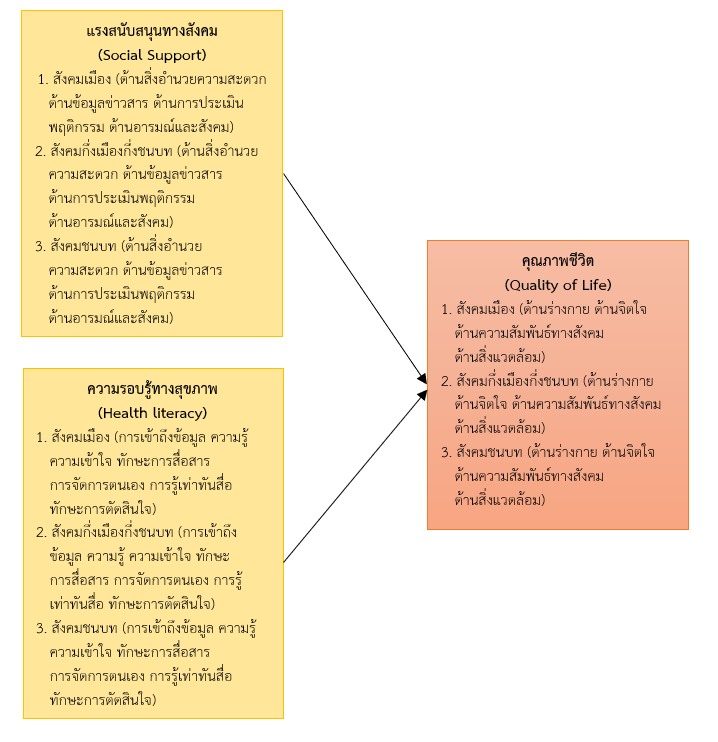
This predictive research aimed to study the levels of social support, health literacy and quality of life, prior to evaluate the influence of both social support and health literacy on quality of life among elderly who are living in urban, semi-urban, rural and semi-rural context in Mueang district of Nakhon Si Thammarat province. Sample was 390 older adults (130 from each of those context), and selected by stratified and simple random sampling. All data were collected using questionnaires. Reliability of social support questionnaire and quality of life questionnaire were both determined using Cronbach’s alpha coefficient and obtained the values of .97 and .94, respectively. For the health literacy questionnaire, health knowledge component was examined by using Kuder and Richardson method, yielding values of .68 and .83, respectively. Other components, namely access to health information, communication of health information, decision making, self-management and media literacy, were tested using Cronbach’s alpha coefficient, obtaining values of .86, .56, .85, and .89, respectively. Data were analyzed using descriptive and regression analysis. Results revealed the following.
1. Social support of the older adults, living in urban, semi-urban and semi-rural, and rural society were at a high level (M=3.81, SD=0.71; M=4.12, SD=0.78; M=3.69, SD=0.56, respectively).
2. Health literacy in older adults, living in urban, semi-urban and semi-rural, and rural society were at a low level (M=33.67, SD=10.16; M=39.88, SD=8.13; and M=29.39, SD=7.00, respectively).
3. Quality of life of the older adults in urban society was at a good level (72.31%), in semi-urban and semi-rural, and rural society were at a moderate level (60.77%, and 63.85%, respectively).
4. In a semi-urban and semi-rural society, the social support could predict 45.50 percent of quality of life. While in rural society, social support could predict 9.60 percent of quality of life.
Per findings of the study, tangible and intangible social support should be provided to older people in order to promote their quality of life.
References
Anantakul, A. (2016). Aging Society Challenges Thailand. Proposed Documents at the Meeting of the Royal Academy Thammasat Political Office, Royal Society of Thailand. (in Thai)
Ayott, B. J., Allaire, J. C., & Bosworth, H. (2009). The Association of Patient Demographic Characteristics and Health Information Recall: The Mediating Role of Health Literacy. Neurophychal Dev Cogn B Aging Neuropsychal Cogn, 16(4), 419-32.
Cohen, J. (1977). Statistical Power Analysis for the Behavioral Sciences. New York: Academic Press.
Department of Mental Health. (2016). Annual Report 2016. Bangkok: Bangkok Block. (in Thai)
Department of Older Persons. (2019). Statistics of the Number of Elderly by Province and Age in 2018. Retrieved March 18 2019, from www.dop.go.th/th/know/1/159. (in Thai)
Foundation of Thai Gerontology Research and Development Institute. (2018). Situation of the Thai Elderly. Retrieved November 1, 2020, from https://thaitgri.org/?p=38670. (in Thai)
Howard, D. H., Sentell, T., & Gazmararian, J. A. (2006). Impact of Health Literacy on Socioeconomic and Racial Differences in Health in a Elderly Population. J Gen Intern Med, 21(8), 857-61.
Intarakamhang, U. (2017). Health Literacy: Measurement and Development. Bangkok: Sukhumvit Printing Co., Ltd. (in Thai)
Jintana, P., Suktan, S., & Takaew, C. (2018). Correlation and Predictive Power Between Social Support and Quality of Life among Older Adult. The Southern College Network Journal of Nursing and Public Health, 5(2), 119-131. (in Thai)
Kandee, P., Sukwong, P., & Weiangkham, D. (2016). Perceived Social Support of Community-Dwelling Rural Elderly in Northern Thailand. Journal Mental Health Thai, 24(1), 40-51. (in Thai)
Lanmeshow, S. L., Hosmer, D. W., Klar, J., & Lwanga, S. K. (1990). Adequacy of Sample Size in Health Studies. New York: John Wiley & Sons.
Laohabutr, P. (2014). Quality of Life of the Elderly in Village, Moo 7, Plutaluang Sub-District, Sattahip District, Chonburi Province. [Research Report]. [Chonburi]. Burapha University. (in Thai)
Mahatanirunkul, S., Tuntinirunkul, W., Pumpisanchai, W., Wongsuwan, K., & Ponmanajirungkul, R. (1997). The Comparison of the World Health Organization Quality of Life Questionnaire, 100 Indicators and 26 Indicators. Chiang Mai: Suan Prung Hospital. (in Thai)
Nilnet, W. (2014). Health Literacy of the Thai Elderly in the Elderly Club in Bangkok. [Thesis]. Chulalongkorn University. Retrieved October 18, 2020 from http://cuir.car.chula.ac.th/bitstream/123456. (in Thai)
Noknoi, J., & Boripan, W. (2017). Quality of Life of the Elderly in Songkhla Province. Princess of Narathivas University Journal, 9(3), 94-105. (in Thai)
Nutbeam, D. (2008). The Evolving Concept of Health Literacy. Social Science & Medicine, 67(12), 2072-2078.
Phichit, P. (2015). Quality of Life of the Elderly in Surat Thani Province. Journal of Management Sciences, 2(2), 157-178. (in Thai)
Prutkankit, T. (2013). Community Context under the Semi-Urban, Semi-Rural Society. The Far Eastern University, 9(1), 7-15. (in Thai)
Rattana, W. (2009). Health Care Behavior and Social Support with Quality of Life Elderly, Elderly Club, Surat Thani Hospital. [Thesis]. [Bangkok]. Srinakharinwirot University. (in Thai)
Rojanathammakul, N. (2020). Nursing Care for Elderly: Physiology and Mental Health Aspect. Bangkok; SKS Interprint Co., Ltd. (in Thai)
Sanitluang, N., Sartpet, W., & Napaarak, Y. (2019). Sample Size Calculation Using G* POWER Program. Journal of Suvarnabhumi Institute of Technology, 5(1), 496-507. (in Thai)
Srisaard, B. (2012). Research for Teacher. Bangkok; Suveriyasan. (in Thai)
Srithanee, K. (2017). Relationship Between Health Literacy and Quality of Life of Elderly in the Central Northeastern Region. Public Health System Research Journal, 11(1), 26-35. Retrieved from http://kb.hsri.or.th. (in Thai)
Suramitthree, B. (2013). Health Literacy Study and Operational Situation to Enhance Health Literacy of Thai People to Support Access to the Asean Community. (Online) Retrieved May 18, 2020, from http://www.mfa”go.th/dvifa/contents /files/nbt/nbt5/IS/IS5073.pdf. (in Thai)
Thongthammachat, N. (2014). Life in the Contemporary Condition of Urban Society. Veridian E-Journal, Silpakorn University, 9(1), 1669-1687. (in Thai)
United Nation. (2015). World Populations Ageing. Retrieved November 1, 2020, from https://www.un.org/en/development/desa/population/publication/pdf/ageing/WPA2015_Report.pdf.
Wichitaksorn, N. (2018). Health Focus. Retrieved November 1, 2020, from https://www.hfocus.org/content/2018/01/15303. (in Thai)
Downloads
Published
Issue
Section
License
1. บทความหรือข้อคิดเห็นใด ๆ ที่ปรากฏในวารสารเครือข่าย วิทยาลัยพยาบาลและการสาธารณสุขภาคใต้ ที่เป็นวรรณกรรมของผู้เขียน บรรณาธิการหรือเครือข่ายวิทยาลัยพยาบาลและวิทยาลัยการสาธารณสุขภาคใต้ ไม่จำเป็นต้องเห็นด้วย
2. บทความที่ได้รับการตีพิมพ์ถือเป็นลิขสิทธิ์ของ วารสารเครือข่ายวิทยาลัยพยาบาลและการสาธารณสุขภาคใต้