Health Literacy and other Factors related to Health Promoting Behaviors among Professional Nurses
Keywords:
Health Literacy, Health-Promoting Behaviors, Registered NursesAbstract
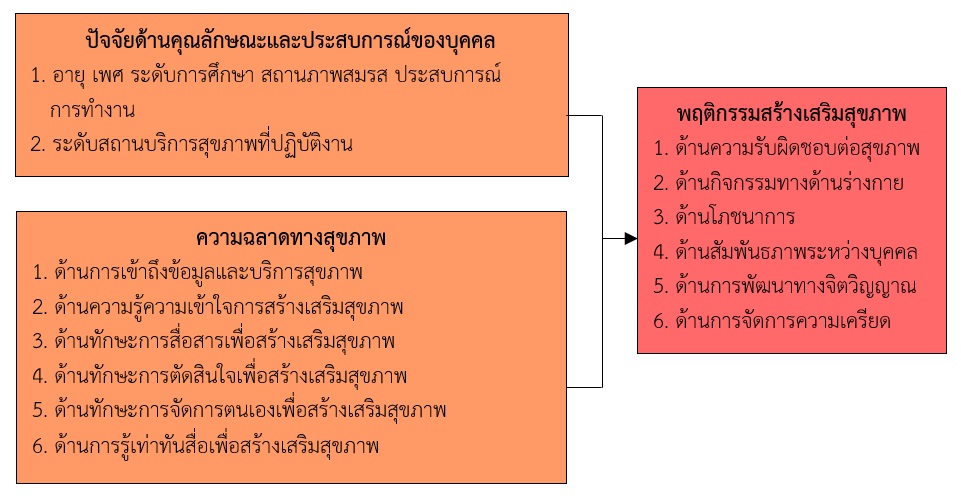
This research aimed to study health literacy levels, as well as levels of health-promoting behaviors, and factors related to health-promoting behaviors among registered nurses. The sample included 184 registered nurses working at every level of hospitals in Yala province, and 6 nurse administrators working at primary, secondary, and tertiary care. Stratified random sampling, and purposive sampling were applied, respectively. Research tools were structured interviews and questionnaires developed by the researchers. Content validity of the tools were confirmed by 3 experts, obtainning IOC values between 0.67-1.00. Reliability of the questionnaires regarding six dimensions of health literacy, and health-promoting behaviors were tested using Cronbach's alpha coefficient, obtaining values of 0.97 and 0.92, respectively. Reliability of both questionnaires was 0.95. In-depth interviews were done among the six nurse administrators. Data were collected during September and October 2019. The study findings revealed as follows.
1. Health literacy of the registered nurses was at a high level (M=4.12, SD=0.40). Seeking health-related information and health care had the highest mean score (M=4.24, SD=0.47), whereas communication skills to promote health had the lowest mean score of health literacy (M=3.98, SD=0.47). Nurse administrators suggested that registered nurses should have enough health literacy and social skills so to participate into activities, knowing how to use news information, distinguishing different communication styles and applying new information for changing health behaviors.
2. The mean score of health-promoting behaviors of the samples was at a high level (M=3.72, SD=0.63). Stress management had the highest mean score (M=3.94, SD=0.77), while exercise behavior had the lowest mean score (M=3.05, SD=1.01).
3. Age, work experience, and health literacy were significantly and positively associated with health-promoting behaviors at a level of .01.
Per findings, chief medical officers or health administrators should give priority to health literacy development of registered nurses, especially encouraging nurses to seeking health-related information. This could be advantageous, not only for health professionals to develop themselves for good health behaviors and increase their work ability based on an up-to-date knowledge, but also for clients/patients to participate in self-care and finally have positive health behaviors.
References
Best, J. W. (1981). Research in Education (4th ed.). New Jersey: Prentice Hall.
Bunlong, N. (2009). Factors Related to Health Promoting Behaviors of Health Personnel in General Hospitals, Phangnga Province. (Master’s thesis). Burapha University
Ginggeaw, S., & Prasertsri, N. (2016). The Relationship Between Health Literacy and Health Behaviors among Older Adults who have Multi-Morbidity. Nursing Journal of the Ministry of Public Health, 25(3), 43-54.
Hair, F. J., Black, C. W., Babin, J. B., & Anderson, E. R. (2010). Multivariate Data Analysis. (7th ed). New Jersey: Pearson Education.
Health Education Division. Department of Health Service Support. Ministry of Public Health. (2011). Health Literacy. (1th ed.). Bangkok: Newthammada Printing.
Health Education Division. Department of Health Service Support. Ministry of Public Health. (2018). Strengthening and Evaluating Health Literacy and Health Behavior. Nonthaburi: Printing House, Agricultural Cooperative Association of Thailand, Ltd.
Indhraratana, A. (2014). Health Literacy of Health Professionals. Journal of The Royal Thai Army Nurses, 15(3), 174-178.
Khampisut, J. (2018). Health Literacy and Health Promotion Behaviors of Students in Naresuan University. Journal of Educational Measurement, Mahasarakham University, 24(1), 67-78.
Krejcie, R. V., & Morgan, D. W. (1970). Determining Sample Size for Research Activities. Educational and Psychological Measurement, 30, 607-610.
Nutbeam, D. (2000). Health Literacy as a Public Health Goal: a Challenge for Contemporary Health Education and Communication Strategies Into the 21st Century. Health Promotion International, 15(3), 259-267.
Pender, N. J. (1996). Health Promotion in Nursing Practice (3rd ed.). Stamford Connecticut: Appleton and Lange.
Pender, N. J., Murdaugh, C. L., & Parsons, M. A. (2006). Health Promotion in Nursing Practice (5th ed.). New Jersey: Pearson Education, Inc.
Saedkong, P., Potchana, R., Wayo W. & Klungklang, R. (2020). Effects of Using Hug Tai Application on Health Literacy among Patients with Diabetes Type 2, Hypertension, and Chronic Kidney Disease Stage 3 at Wat Nong Weang Pra-Aramluarg Parimary Care Unit in Khon Kaen. The Southern College Network Journal of Nursing and Public Health, 7(3), 195-206.
Surawongsin, K. (2008). Factors Relating to Health Promotion Behaviors of Health Personnel in Permanent Secretary Ministry of Public Health. (Master of Science, Health Education, Kasetsart University)
Thailand Nursing and Midwifery Council. (2008). National Nursing and Midwifery Development Plan (2nd Edition) 2007-2016. Bangkok: Siriyod Publication.
Thungjaroenkul, P., Swaengdee, K., Theerawit, T., & Tungcharoensathien, V. (2015). Health Problems and Health Care Behaviors Among Registered Nurses in Thailand. Journal of Health Systems Research, 9(1), 49-60.
Vimonwattana, N., Sangkapong, T., & Panriansaen R. (2017). Factors Affecting the Health Promotion Behaviors of Professional Nurses in Faculty of Medicine, Vajira Hospital, Navamindradhiraj University. Kuakarun Journal of Nursing, 24(2), 67-81.
Wiersma, W., & Jurs, S. G. (2009). Research Methods in Education. Massachusetts: Pearson.
World Health Organization. (2009). Health Literacy and Health Promotion. Definitions, Concepts and Examples in the Eastern Mediterranean Region. Individual Empowerment Conference Working Document. 7th Global Conference on Health Promotion Promoting Health and Development. Nairobi, Kenya.
Downloads
Published
Issue
Section
License
1. บทความหรือข้อคิดเห็นใด ๆ ที่ปรากฏในวารสารเครือข่าย วิทยาลัยพยาบาลและการสาธารณสุขภาคใต้ ที่เป็นวรรณกรรมของผู้เขียน บรรณาธิการหรือเครือข่ายวิทยาลัยพยาบาลและวิทยาลัยการสาธารณสุขภาคใต้ ไม่จำเป็นต้องเห็นด้วย
2. บทความที่ได้รับการตีพิมพ์ถือเป็นลิขสิทธิ์ของ วารสารเครือข่ายวิทยาลัยพยาบาลและการสาธารณสุขภาคใต้