New Health Literacy Model Applying Artificial Intelligence Technology and Social Network for Overweight Teenagers
Keywords:
Health Literacy, Overweight Teenagers, Artificial Intelligence Technology, Social NetworkAbstract
The objectives of this research and development were to 1) study the situation, problems, and needs of overweight teenagers of health zone 12, 2) develop and implement, using artificial intelligence technology and social networks, a model for health literacy, and 3) evaluate the model's efficacy. Participants were 54 overweight teenagers, school administrators, teachers, parents, food vendors, and public health personnel. The research instrument used was a questionnaire. Its content validity and reliability were tested. Data were analyzed by descriptive statistics. In-depth interviews were conducted among 34 Informants. Data were analyzed using content analysis. The model was then implemented with 60 overweight teenagers, and data were analyzed using one-way MANOVA. The model was therefore evaluated, using quantitative and qualitative data collection methods. The research instrument used was a questionnaire, which content validity and reliability were tested. Data analysis was performed, using descriptive statistics. A focus group was conducted among 16 Informants. Data were analyzed using content analysis. The research results were as follows.
1. Health literacy of overweight teenagers in health zone 12 was at a moderate level (M=2.64, SD=0.66). They need to lose weight through food selling, continuous exercise, and enough sports equipment in schools and need public health personnel education, monitoring, controlling.
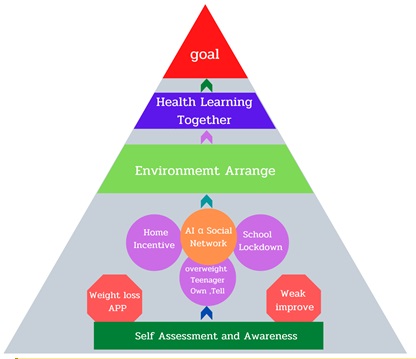
2. The health literacy model of overweight teenagers applying artificial intelligence technology and social network was called APP WEIGHT LOSS. After using the 12-week program of health literacy application, the experimental group had higher scores on health behavior for overweight prevention than before and higher than the control group (p<.05). The experimental group had more mean weight reduction than the control group, with a statistically significant level of .05.
3. Overall, satisfaction was at a high level (M = 4.32, SD = 0.14).
Schools should have the policy to develop health literacy among overweight teenagers and use this application to motivate them, so they feel that losing weight is easier.
References
Berkman, N. D., Sheridan, S. L., Donahue, K. E., Halpan, D. J. & Crothy, K. (2011). Low Health Literacyand Health Outcomes: an Updatedsystematic Review. Ann Intern Med, 155, 97-107.
Chanthapanit, K., hunnirun, P. & Jones, P. (2015). Effectiveness of Social Marketing Application in Promoting Helmet Wear in Pillion Children Motorcycles. Journal of Public Health, 24(4), 636-647. (in Thai)
Chuchan, S. (2016). Effect of Self-Efficacy Promotion Program and Family Support on Consumption Behavior of Overweight High School Children. Journal of Boromarajonani College of Nursing, Bangkok, 32(1), 31-43. (in Thai)
Crabtree, B. F., & Miller, W. L. (1992). Doing Qualitative Research. London: SAGE Publications.
Hambleton, R. K. (1984). Validating the Test Scores. In R. A. Berk. (Ed). A Guide to Criterion-Referenced Test Construction. (199-223). Baltimore and London: The Johns Hopkins University Press.
Health Education Division. (2014). Health Litheracy Scale for Thai Childhood Overweight. Retrieved August 20, 2018 from www.hed.go.th. (in Thai)
Iamsupssit, S. (2015). Theories and Techniques of Behavior Modification. 8 th Edition, Bangkok: Chulalongkorn University.
Intarakamhaeng, U. (2017). Building and Developing Tools for Knowledge on Health of Thai People. Retrieved December 18, 2018 from http://bsris.swu.ac.th/upload/268335.pdf. (in Thai)
Jinamul, J. & Chichai, S. (2018). Ministry of Public Health Inspection Results, 2nd Round, Third Quarter, Fiscal Year 2018, Faculty 1, Health Promotion, Disease Prevention And Health Management. (Online). Retrieved 20 August 2018 from http://www.rh12.moph.go.th/ (in Thai)
Kaewdamkeng, K. (2018). Health Literacy: Access, Understand and Apply. 2nd edition. Bangkok: Amarin Printing and Publishing Public Company Limited. (in Thai)
Lawrence, T. & Lamand, L. Y. (2014). Archives of Public HealthThe Official Journa Lof the Belgian Public Health Association. Retrieved April 9, 2020. from https://doi.org/10.1186/2049-3258-72-11. (in Thai)
Noin, K. (2017). Overweight, Obesity, Thai School-Age Children and Aldolescents. Journal of Royal Thai Army Nurses, 18(Spacial), 1-8. (in Thai)
Pengchan, W. (2017). Annual Report 2017, Department of Health. Retrieved December 24, 2018. from http://env.anamai.moph.go.th. (in Thai)
Phetchakong, A. (2019). Effect of Health Literacy Promotion Program in Conjunction with the Use of Social Media Online Society Towards Obesity Prevention Behavioramong Secondary School Students in the Second Year. Retrieved April 9, 2020 from https://he01.tci-thaijo.org/index.php/muhed/article/view/194631/154139 (in Thai)
Rattanakitakul, S. (2011). Development of Family Management Model to Prevent Over-Nutritional Status in Thai Children Before Teenagerss in Urban Areas. Journal of Pacific Rim Int J Nurs. Res, 14(1), 45-60.
Baranowski, T. (2006). Playing for Real: Video Games and Stories for Health-Related Behavior Change. Am J Prev Med, 34(1) 74-82 e(10). (in Thai)
Sirikulchayanon, C. (2015). Obesity in School-Age Children; From the Molecule to the Community. Second Edition. Bangkok : U Open Co., Ltd. (in Thai)
Siriwannabut, P. (2013). Theory of Developmental Psychology. 6th Printing, Bangkok: Active Print Co., Ltd. (in Thai)
Somphot, I. (2015). Theories and Techniques of Behavior Modification. 8th edition, Bangkok: Chulalongkorn University. (in Thai)
Somsap, S. (2018). Knowledge of Health in the Management of Overweight and Obesity among School-Aged Children. Journal of the Health Center at 9 Health Promotion Journal and Environmental Health, 12(29), 20-33. (in Thai)
Wichianchai, W. (2010). Guidelines for Solving the Problem of Obesity in Children of the SAO. Bo Nok, Mueang District Prachuap Khiri Khan Province. A Dissertation Submitted in Partial Fulfillment of Requirement for the Master of Education Degree in Public Administration of Khon Kaen University. (in Thai)
Wongchan, S. (2014). Effects of 3-Self-Health Behavior Modification to Reduce the Condition. Overweight in Late Adolescence. (Doctoral Thesis, Srinakarinwirot University). (in Thai)
Downloads
Published
Issue
Section
License
Copyright (c) 2022 The Southern College Network Journal of Nursing and Public Health

This work is licensed under a Creative Commons Attribution-NonCommercial-NoDerivatives 4.0 International License.
1. บทความหรือข้อคิดเห็นใด ๆ ที่ปรากฏในวารสารเครือข่าย วิทยาลัยพยาบาลและการสาธารณสุขภาคใต้ ที่เป็นวรรณกรรมของผู้เขียน บรรณาธิการหรือเครือข่ายวิทยาลัยพยาบาลและวิทยาลัยการสาธารณสุขภาคใต้ ไม่จำเป็นต้องเห็นด้วย
2. บทความที่ได้รับการตีพิมพ์ถือเป็นลิขสิทธิ์ของ วารสารเครือข่ายวิทยาลัยพยาบาลและการสาธารณสุขภาคใต้