The Development of a Fall Prevention Model for Elderly Patients at a Provincial Administrative Organization Hospital
Keywords:
Fall Prevention Model, Elderly Patients, Provincial Administrative Organization HospitalAbstract
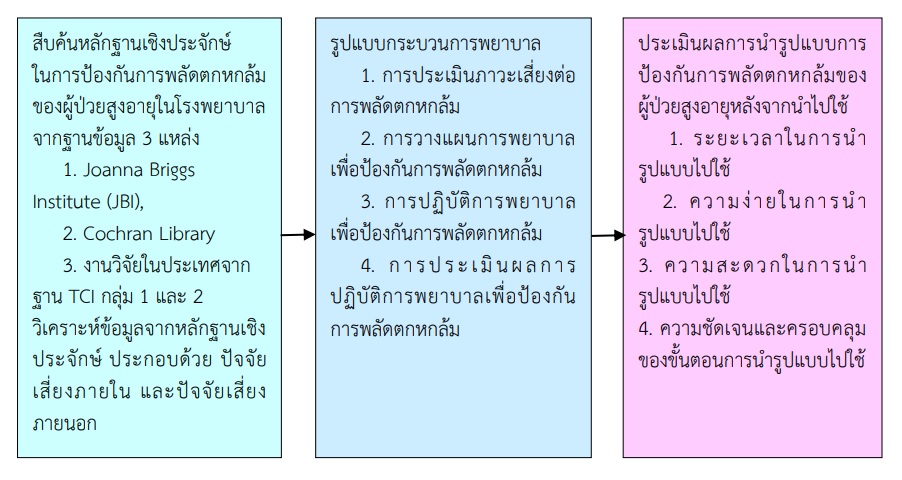
This research and development study aimed to 1) document fall prevention models for elderly patients, 2) develop a fall prevention model for elderly patients in a provincial administrative organization hospital, and 3) evaluate the implementation of such a model. The empirical evidence related to fall prevention models for elderly patients was systematically searched from the international databases, namely Joanna Briggs Institute (JBI), Cochrane Library, and Thai-Journal Citation Index (TCI) database (groups 1 and 2). The sample was 10 registered nurses, selected by purposive sampling technique. The research tools consisted of 1) a newly developed fall prevention model for elderly patients, 2) an evidence-based quality assessment form, 3) a form for evaluating the appropriateness of the developed model, and 4) a form for evaluating the developed model implementation at the Provincial Administrative Organization Hospital. The content validity index score of the research tool was 1.0. Data were synthesized and analyzed using descriptive statistics and content analysis. There were 4 development phases: Phase I to find empirical evidence related to fall prevention models for elderly patients, Phase II to develop a fall prevention model for elderly patients, Phase III to evaluate the suitability of the fall prevention model for elderly patients, and Phase IV to evaluate the implementation of the developed model in the hospital. The research findings were as follows. Twenty-seven (27) empirical evidence samples from systematic searching and 19 articles from the international databases were evaluated as having a high level of research quality. The rest was 8 articles from the Thai Journal Citation Index (TCI) database.
The developed fall prevention model was evaluated as appropriate at a high level. It consists of 4 steps: 1) fall risk assessment, 2) nursing care plan for fall prevention, 3) nursing implementation for fall prevention, and 4) nursing evaluation for fall prevention.
Implementing the developed model was evaluated as appropriate in 4 aspects: 1) the least time-consuming, 2) easiest to understand, 3) the most convenient, and 4) clear and comprehensive implementation steps. Providing information on preventing falls and awareness of elder patients’ safety is important.
References
Alamgir, H., Muazzam, S., & Nasrullah, M., (2012). Unintentional Falls Mortality among Elderly in the United States: Time for Action. Injury, 43(12), 2065-71.
Bureau of Epidemiology, Department of Disease Control, Ministry of Public Health. (2015). Control of NCDs. Retrieved 21 May 2010, from http://203.157.15.4/Annual/ANNUAL2550/Part1/6650_Chronic.doc (in Thai)
Bureau of NCDs, Department of Disease Control, Ministry of Public Health. (2020). Annual Report 2017. Retrieved June 4, 2019. from http://www.thaincd.com/2016/media-detail.php?id=12986&tid=30&gid=1-015-008 (in Thai)
Chung, H. & Coralic, A. (2016). A Multidisciplinary Assessment Instrument to Predict Fall Risk in Hospitalized Patients: A Prospective Matched Pair Care Study. Journal of Nursing Education and Practice, 6(6).
Hendrich, A. L. Bender, P. S. & Nyhuis, A. (2003). Validation of the Hendrich II Fall Risk Model: A Large Concurrent Case/Control Study of Hospitalized Patients. Applied Nursing Research, 16(1), 921.
Hignett, S., Sands, G., Youde, J., & Griffiths, P. (2010). Targeting Environmental Factors to Reduce Elderly in-Patient Falls. Loughborough University. Retrieved March 10, 2016, from http://dspace.Iboro.ac.uk/dspace.
Perell, K. L., Nelson, A., Goldman, R. L., Luther, S. L., Prieto-Lewis, N., & Rubenstein, L. Z. (2001). Fall Risk Assessment Measures: An analytic Review. Gerontol A Biol Sci Med Sci, 56(12), 716-6.
Severo, I. M. Almeida, M. A., Kuchenbecker, R., Vieira, D. F. V. B., Weschenfelder. M. E., Pinto, L. R. C., et al., (2014). Risk Factors for Falls in Hospitalized adult Patients: an Integrative Review. Retrived March 12.2016 from http://www.scielo.br/scielo.php.
Srichang, N., & Kawee, L. (2017). Fall Forecast Report for the Elderly (Age 60 Years and Older) In Thailand, 2017-2021, Bureau of Non-Communicable Diseases, Department of Disease Control, Ministry of Public Health. Bangkok: Printing Affairs Office, The War Veterans Organization of Thailand. (in Thai).
Tanaka, B., Sakuma M., Ohtani M., Toshiro J., Matsumaru T., & Morimoto T. (2012). Incidence and Risk Factors of Hospital Falls on Long-Term Care Wards in Japan. J Eval Clin Pract, 18(3), 572-7.
The Joanna Briggs Institute. (2013). New JBI Levels of Evidence. Retrived July 10.2018 from http://joannabriggs.org/assets/docs/approach/JBI-Levels-of-evidence_2014.pdf
Waltz, C., Strickland, O. & Lenz, E. (1991). Measurement in Nursing Research. 2nd Edition, F.A. Davis Company, Philadelphia. Retrived July 09.2018 from https://books.google.co.th/books?id=807SCgAAQBAJ&pg=PA198&dq=Waltz,+C.,+Strickland,+O+and+Lenz,+E.+(1991).+Measurement+in+Nursing+Research.++2nd+Edition
World Health Organization. (2016). Violence and Injury Prevention: Falls. Retrieved June 4, 2019 From http://www.who.int/violence_injury_prevention/other_injury/falls/en/.
Downloads
Published
Issue
Section
License
Copyright (c) 2022 The Southern College Network Journal of Nursing and Public Health

This work is licensed under a Creative Commons Attribution-NonCommercial-NoDerivatives 4.0 International License.
1. บทความหรือข้อคิดเห็นใด ๆ ที่ปรากฏในวารสารเครือข่าย วิทยาลัยพยาบาลและการสาธารณสุขภาคใต้ ที่เป็นวรรณกรรมของผู้เขียน บรรณาธิการหรือเครือข่ายวิทยาลัยพยาบาลและวิทยาลัยการสาธารณสุขภาคใต้ ไม่จำเป็นต้องเห็นด้วย
2. บทความที่ได้รับการตีพิมพ์ถือเป็นลิขสิทธิ์ของ วารสารเครือข่ายวิทยาลัยพยาบาลและการสาธารณสุขภาคใต้