Applying the Empowerment Evaluation Model to Develop Nursing Students’ Identity of Praboromarajchanok Institute
Keywords:
Empowerment Evaluation, Identity of Nursing Graduates, Nursing StudentsAbstract
This study aimed to develop and evaluate the empowerment evaluation (EE) model for developing nursing students' identity of the Praboromarajchanok Institute (PBRI). The study consisted of two phases. The first phase was the development of the EE model for developing nursing students' identity at the PBRI. A total of 240 participants were selected from thirty colleges of nursing which consisted of one each of director, deputy director, and BSN curriculum committee including five each of nursing instructors. Instruments were a questionnaire on the situation of graduate's identity development, an one questionnaire on graduate's identity behaviors. Data were analyzed using the index of the item - object congruence (IOC), mean, and standard deviation. Then the second phase was conducted to test the EE model to develop nursing students' identity. Key informants were 115 junior year students and 55 administrators, instructors, and preceptors. Research instruments consisted of the EE model, graduates' identity questionnaire, cognition of graduates' identity development questionnaire, and satisfaction questionnaire. Mean, standard deviation, and t-test were used to analyze data.
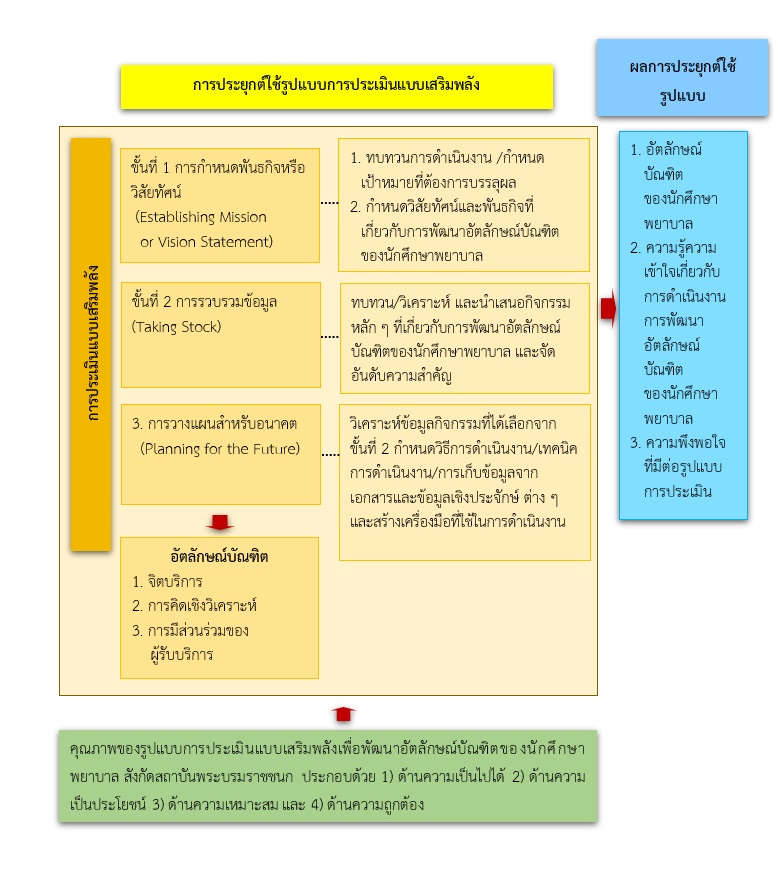
Results identified three aspects for an EE model that would develop positively the nursing students' identity: 1) mission/vision establishment, 2) data collection of main activities, priority-setting, and consensus, as well as 3) planning for the future. Strategies for implementing the EE model were training, counseling, facilitating, clarifying, and providing freedom of action. Nursing students had significantly higher graduates' identity scores after receiving the EE model than before, at the p-value of .001. Academic professionals had also higher scores of graduates' identity development knowledge after receiving the EE model than before, at the p-value of .001, and they were satisfied with the EE model at the high level.
Per the findings, the EEF can be an educational management guideline to enhance PBRI graduate identity among nursing students.
Downloads
Published
Issue
Section
License
1. บทความหรือข้อคิดเห็นใด ๆ ที่ปรากฏในวารสารเครือข่าย วิทยาลัยพยาบาลและการสาธารณสุขภาคใต้ ที่เป็นวรรณกรรมของผู้เขียน บรรณาธิการหรือเครือข่ายวิทยาลัยพยาบาลและวิทยาลัยการสาธารณสุขภาคใต้ ไม่จำเป็นต้องเห็นด้วย
2. บทความที่ได้รับการตีพิมพ์ถือเป็นลิขสิทธิ์ของ วารสารเครือข่ายวิทยาลัยพยาบาลและการสาธารณสุขภาคใต้