Knowledge of Nursing Students about Rational Drug Use in Elderly People, as well as Their Attitudes and Teamwork Abilities Towards Inter-Professional Education (IPE)
Keywords:
Inter-Professional Education (IPE), Nursing StudentsAbstract
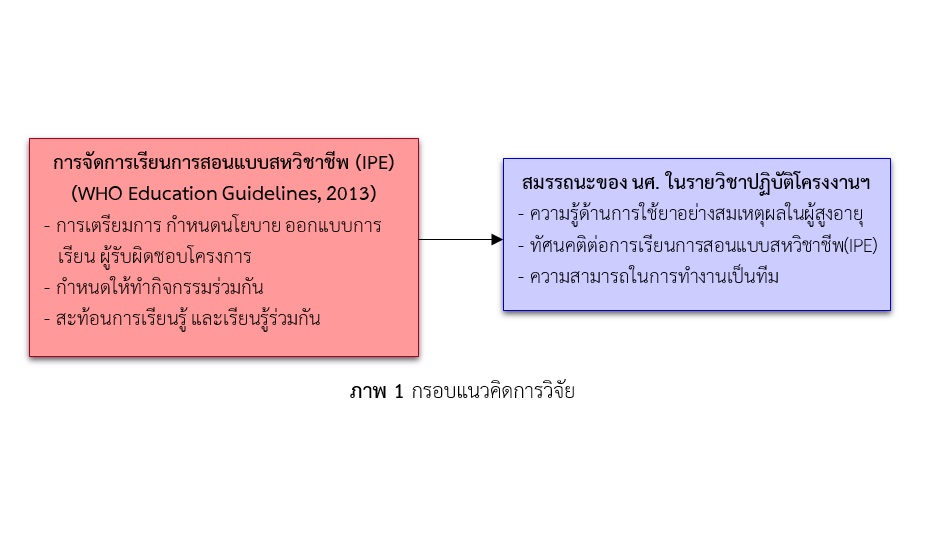
This quasi-experimental research aimed to study the knowledge of nursing students about rational drug use in elderly people, as well as their attitudes and teamwork abilities towards inter-professional education (IPE), and to compare those two variables after participating into Inter-Professional Education (IPE) activities. Participants were 61 Fourth-Year nursing students. Data were collected by using three instruments: 1) a students' knowledge measurement form on rational drug use in elderly people, 2) a students’ attitude form towards Inter-Professional Education (IPE), and 3) an inter-professional teamwork ability assessment form. The instruments' reliability yielded .74, .81 and .91, respectively. Participants were assigned to create a relationship and work together with pharmacy students in five activities for a duration of three or four hours per each. Data were analyzed by using mean, standard deviation and dependent pair t-test statistics. The results of the study showed the following. Before participating in Inter-Professional Education (IPE), the level of knowledge of participants about sensible rational drug use in the elderly was at a moderate level (M=13.30, SD=1.10), while it was at an excellent level (M=21.98, SD=1.39) 2) after participating in Inter-Professional Education (IPE) activities. The attitudes and Inter-Professional teamwork abilities of nursing students were at moderated level before receiving the IPE activity (M=2.72, SD=0.13, M=3.18, SD=0.53), while they were at the highest level, and a high level (M=4.62, SD=0.49, and M=4.16, SD=0.49) after the IPE activities. Comparing the differences between the groups, results were better as well as their scores in all aspects after participating in the Inter-Professional Education (IPE) activities (p<.001).
Nursing students should learn more on the other professions for deeper learning and sharing to others. Moreover, nursing education can perform Inter-Professional Education (IPE) with other professions such as engineer, architect, and nutritionist.
References
Boonchom, S. (2013). Introduction to Research. (9th ed). Bangkok: Suweeriyasarn. (in Thai)
Brandt, B., Lutfiyya N. M., King, J., & Chioreso, C. (2014). A Scoping Review of Interprofessional Collaborative Practice and Education Using the Lens of the Triple Aim. Journal of Interprofessional Care, 28(5), 393-399.
Brashers, V., Erickson, J. M., Blackhall, L., Owen, J. A., Thomas, S. M., & Conaway, M. R., (2016). Measuring the Impact of Clinically Relevant Interprofessional Education on Undergraduate Medical and Nursing Student Competencies: A Longitudinal Mixed Methods Approach. Journal of Interprofessional Care, 30(4), 448-457.
Chenkongkaew, W. (2018). Manual of Interprofessional Education. (2nd ed). Bangkok: P.A.Living. (in Thai)
Cohen, J. (1988). Statistical Power Analysis for the Behavioral Sciences. (2nd). New Jersey: Lawrence Erlbaum Associates, Publishers.
Colonio Salazar, F. B., Andiappan, M., Radford, D. R., & Gallagher, J. E. (2016). Attitudes of the first Cohort of Student Groups Trained Together at the University of Portsmouth Dental Academy Towards Dental Interprofessional Education. Retrieved in September 26, 2017 from https://onlinelibrary.wiley.com/doi/abs/10.1111/eje.12183
Commission on Interprofessional Education. (2015). Inter-Professional Education. Retrieved in September 26, 2017 from http://www.healthprofessionals21thailand.org/wp-content/uploads//11/Book-IPE-Fin.pdf
Faul, F., Erdfelder, E., Lang, A. G., & Buchner, A. (2007). G*Power 3: A Flexible Statistical Power Analysis Program for the Social, Behavioral, and Biomedical Sciences. Behavior Research Methods, 39(2), 175-191.
Poorananon, P., & Krirkgulthorn, T. (2011). Factors Predicting Nursing Student’s Competency in Evidence-Based Nursing. J Nurs Sci, 29(2), 47-55. (in Thai)
Rational Use of Drug Subcommittee. (2017). Teacher’s Guide for Promoting Rational Drug Use. Bangkok: Agricultural Cooperative Printing Demonstrations of Thai Ltd. (in Thai)
Rotz, E. M., Duenas, G. G., Grove, A. B., Headly, A., & Parvanta, C. F. (2015). Exploring First-Year Pharmacy and Medical Students’ Experiences During a Longitudinal Interprofessional Education Program. Pharm Teach Lear, 7(3), 302–311.
Rungruang, K., Plosingehan, S., & Phuvipadawit, S. (2013). Factors Affecting The Nursing Professional In tention of Nursing Students in Colleage of Nursing Under The Ministry of Public Health. Journal of Nursing and Education, 6(3), 119-127. (in Thai)
Sethasathien, S. (2015). A Model of Interprofessional Education (IPE) in Department of Physical Medicine and Rehabilitation, Udonthani Hospital. J Thai Rehabil Med, 25(2), 65-70. (in Thai)
Stull, C. L., & Blue, C. M. (2016). Examining the Influence of Professional Identity Formation on the Attitudes of Students Towards Inter-Professional Collaboration. Journal of Inter-Professional Care, 30(1), 90-96.
Tanglakmankhong, K., Khammathit, A., Thammawongsa, N., & Ardpara, A. (2019). The Effectiveness of Teaching in a Nursing Innovation Course Using Interprofessional Education (IPE) Approach on Readiness for IPE, and the 21st Century Skills. The Southern College Network Journal of Nursing and Public Health, 6(2), 126-139.
World Health Organization. (2013). Interprofessional Education Guildline. Retrieved from http://www. WHO/HRH /HPN /10.3.
World Health Organization. (2010). Framwork for Action on Interprofessional Education & Collaborative Practice. Retried from http://www. WHO/HRH /HPN /10.3.
World Health Organization. (2002). Promoting Rational Use of Medicines: Core Components. WHO Policy Perspectives on Medicines. No.5. Document WHO/EDM/2002.3. Geneva, 2002. Retried from URL:http://apps.who.int/medicinedocs/pdf/h3011e/h3011e.pdf
Zeeni, N., Zeenny, R., Hasbini-Danawi, T., Asmar, N., Bassil, M., Nasser, S. et al. (2016). Student Perceptions Towards Interprofessional Education: Findings from a Longitudinal Study Based in a Middle Eastern University. Journal of Interprofessional Care, 30(2), 165-174. doi:10.3109/13561820.2015.1117060
Downloads
Published
Issue
Section
License
1. บทความหรือข้อคิดเห็นใด ๆ ที่ปรากฏในวารสารเครือข่าย วิทยาลัยพยาบาลและการสาธารณสุขภาคใต้ ที่เป็นวรรณกรรมของผู้เขียน บรรณาธิการหรือเครือข่ายวิทยาลัยพยาบาลและวิทยาลัยการสาธารณสุขภาคใต้ ไม่จำเป็นต้องเห็นด้วย
2. บทความที่ได้รับการตีพิมพ์ถือเป็นลิขสิทธิ์ของ วารสารเครือข่ายวิทยาลัยพยาบาลและการสาธารณสุขภาคใต้