Effects of Using Hug Tai Application on Health Literacy among Patients with Diabetes Type 2, Hypertension, and Chronic Kidney Disease Stage 3 at Wat Nong Weang Pra-Aramluarg Parimary Care Unit in Khon Kaen
Keywords:
Hug-Tai Application, Health Lliteracy, Case StudyAbstract
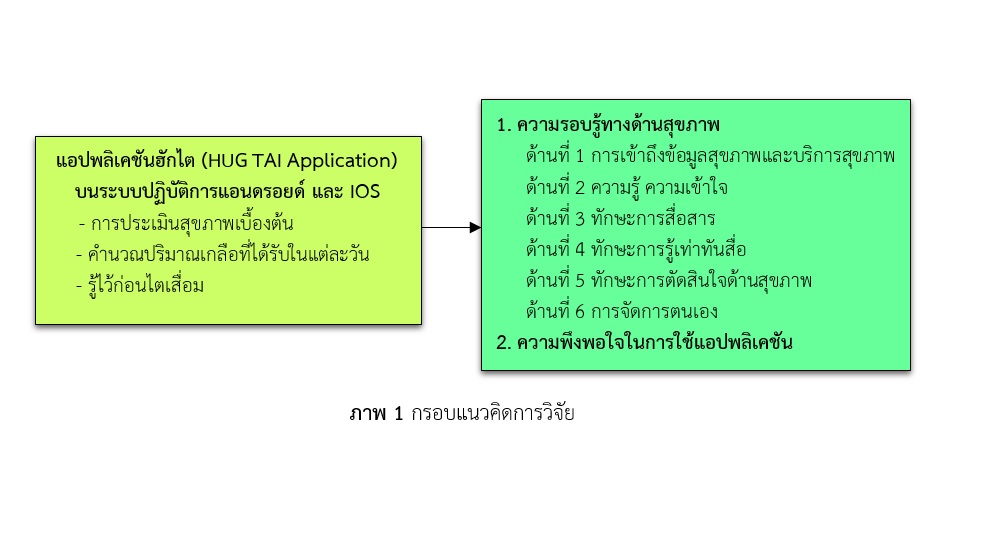
The purpose of this quasi experimental, two group pre-post-test design research, was to study health literacy among diabetes type 2 and hypertension with the 3rd stage of chronic kidney disease patients, using a Hug-Tai application. Study was conducted at Wat Nong Weang Pra-Aramluang primary health care of Khon Kaen. Sample was 30 participants, who were assigned to an experimental group or control group (15 participants/group). The experimental group used the application through their mobile phone. The application was used to calculate sodium and sugar calories. In addition, the application could also provide the health information about slowing the progression of kidney disease. The measurements of this study were related to health literacy. Cronbach’s alpha coefficient was used to test reliability of research instruments. It obtained a value of 0.74. Descriptive data analysis was also used with percentage, mean, standard deviation, paired t-test and independent t-test.
Results revealed that the health literacy scores of experimental groups after using the Hug-Tai application was significantly higher than before using the application (p-value<0.05). Health literacy score between experimental group and control group was significantly different (p-value<0.05). In addition, the satisfaction score to the application was at a high level (M=4.24, SD=0.74).
The findings suggest that this application is useful for patients with chronic kidney disease. Furthermore, the application can also promote the healthy self-care of patients. Future research should continue developing the application to be more culturally appropriate that can promote health literacy to patients, family, and community.
References
Apinya, T. (2018). Operating Manual for Implementation Chronic Kidney Disease (CKD) in Diabetes Patient and Hypertension. Nonthaburi: Bureau of Non Communicble Disease Ministry of Public Health. (in Thai)
Division of Non-Communicable Disease. (2018). Situation of Non-Communicable Diseases (NCD), Illness Statistics and Premature Death. 2018. Retrieved 5 October 2018 from http://thaincd.com/2016/media-detail.php?id=12986&gid=1-015-008 (in Thai)
Ginggaeaw, S., Prasertsri, N., & Promwong, W. (2019). The Roles of Community Nurse for Promoting Health Literacy in the Elderly with Chronic Illness. Journal of Nursing, Public Health, and Education, 20(1), 3-13. (in Thai)
Health Education Divition. (2018). Enhancing and Assessing Health Literacy and Health Behavior. Nontaburi: Ministry of Public Health.
Kidney Disease Association of Thailand. (2017). Recommendations for Care for Chronic Kidney Disease Patients Before Kidney Replacement Treatment, 2015. Bangkok: Kidney Disease Association of Thailand. (in Thai)
Kidney Disease Association of Thailand. (2016). Global Prevalence Tate of Diabetes from IDF. 2016. Retrieved 5 October 2016 from http://iregist.igenco.co.th/web/dmthai_old/ statistic/406 (in Thai)
Nutbeam, D. (2008). The Evolving Concept of Health Literacy. Social Science and Medicine, 67(12), 2072-2078.
Pannark, P., Moolsart, S., & Kaewprom, C. (2018). The Effectiveness of a Program for Health Literacy Development of the Patients with Uncontrolled Type 2 Diabetes at Bangwua District, Chachoengsao Province. Nursing Journal of the Ministry of Public Health, 27(3), 91-106. (in Thai)
Phongissaranuporn, S., Laipoonsawad, S., & Supachaipanichpong, P. (2018) Outputs of Self-Management Support Program for Delayed-Progression of Diabetes Nephropathy and Clinical Outcomes in Patients Type 2 Diabetes Mellitus Damnoen Saduak Hospital. Region 4-5 Medical Journal, 37(2), 148-159. (in Thai)
Saedkong, P, Lunput, S., PhanomKaen, S., Mahem, K., & Pornpeng, D. (2019). Effect of Using Haktai Tool Innovative on Knowledge Believe and Health Behaviors in Chronic Kidney Disease. Journal of Nursing and Health Care, 36(4), 214-222. (in Thai)
Seesanea, S., Wattanakitkrileart, D., Charoenkitkarn, V., Dumavibhat, C., & Vanijja, V. (2018). The Effect of Mobile Application on Medication Adherence in Patients with Acute Coronary Syndrome after Hospitalization. Nursing Journal of the Ministry of Public Health, 28(1), (61-74). (in Thai)
Unaphak, P., & Rattanamanee, K. (2013). The Correlation Factors of Self-Care Behaviors to Prevent Complications among Patients with Chronic Kidney Disease at Somdetphraphutthalertla Hospital in Samutsongkhram Province. The Public Health Journal of Burapha University, 10(2), 44-54. (in Thai)
Wat Nong Wang Community Medical Center. (2018). Kidney Disease Patient Information at Nong Waeng Community Medical Center Khon Kaen Province. Khon Kaen: Wat Nong Wang Community Medical Center. (in Thai)
Winaiprasert, P., & Mamom, J. (2019). Development the Required Daily Nutrition Applications (NuTu-App) to Promote Nutrition Status in Patients with Pressure Ulcers. Thai Science and Technology Journal, 27(3), 485-498. (in Thai)
Wongnisanatakul, K. (2019). Health Literacy among Diabetic Patients at the Family Practice Center of Phra Nakhon Si Ayutthaya Hospital. Journal of Preventive Medicine Association of Thailand, 8(1), 49-61. (in Thai)
Downloads
Published
Issue
Section
License
1. บทความหรือข้อคิดเห็นใด ๆ ที่ปรากฏในวารสารเครือข่าย วิทยาลัยพยาบาลและการสาธารณสุขภาคใต้ ที่เป็นวรรณกรรมของผู้เขียน บรรณาธิการหรือเครือข่ายวิทยาลัยพยาบาลและวิทยาลัยการสาธารณสุขภาคใต้ ไม่จำเป็นต้องเห็นด้วย
2. บทความที่ได้รับการตีพิมพ์ถือเป็นลิขสิทธิ์ของ วารสารเครือข่ายวิทยาลัยพยาบาลและการสาธารณสุขภาคใต้