Prevention of Zika Virus Infection among Pregnant Women: An Integrative Review on Nurses’ Role and Knowledge
Keywords:
Zika Virus, Pregnant Women, Nurses’ Role, Prevention, ReviewAbstract
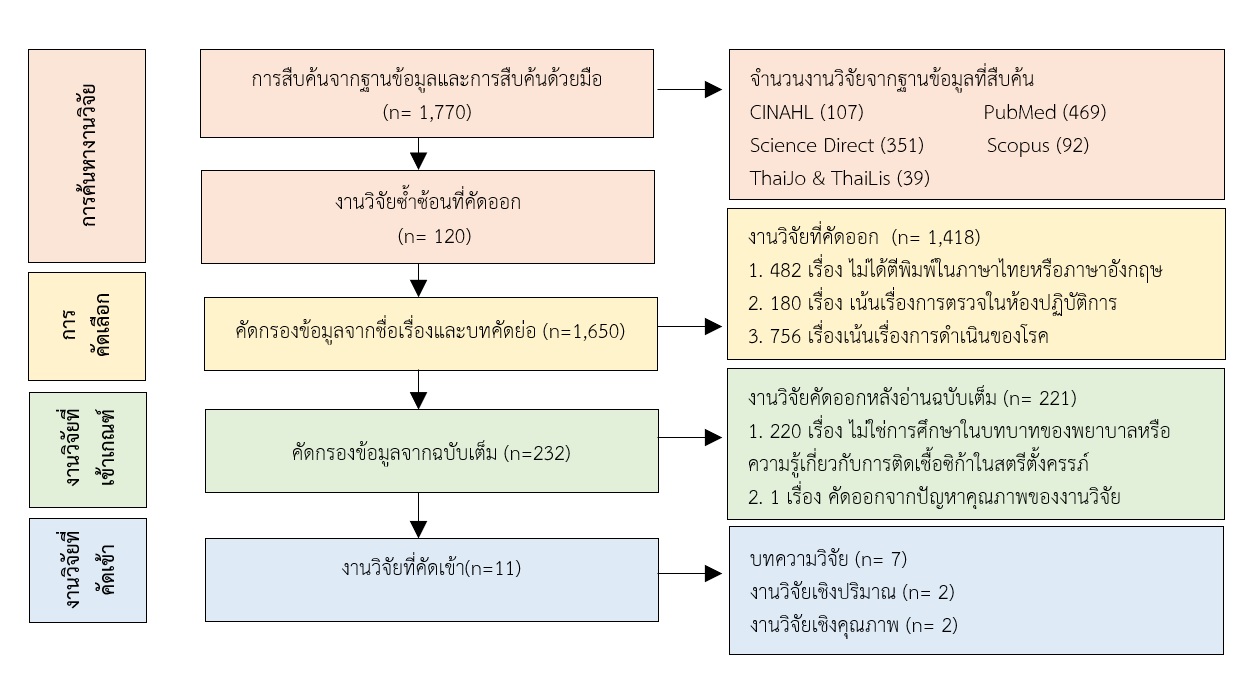
This integrative review aimed to summarize and analyze primary researches focus on nurses' role and knowledge in preventing Zika virus infection in pregnant women. Sample was the population from primary researches, including quantitative and qualitative studies that were related to nurse’s role and knowledge into prevention of Zika virus infection in pregnant women. Interventions included a program to improve knowledge and role to prevent Zika virus infection. Comparison was made between intervention group and control group, and outcome is presenting nurses’ role and knowledge to prevent Zika virus infection. The primary research published between January, 2015 to December, 2020. Electronic databases, including CINAHL, PubMed, Scopus, Thai Journal, and ThaiLis, were compressively searched for primary researches. A total of 1,770 studies were identified. Full text of 232 studies met the inclusion criteria and appraised. Finally, 11 articles were included in this review, using a systematic guideline developed by the Joanna Briggs Institute.
Results of this study revealed that nurses play an important role as educator, counselor, collaborator, and learner. However, nurses lacked of knowledge on Zika virus infection in pregnant women and needed more training, including on disease, signs and symptoms, affection, and prevention.
The findings should be used as basic information in promoting nurses’ role. In addition, primary research on the effectiveness and efficiency programs or guideline for preventing in pregnant women are needed.
References
Abu-rish, E. Y., Elayeh, E. R., & Browning, M. J. (2019). Physicians’ Knowledge, Attitudes, and Practices Towards Zika Virus Infection in Jordan. Journal of Infection in Developing Countries, 13(7), 584-590.
Affini, A. M., Rocha, S. N., Silva, S. A., Leite, E. P., Terra, F. D., Godinho, M. L., et al. (2017). Conduct of Nurses about the Zika Virus in the Prenatal Consultation. Journal of Nursing, 11(12), 5231-5244.
Asokan, G. V., Nama, M., Salman, F., AlGhareeb, Z., Almoosawi, A., Hammam, R., et al. (2018). Appraisal of the Preparedness of Midwives and Nurses in Bahrain to Conduct early Screening for Zika Virus Infection in Pregnant Women. Disaster Medicine and Public Health Preparedness, 12(1), 7-13.
Besnard, M., Lastere, S., Teissier, A., Cao-Lormeau, V., & Musso, D. (2014). Evidence of Perinatal Transmission of Zika Virus, French Polynesia, December 2013 and February 2014. Eurosurveillance, 19(13), 1-4.
Bureau of Vector Born Disease. (2018). Annual Report. Retrieved from https://ddc.moph.go.th/uploads/ ckeditor/6f4922f45568161a8cdf4ad2299f6d23/files/Zika%20Fever/2561/Zika%2031.pdf. (in Thai)
Centers for Disease Control and Preventiona [CDC]. (2019). Zika Virus: Symptoms. Retrieved from https://www.cdc.gov/zika/symptoms/symptoms.html
Chibueze, E. C., Tirado, V., Lopes, K. D., Balogun, O. O., Takemoto, Y., Swa, T., et al. (2017). Zika Virus Infection in Pregnant: a Systematic Review of Disease Course and Complications. Reproductive Health, 14(1), 28-32.
Department of Disease. (2016). Hanbook of Zika Virus Infection for Professional Health. Bangkok: Veterans Organization Publishing.
Dogan, A. C., Wayne, S., Bauer, S., Ogunyemi, D., Kulkharni, S. K., Maulik, et al. (2017). The Zika Virus and Pregnant: Evidence, Management, and Prevention. The Journal of Maternal-Fetal & Neonatal Medicine, 30(4), 386-396.
Duarte, G. (2016). Challenges of Zika Virus Infection in Pregnant Women. Revista Brasileira de Ginecologia e Obstetrícia/RBGO Gynecology and Obstetrics, 38(6), 263-265.
Joanna Briggs Institute. (2019). Joanna Briggs Institute Reviewer Manual 2019. Retrieved from https://wiki.joannabriggs.org/display/MANUAL/JBI+Reviewer%27s+Manual
Lguiniz- Romero, R., & Guerra- Reyes, L. (2020). On the Front Line: Health Professional and System Preparedness for Zika Virus in Peru. International Journal of Gynnecology and Obstetrics, 148(Suppl.2), 45-54.
Liberati, A., Altman, D. G., Tetzlaff, J., Mulrow, C., Gøtzsche, P. C., Ioannidis, J. P., et al. (2009). The PRISMA Statement for Reporting Systematic Reviews and Meta-Analyses of Studies That Evaluate Health Care Interventions: Explanation and Elaboration. J Clin Epidemiol, 62, e1-34.
Lins Bentes, C. M., Nascimento Bentes, M., Godlnho Bertoncello, K. C., de Andrade, S. R., Azevedo Lima, V. L., & De Lourdes de Souza, M. (2019). Nursing Care Actions to Prevent and Control the Zika Virus: A Review. Journal of Nursing and Health Sciences, 5(2), 30-42.
Maharajan M. K., Ranjan, A., Chu, J. F. Foo, W. L., Chai, Z. X., Lau, E., et al. (2016). Zika Virus Infection: Current Concerns and Perspectives. Clinical Reviews in Allergy & Immunology, 51(3), 383-394. doi: 10.1007/s12016-016-8554-7.
McNeill, C., Shreve, M. D., Jarrett, A., & Perry, C. (2016). Zika: What Providers Need to Know. The Journal of Nurse Practitioners, 12(6), 359-366.
Moher, D., Liberati, A., Tetzlaff, J., & Altman, D. G. (2009). Preferred Reporting Items for Systematic Reviews and Meta-Analyses: The PRISMA Statement. PloS Medicine, 6(7), e1000097.
Moor, K. S. (2016). Assessing Nurse Practitioner Knowledge of Zika Virus. The Journal for Nurse Practitioners, 12(10), 697-704.
Moos, M-K. (2016). Zika Virus: What Every Nurse Should Know [PDF]. Retrieved from https://www.marchofdimes.org/nursing/modnemedia/othermedia/articles/wm05_Zika_article_English_FINAL.pdf
Olson, C. K., Iwamoto, M., Perkins, K. M., Polan, K. M., Hageman, J., Meaney- Delman, D., et al. (2016). Preventing Transmission of Zika Virus in Labor and Delivery Setting Through Implementation of Standard Precautions-United States, 2016. Retrieved from http://www.cdc.gov/zika/geo/active-countries.html
Pornpatkul, W. (2017). Zika Virus Infection and Situations in Nonthaburi Province. Journal of Preventive Medicine Association of Thailand, 7(2), 244-250.
Rajiah, K., Maharajan, M. K., Yin, P. Y., Yee, Y. W., Lin, W. W., & Kean, C. H. (2019). Zika Outbreak Emergency Preparedness and Response of Malayaian Private Healthcare Professionals: Are they Ready? Microorganism, 7, 87. doi: 10.3390/microorganisms7030087
Salge, A. K. M, Castral, T. C, Sousa, M. C, Souza, R. R. G, Minamisava, R., & Souza, S. M. B. (2016). Zika Virus Infection During Pregnant and Microcephaly in Newborns: an Integrative Literature Review. Revista Eletronica de Enfermagem, 18, e1137. doi: 10.5216/ree.v18.39888.
The Royal College of Pediatricians of Thailand and Pediatric Society of Thailand. (2017). Guidance for the Evaluation and Management of Infants with Possible Congenital Zika Virus Infection. Retrieved from http://www.thaipediatrics.org/Media/media-20170724141150.pdf. (in Thai)
Turienzo, C. F., & Brown, M. (2016). What Should Midwives Know about Zika Virus Infection? British Journal of Midwifery, 24(10), 694-700.
Wauter, Y., Poopattayakorn, A., & Chotibun, P. (2018). Zika Virus Disease and Pregnancy: Role of Community Health Nurse in the Disease Prevention. The Southern College Network Journal of Nursing and Public Health, 5(2), 312-321. (in Thai)
Whittemore, R., & Knafl, K. (2005). The Integrative Review: Updated Methodology. Journal of Advanced Nursing, 52(5), 546-553.
Wilson, A., & Nguyen, T. N. M. (2017). The Zika Virus Epidemic: Public Health Roles for Nurses. The Online Journal of Issues in Nursing, 22(1). doi: 10.3912/OJIN.Vol22No01Man04
World Health Organization [WHO]. (2018). Zika Virus. Retrieved from http://www.who.int/news-room/fact-sheet/detail/Zika- virus
Downloads
Published
Issue
Section
License
1. บทความหรือข้อคิดเห็นใด ๆ ที่ปรากฏในวารสารเครือข่าย วิทยาลัยพยาบาลและการสาธารณสุขภาคใต้ ที่เป็นวรรณกรรมของผู้เขียน บรรณาธิการหรือเครือข่ายวิทยาลัยพยาบาลและวิทยาลัยการสาธารณสุขภาคใต้ ไม่จำเป็นต้องเห็นด้วย
2. บทความที่ได้รับการตีพิมพ์ถือเป็นลิขสิทธิ์ของ วารสารเครือข่ายวิทยาลัยพยาบาลและการสาธารณสุขภาคใต้